

Injection Molding of Plastic Gears: A Comprehensive Guide to Materials and Process
Plastic gears are evolving rapidly, moving toward larger dimensions, more complex geometries, and higher strength requirements. This shift is largely driven by advancements in high-performance resins1 and long-glass-fiber-filled composite materials.
Over the past 50 years, plastic gears have transitioned from novel curiosities to essential industrial components. Today, they are deeply embedded in diverse applications ranging from automotive systems and watches to missile guidance systems. As new, more demanding applications emerge, the trend of replacing metal with plastic continues to accelerate.
Belangrijkste afhaalmaaltijd: The automotive industry has become the fastest-growing sector for plastic gears, driven by the need for lightweight, quiet, and cost-effective drive assistance systems.
The Automotive Boom and Expanding Applications
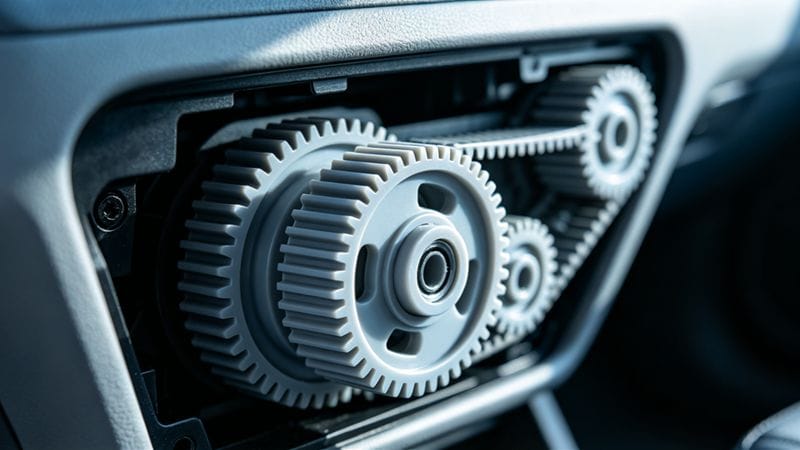
The automotive sector represents a massive success story for plastic gears. Manufacturers are increasingly replacing hydraulic or cable-driven systems with electric motors and plastic gears. This shift is evident in applications such as:
- Lift gates and seat adjustments
- Headlight tracking systems
- Brake actuators and electronic throttle segments
- Turbo adjustment devices
Beyond automotive, plastic power gears are widening their scope. In large-scale applications, such as washing machine transmissions, plastic gears are replacing metal, effectively changing the size limitations previously imposed on gear applications.
Other key sectors include:
- HVAC: Vibration-dampening drives.
- Flow Control: Valve actuation.
- Aerospace: Control surface stabilizers for small aircraft.
- Defense: Gyroscopes and control mechanisms.
Challenges in Manufacturing Large, High-Strength Gears
One of the primary reasons for the development of plastic gears is the ability to mold larger, high-precision, and high-strength features that are difficult to machine from metal. However, designing a gear configuration that maximizes power transmission while minimizing noise and transmission error presents significant challenges.
The Control Challenge
High-precision gears require tolerances that go beyond standard "good" classifications (such as those by the SPI).
- Process Control: Modern molding experts use machines equipped with processing control units to manage melt temperature, injection pressure, and other variables within a complex window.
- Sensors: Advanced manufacturers place temperature and pressure sensors inside the cavity to improve consistency and repeatability.
- Environment: Seasonal temperature changes or even the heat from a passing forklift can affect gear dimensions. Strict environmental control in the molding area is essential.
The Cooling Phase
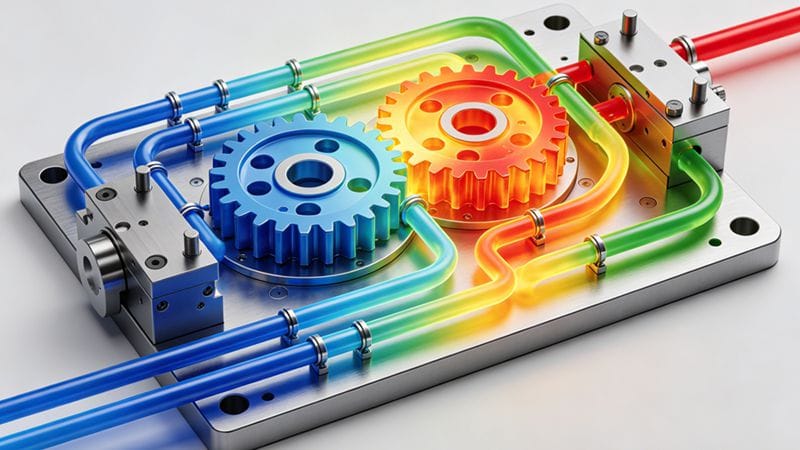
The most common issue in precision gear processing is ensuring symmetrical cooling and consistency across multiple cavities.
- Gate Location: Precision gears should ideally be injected from a gate at the center of the gear. Multi-gate systems can create weld lines, altering pressure distribution and shrinkage, which affects tolerances.
- Fiber Orientation: For glass-fiber-reinforced materials, multi-gate usage can cause fibers to align radially along the weld line, leading to eccentric "collisions."
New Processes and High-Performance Resins
Advanced molding methods are being developed, such as Two-Shot Molding2. This involves molding an elastomer between the wheel shaft and teeth, resulting in quieter operation and better vibration absorption. Additionally, Gas-Assisted Injection Molding3 en Injection Compression Molding are being used to improve tooth quality and reduce internal stress.
Material Selection Guide
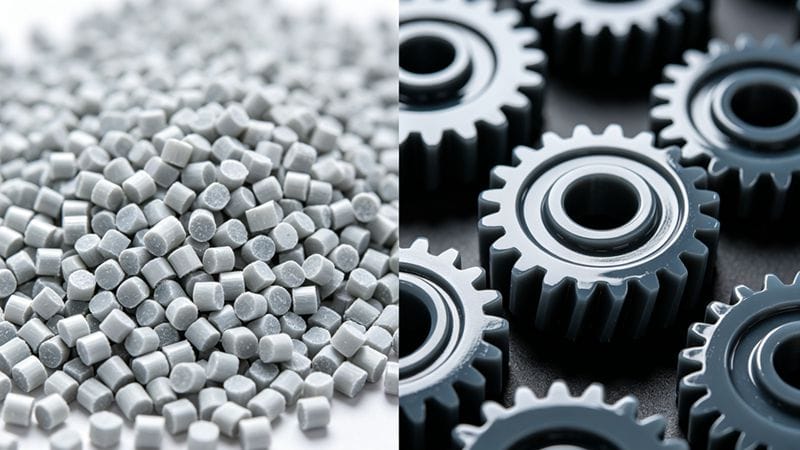
Choosing the right polymer is critical. Below is a comparison of common materials used in precision gear manufacturing.
| Materiaal | Key Characteristics | Max Operating Temp (Unfilled/Filled) | Common Applications |
|---|---|---|---|
| Acetal (POM) | Excellent dimensional stability, low friction, fatigue resistant. | ~90°C+ | Automotive, appliances, office equipment. |
| PBT (Polyester) | Very smooth surface, good strength. | 150°C / 170°C (Glass Filled) | Structural gears, high-speed applications. |
| Polyamide (Nylon) | Tough, durable, good for worm drives. Prone to moisture absorption. | 150°C / 175°C (Glass Filled) | Gear frames, heavy-load drives. |
| PPS | High hardness, excellent chemical resistance. | Up to 200°C | Harsh chemical environments, automotive. |
| LCP | Low shrinkage, high dimensional stability. | Up to 220°C | Miniature precision gears (e.g., watches). |
Note on Fillers: Adding fillers like short or long glass fibers (10mm or smaller) significantly increases tensile strength, stiffness, and creep resistance. Long glass fiber reinforcement is becoming an attractive alternative for large structural gears.
Advantages of Plastic Gears vs. Metal Gears
While metal gears offer excellent temperature stability, plastic gears provide distinct advantages in cost, design freedom, and performance.
- Cost Reduction: Plastic gears generally do not require secondary machining. This can reduce costs by 50% to 90% compared to stamped or machined metal gears.
- Design Freedom: Injection molding allows for the creation of internal gears, gear trains, and worms that are difficult or expensive to produce with metal.
- Noise Reduction: Plastic is inherently quieter. With high-precision tooth profiles and self-lubricating materials, plastic gears are ideal for low-noise environments.
- Corrosion Resistance: Unlike metal, plastic does not rust, making it perfect for water meters and chemical equipment.
- Shock Absorption: Plastic gears can deflect slightly to absorb impact loads and accommodate shaft misalignment, distributing the load more evenly.
Conclusie
The shift toward plastic gears is not just a trend but a technological evolution. With the right combination of material science—such as long-glass-fiber reinforcement—and precise injection molding controls, plastic gears are now capable of handling high loads and high temperatures that were once the exclusive domain of metal.


 English
 French
 Dutch
Dutch German
 Japanese
 Korean