

Introduction: The Rise of LFT in Advanced Manufacturing
In the rapidly evolving landscape of material science, Long Fiber Reinforced Thermoplastics (LFT) have emerged as a cornerstone for the "Plastic-to-Steel" revolution. Unlike traditional Short Fiber Thermoplastics (SFT), LFT utilizes fibers longer than 10mm, creating a robust 3D network within the polymer matrix.
This guide dives deep into the world of LFT, combining essential mechanical data with the latest industry trends from 2026, including advancements in D-LFT (Direct LFT) processing, high-performance polymers like PEEK and PPS, and sustainable bio-based solutions.
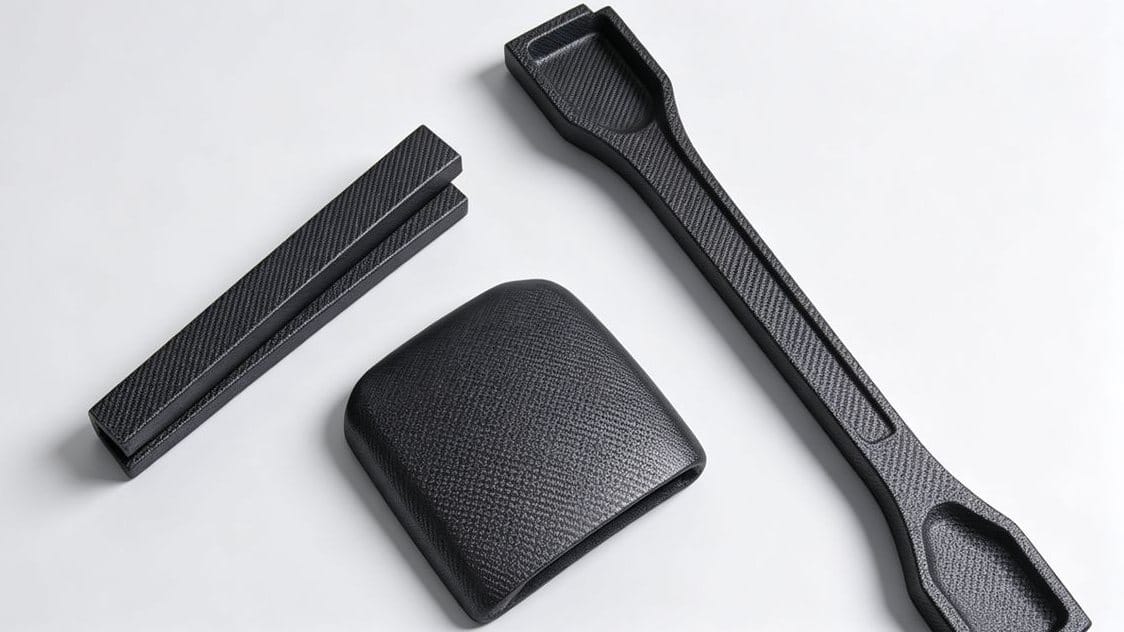
What is LFT? Composition and Core Advantages
LFT is a composite material consisting of a thermoplastic resin matrix (e.g., PP, PA, PEEK) reinforced with long fibers (typically 10-25mm), usually glass or carbon fibers.
Why choose LFT over SFT or metals?
- Enhanced Mechanical Properties1: Superior strength, stiffness, and impact resistance due to the continuous fiber network.
- Excellent Fatigue Resistance2: Performs well under cyclic loads, ideal for structural components.
- Lightweight3: Significantly lighter than metals, aiding in fuel efficiency (especially in EVs).
- Design Freedom & Recyclability4: Can be molded into complex shapes and recycled, aligning with modern sustainability goals.
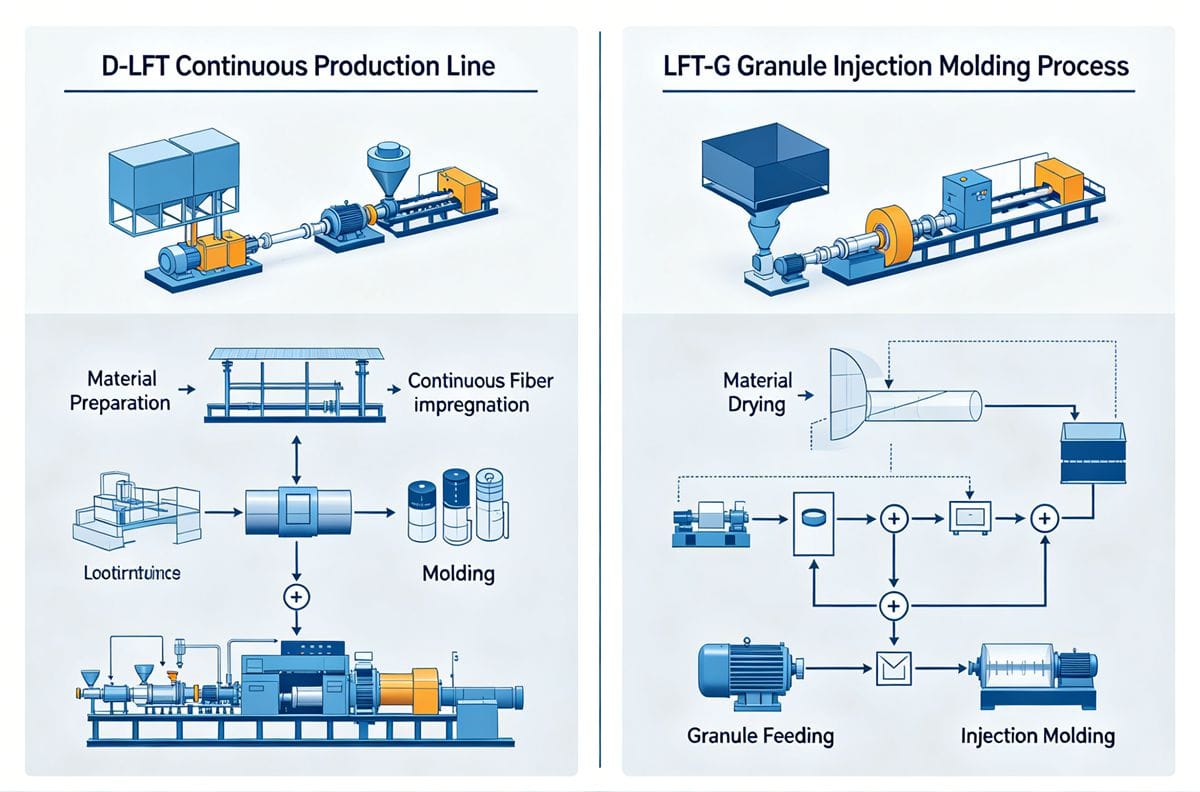
LFT Manufacturing Processes: LFT-D vs LFT-G
Understanding the manufacturing process is key to selecting the right LFT material. The industry primarily uses two methods:
| 特徴 | LFT-G (Granule/Indirect Method) | LFT-D (Direct Method) |
|---|---|---|
| Process | Pre-made pellets are injection molded. | Resin and fibers are mixed online and directly molded. |
| Fiber Length | Good retention (5-25mm). | Excellent retention, less processing degradation. |
| Cost & Logistics | Easy to transport and store; flexible for small batches. | Reduced intermediate steps; lower cost for mass production. |
| 最適 | Complex shapes5, small to medium batches. | Large-scale automotive production, high-volume parts. |
プロのアドバイス If you are designing for mass-market automotive, LFT-D is often the more economical and performance-driven choice.
Material Evolution: From Standard to High-Performance
While LFT-PP and LFT-PA remain industry staples, the market is shifting towards high-performance and sustainable materials.
- Standard LFT: Based on Polypropylene (PP) and Polyamide (PA). Known for cost-effectiveness and good impact resistance.
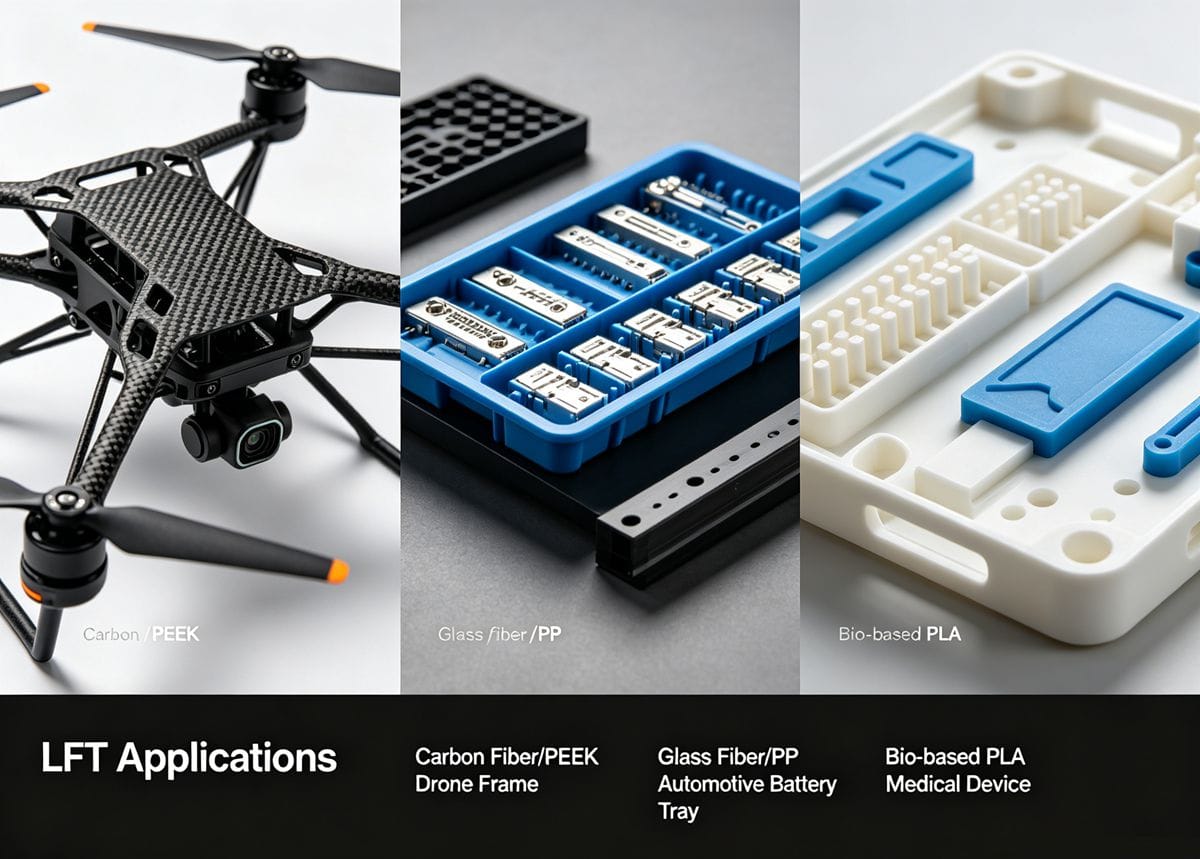
- Advanced LFT: Incorporating high-temperature resins like PEEK (Polyetheretherketone), PPS(ポリフェニレンサルファイド), そして PEKK. These offer superior chemical resistance and heat tolerance for aerospace and medical applications.
- Functional Additives: The integration of nanofillers, flame retardants, and conductive agents allows for antibacterial, flame-retardant, or conductive LFT composites.
- Sustainability6: The use of Bio-based resins (e.g., PLA) is on the rise, reducing dependence on petroleum and enhancing the eco-credentials of LFT.
Mechanical Properties: LFT-PA vs LFT-PP Deep Dive
Let's compare the specific performance of the two most common LFT matrices: Nylon (PA) and Polypropylene (PP) with Glass Fiber (GF) reinforcement.
A. LFT-PA (Nylon) Properties Renowned for high thermal resistance and strength, perfect for under-the-hood applications.
| Performance Indicator | 20% GF | 30% GF | 40% GF | 50% GF |
|---|---|---|---|---|
| Tensile Strength (MPa) | 150 | 170 | 210 | 240 |
| Flexural Modulus (GPa) | 6.8 | 8.0 | 9.5 | 13 |
| Impact Strength (kJ/m²) | 19 | 25 | 25 | 20 |
| HDT @ 1.8MPa (°C) | 205 | 210 | 215 | 220 |
B. LFT-PP (Polypropylene) Properties Offers the best balance of performance, low density, and cost.
| Performance Indicator | 20% GF | 30% GF | 40% GF | 50% GF |
|---|---|---|---|---|
| Tensile Strength (MPa) | 90-110 | 100-120 | 120-135 | 130-150 |
| Flexural Modulus (GPa) | 3.0-4.0 | 4.0-5.0 | 5.0-7.0 | 8.0-9.5 |
| Impact Strength (kJ/m²) | 20-30 | 20-40 | 25-35 | 30-45 |
| HDT @ 1.8MPa (°C) | 120-140 | 130-150 | 140-160 | 140-160 |
Key Applications Across Industries
LFT is no longer limited to just automotive. Here is where LFT is making an impact in 2026:
- 🚗 Automotive (The Core Market):
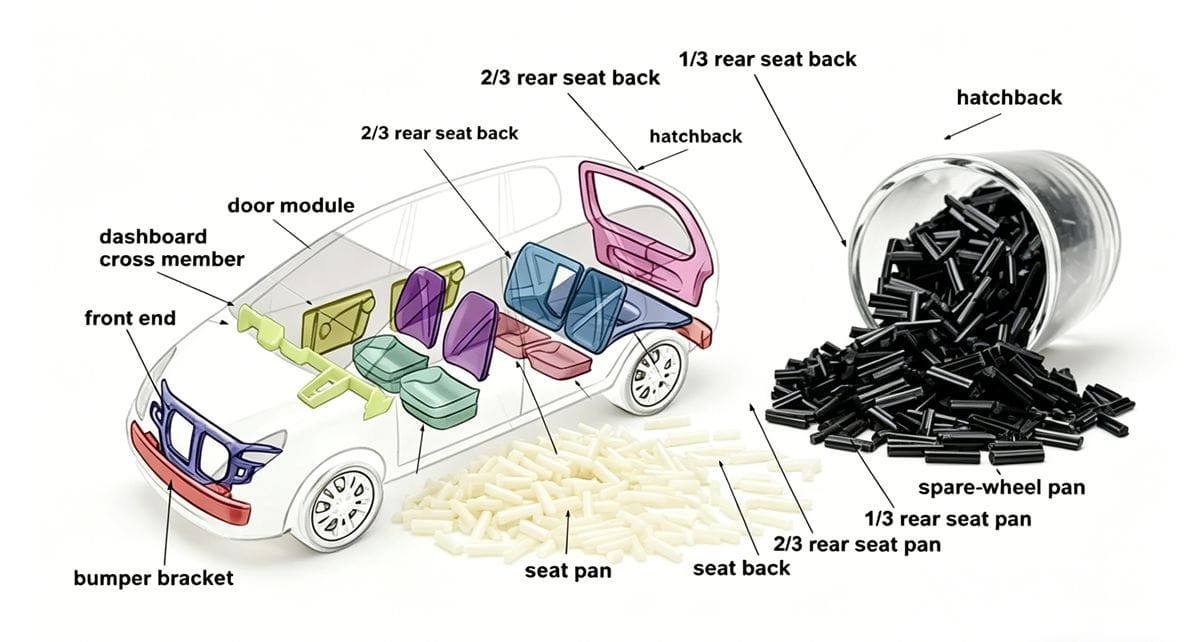
- Structural Parts: Front-end modules, seat frames, and battery trays (reducing EV weight by 30-50%).
- Functional Parts: Engine covers and under-body shields.
- ✈️ Aerospace & Drones:
- Used for drone frames, satellite brackets, and interior panels due to high specific strength and corrosion resistance.
- ⚡ Electronics & 5G:
- Ideal for connector housings and insulating components due to excellent dimensional stability and electrical insulation.
- 🏗️ Construction & Infrastructure:
- Corrosion-resistant pipes, tanks, and scaffolding replacing traditional steel.
- 🚴 Sports & Leisure:
- High-performance bicycle frames7 and helmets leveraging the strength-to-weight ratio.
Conclusion: The Future is Lightweight—Are You Ready to Lead?
The engineering landscape is shifting rapidly. The transition from metals to Long Fiber Reinforced Thermoplastics (LFT) is no longer just an option—it is a competitive necessity for staying ahead in 2026 and beyond. From the cost-effective versatility of LFT-PP to the high-performance resilience of LFT-PA, the data is clear: those who master these materials will define the future of the industry.
But understanding the material is only half the battle. Executing the design requires a partner who understands the nuances of D-LFT processing, structural integrity, and cost-reduction strategies.
At IDEAL PRO, we don’t just mold plastic; we engineer success. Our mission, “Sustainable Solutions, Enduring Excellence,” drives us to look beyond the immediate transaction. We are dedicated to forging partnerships that deliver tangible cost savings, enhanced quality, そして production efficiency for the long haul. We don't stop at solving the problem; we provide the ongoing insights that keep your product ahead of the curve.
Don’t let outdated designs weigh you down. Whether you are looking to replace steel components or optimize an existing assembly, IDEAL PRO is ready to turn your vision into a high-performance reality.
Contact IDEALPRO today. Let’s build a lighter, stronger, and more sustainable future together.
"[PDF] Analyzing the Mechanical Properties of Thermoplastic Reinforced ...", https://par.nsf.gov/servlets/purl/10336317. Research indicates that Long Fiber Reinforced Thermoplastics (LFT) exhibit superior mechanical properties, including strength and stiffness, compared to Short Fiber Thermoplastics (SFT). Evidence role: statistic; source type: paper. Supports: LFT exhibits enhanced mechanical properties over SFT.. Scope note: The support is based on comparative studies and may not encompass all types of LFT or SFT materials. ↩
"Fatigue Behaviour and Its Effect on the Residual Strength of Long ...", https://pmc.ncbi.nlm.nih.gov/articles/PMC10532970/. Studies show that Long Fiber Reinforced Thermoplastics (LFT) demonstrate excellent fatigue resistance, making them suitable for cyclic load applications. Evidence role: statistic; source type: paper. Supports: LFT has excellent fatigue resistance.. Scope note: The evidence may not cover all applications or conditions under which LFT is used. ↩
"[PDF] A review of Long fibre-reinforced thermoplastic or long fibre ...", https://engineering.purdue.edu/SMARTLab/publications/2019_IMR_%20a%20review%20of%20long%20fiber-reinforced%20thermoplastics%20for%20LFT%20composites%20.pdf. Research confirms that Long Fiber Reinforced Thermoplastics (LFT) are significantly lighter than metals, contributing to improved fuel efficiency in vehicles. Evidence role: statistic; source type: paper. Supports: LFT is significantly lighter than metals.. Scope note: The support is based on general comparisons and may not apply to all LFT formulations or metal types. ↩
"Recycling, Remanufacturing and Applications of Semi-Long ... - PMC", https://pmc.ncbi.nlm.nih.gov/articles/PMC12334481/. Long Fiber Reinforced Thermoplastics (LFT) allow for complex shapes and are recyclable, aligning with sustainability goals in manufacturing. Evidence role: general_support; source type: research. Supports: LFT offers design freedom and recyclability.. Scope note: The evidence may not detail specific examples or case studies of LFT recycling processes. ↩
"[PDF] A review of Long fibre-reinforced thermoplastic or long fibre ...", https://engineering.purdue.edu/SMARTLab/publications/2019_IMR_%20a%20review%20of%20long%20fiber-reinforced%20thermoplastics%20for%20LFT%20composites%20.pdf. Long Fiber Reinforced Thermoplastics (LFT) can be molded into complex shapes, providing design flexibility in manufacturing. Evidence role: general_support; source type: research. Supports: LFT allows for complex shapes in manufacturing.. Scope note: The evidence may not provide specific examples of complex shapes achieved with LFT. ↩
"Bio-Based Resin Reinforced with Flax Fiber as Thermorheologically ...", https://pmc.ncbi.nlm.nih.gov/articles/PMC6432415/. The use of bio-based resins in Long Fiber Reinforced Thermoplastics (LFT) is increasing, contributing to reduced reliance on petroleum resources. Evidence role: general_support; source type: government. Supports: Bio-based resins are increasingly used in LFT.. Scope note: The evidence may not provide specific statistics on the adoption rates of bio-based resins in LFT. ↩
"Contemporary advances in polymer applications for sporting goods", https://pmc.ncbi.nlm.nih.gov/articles/PMC11589808/. Long Fiber Reinforced Thermoplastics (LFT) are increasingly used in high-performance bicycle frames due to their strength-to-weight ratio. Evidence role: case_reference; source type: research. Supports: LFT is used in high-performance bicycle frames.. Scope note: The evidence may not provide comprehensive data on all bicycle frame applications using LFT. ↩




 English
 French
 Dutch
Dutch German
 Japanese
 Korean