 日本語



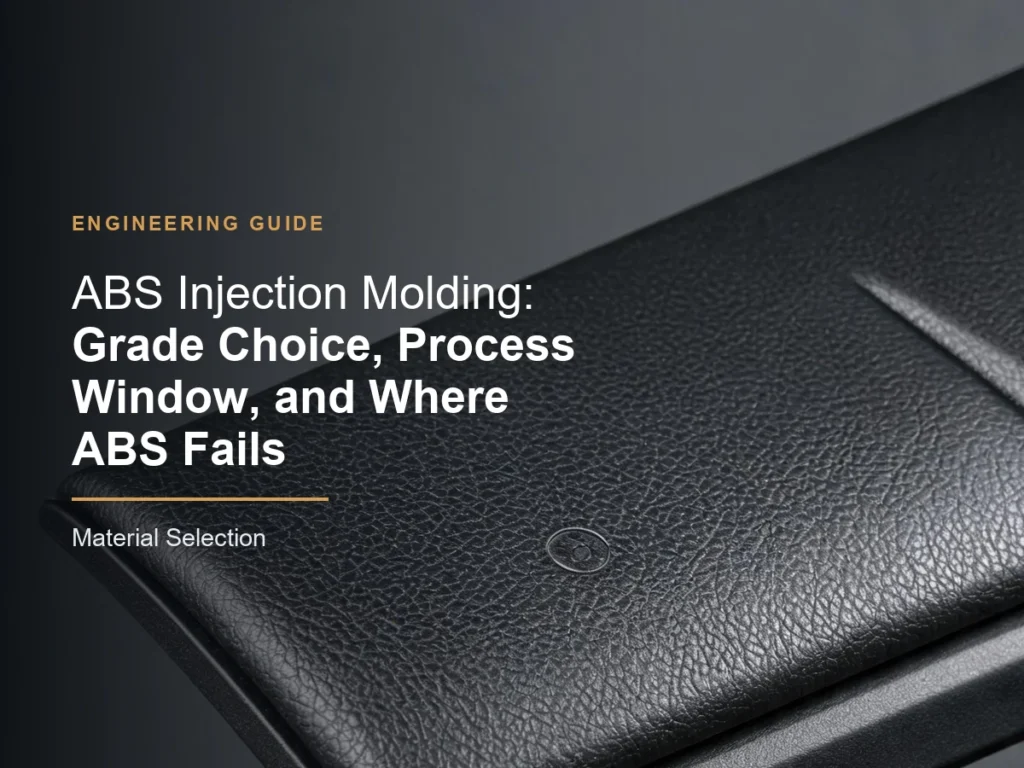
ABS is the resin people reach for when a part has to be rigid, survive being dropped, look good, and come out of a tool that was not built to a knife edge. It is also the resin most often specified for a housing that then sits in the sun for two summers and chalks, or is wiped with a chlorinated cleaner and crazes three weeks later. Those are not moulding failures. They are selection failures, and they are visible on the drawing long before the first shot.
This article is the decision layer on top of our ABS material page: grade families with the numbers that separate them, the process window with what breaks at each edge, the arithmetic on when ABS stops being the cheap option, and a defect triage you can work down on the press. Where a number is a planning band rather than a measurement from a specific grade, it is labelled as one, because the supplier TDS always outranks a generic guide.
Why Trust This ABS Guide?
私たちが発言する権利のあること: ABS is moulded here every week, from prototype tools to multi-cavity production, and the grade families below are the ones we quote against real drawings. Process and cost figures are planning bands for selection, not promises about your machine or your resin lot; the supplier TDS and your first measured shots outrank them. Author: Alex Yu, co-founder of Ideal Pro, 20+ years across injection moulding programmes and tooling projects, Huzhou facility.
What is ABS really made of, and why do two same-named grades behave differently?
ABS is a terpolymer: acrylonitrile, butadiene and styrene, with the butadiene present as a rubbery dispersed phase inside a styrene-acrylonitrile matrix. The three letters are not a label, they are a recipe with three dials:
- Acrylonitrile brings rigidity, heat resistance and chemical resistance. More of it, and the part holds stiffness longer at temperature and resists solvents better.
- Butadiene brings toughness. More of it, and notched impact climbs, gloss drops and the melt gets harder to keep stable.
- Styrene brings processability and surface. More of it, and the part flows and shines, at the cost of heat and chemical resistance.
Every supplier turns those dials differently, which is why "ABS, natural, general purpose" from two producers can differ by 30 percent in notched impact and by ten degrees in heat deflection while the datasheet headline looks identical. The consequence for a buyer is practical rather than academic: qualify a grade, not a material family, and never switch suppliers mid-campaign on a cosmetic or snap-fit part without re-running the colour and the impact check.
Amorphous structure matters twice as much as the chemistry when you are planning tooling. ABS has no crystalline melting point; it softens over a range. That is why its shrinkage is modest and fairly even in and across the flow direction, unlike a semi-crystalline resin such as POM or PA, where the two directions can differ by a factor of two.
| 成分 | What it contributes | What you lose when you increase it |
|---|---|---|
| Acrylonitrile | Rigidity, heat deflection, chemical resistance | Impact toughness, process window |
| Butadiene | Notched impact, low-temperature toughness | Gloss, stiffness, UV stability, thermal stability |
| Styrene | Flow, gloss, ease of moulding, surface finish | Heat resistance, solvent resistance |
Typical bands for unfilled general-purpose ABS: density 1.04 to 1.07 g/cm3, tensile strength roughly 35 to 50 MPa, flexural modulus 2.0 to 2.6 GPa, notched Izod 180 to 260 J/m, heat deflection at 1.8 MPa around 85 to 98 °C, UL94 flammability HB. Those numbers are the reason ABS is a housing material and not a bearing material.
Which ABS grade family does this part actually need?
Five questions sort almost every ABS job into a family: is it seen, is it dropped, is it hot, is it near a flame, and is it outdoors.
| 家族 | What changes | Typical numbers to plan against | Buy it for | Do not buy it for |
|---|---|---|---|---|
| General purpose | Balanced recipe | HDT 85-95 C, notched Izod 180-260 J/m | Indoor housings, covers, brackets | Sunlight, solvents, screws under load |
| インパクトが大きい | More rubber phase | Notched Izod 400-900 J/m, gloss and stiffness drop | Tool cases, drop-exposed consumer parts, low-temperature parts | Glossy cosmetic faces, tight creep performance |
| High heat | More acrylonitrile, sometimes alpha-methylstyrene grades | HDT 98-108 C at 1.8 MPa | Around motors, lamps, hair appliances, dashboard parts | Parts needing maximum toughness; heat is bought with brittleness |
| Flame retardant | Brominated or phosphorus additives, often with antimony oxide | UL94 V-0 at 1.6 to 3.0 mm depending on grade and wall | Electrical enclosures, connectors, charger housings | Cosmetic clarity, low-cost interior parts, some plating routes |
| Plateable ABS | Modified for adhesion and catalytic sites | Same base mechanics, secondary operation defines cost | Chrome-look trim, shower fittings, decorative bezels | Any part where the plating is cosmetic only and paint would do |
| Glass-filled ABS | 10 to 20 percent glass | Stiffness up, shrinkage down and directional, gloss down, abrasiveness appears | Ribbed structural carriers, parts needing flatness | Cosmetic high-gloss faces; it also changes the tool |
| Recycled ABS | Post-industrial or post-consumer stream | Typically 5 to 20 percent below virgin on impact, colour window narrows | Internal parts, sustainability targets, non-critical housings | Snaps, load paths, anything impact-qualified |
One family does not exist: transparent ABS. ABS is inherently opaque and milky-translucent at best. If the specification says "clear ABS", that is a drawing error and the answer is PMMA, PC or a styrenic alternative — see our transparent and translucent parts guide.
The outdoor question is worth separating from all the others, because the answer is usually not ABS at all. The butadiene phase is where UV attacks, and the failure mode is chalking and gloss loss followed by embrittlement. ASA replaces the rubber with an acrylic that does not carry that double bond, keeps most of the mechanical behaviour, and costs more per kilogram. A 20 to 40 percent material premium against a warranty return is not a close decision.
What process window should the press run, and what fails at each edge?
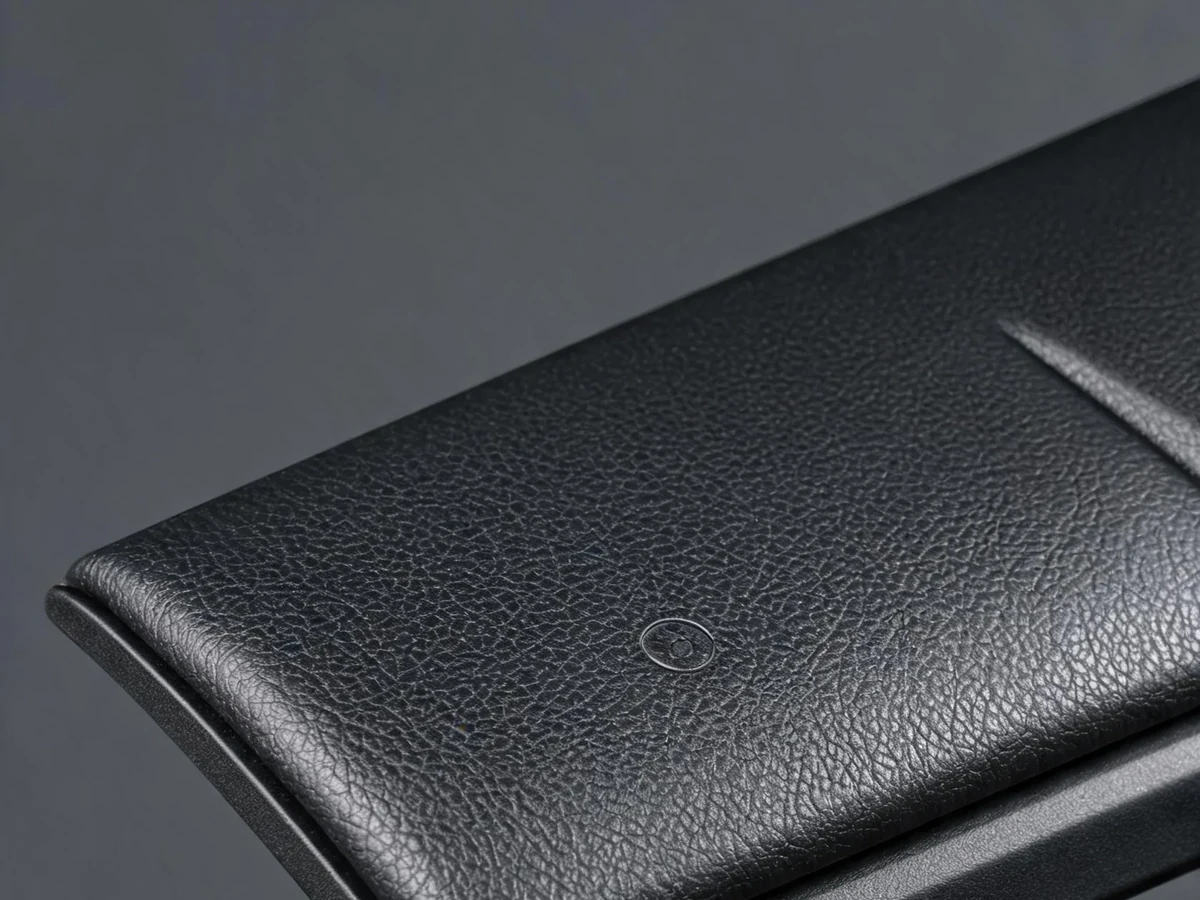
Plan against melt 220 to 260 °C and mould 40 to 80 °C, with drying 2 to 4 hours at 80 to 90 °C. Inside that envelope ABS is the most forgiving engineering resin we run. Outside it, the failures are specific, and the specific failure tells you which edge you crossed.
Melt temperature is not the same as barrel setpoints. Shear adds heat, so a fast screw with a small nozzle can put the actual melt 10 to 20 °C above what the controller displays, which is why we ask for a melt probe reading on the first trial of any cosmetic ABS part. Above roughly 260 °C, and above roughly four to six minutes of residence in an oversized barrel at temperature, the butadiene phase starts to break down. The visible symptom is dullness, silvering and dark streaks; the invisible one is a part that fails the drop test it passed last month.
Mould temperature is where ABS quality is actually won. At the cold end of the window, the melt freezes before packing completes and you get weak, visible weld lines, flow marks around the gate, and a gloss level that changes across the part. At 70 to 80 °C the surface reads better, weld strength climbs and the dimension is more repeatable — paid for in cycle time, typically a few seconds per shot on a 2 to 3 mm wall. On a high-volume housing those seconds are usually worth more than the resin price difference, so the honest answer on a costed programme is often 50 to 60 °C with texture to hide what that costs you in gloss.
| パラメータ | Planning band | Symptom when too high | Symptom when too low |
|---|---|---|---|
| Melt temperature | 220-260 C | Silver streak, dullness, odour, impact loss | Short shot, high injection pressure, visible weld line |
| 金型温度 | 40-80 C | Sink at bosses, long cycle, sticking and gloss bloom | Weak welds, flow marks, low gloss, high internal stress |
| Injection speed | Moderate to fast | Jetting, splay at the gate, burnt vents | Freeze-off before fill, pressure loss down the part |
| Holding pressure | 50-70 percent of peak | Flash at parting line, gate blush, part stress | Sink marks, weight variation, dimension drift shot to shot |
| Screw recovery speed | Keep shear moderate | Melt overheating, colour streak | Long cycle, cushion variation |
| Back pressure | Just enough for colour and homogeneity | Shear degradation, hot melt | Unmelted pellet cores, colour banding |
| Dryer | 2-4 h at 80-90 C, hopper feed on the shift | Over-drying is rarely the problem, but a hot dryer with a blocked filter stalls | Splay, surface haze, loss of impact |
Is it moisture, is it overheat, is it the vent?
Silver streak is the most mis-diagnosed ABS defect, and mis-diagnosis is expensive because the three causes pull the settings in opposite directions.
ABS is mildly hygroscopic: it picks up enough surface moisture in an open bag in a humid shop to matter. The drying band on our material page is 2 to 4 hours at 80 to 90 °C with a dew point in the minus 20 to minus 40 °C range, and a hopper dryer feeding the machine through the shift beats a batch dried overnight and left open at the funnel. Moisture splay looks like a fan of fine silver threads from the gate and gets worse as you slow the injection, because the water has time to leave the melt.
Overheat splay looks similar and behaves oppositely: it usually gets worse with faster injection and longer residence, it is often accompanied by a duller surface and a burnt smell, and it improves when you lower melt temperature or shorten residence.
Vent-starvation marks look like either, and they sit at the end of the flow path rather than near the gate, often at the last point to fill or at a rib or boss where air cannot escape. A vent depth of about 0.02 mm on the parting line at the flow front is the usual starting point for unfilled ABS; too deep and it flashes, too shallow and it is not doing anything.
We wrote the full four-factor diagnostic separately in analyzing silver streak defects and the drying physics in resin drying for injection molding. What matters here is the order of elimination: check the dryer before you touch the barrel, check where the mark sits before you open the mould, and only then start pulling process settings, which is exactly how a small ABS problem becomes a two-week tooling conversation.
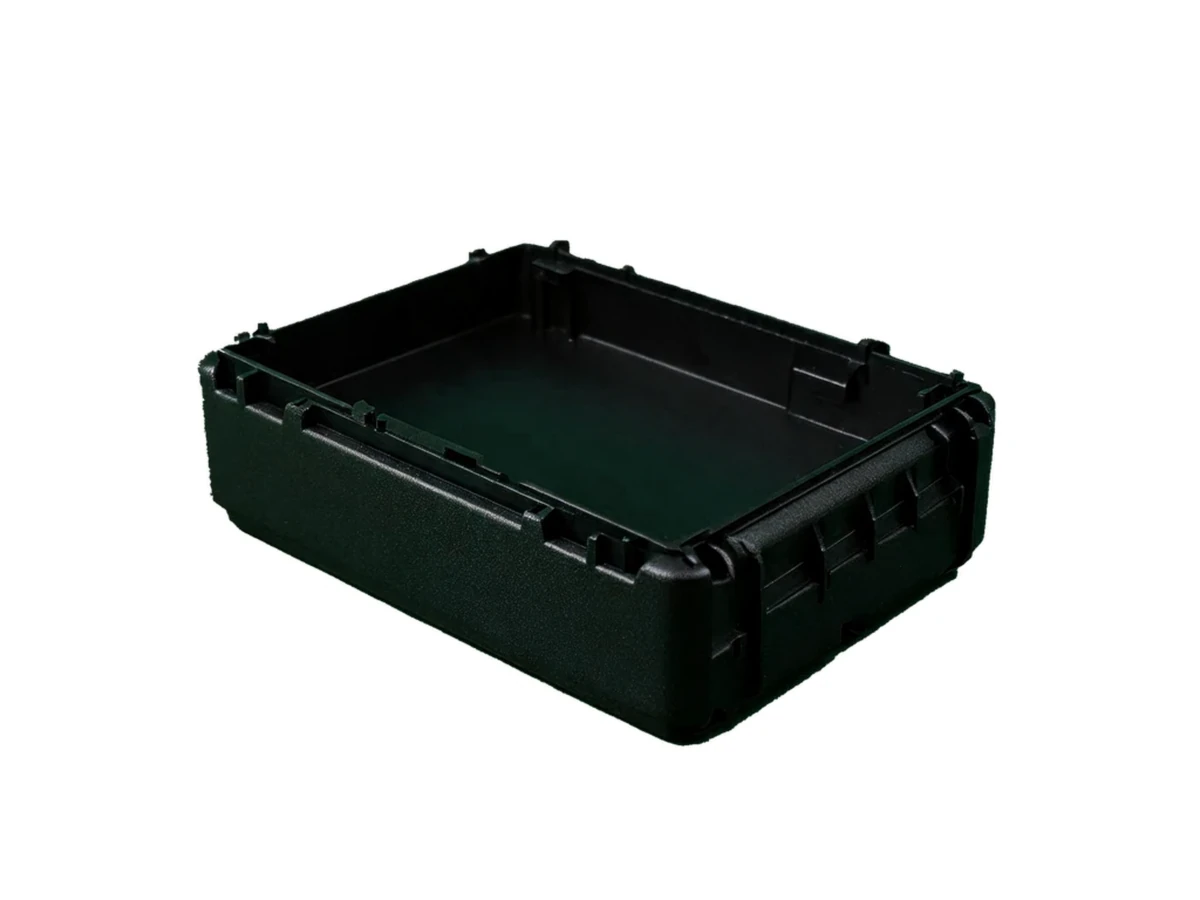
How much does the grade change the cost of the part?
On a moulded part, resin price is a minority of the cost, and the way it becomes a majority is through cycle time and scrap.
The planning index below is relative and per kilogram, with unfilled general-purpose ABS as 1.00. Use it to argue about the shape of a decision, not about a quotation.
| Material choice | Relative resin cost | Relative part cost on a 250 g housing | What actually moves it |
|---|---|---|---|
| ヒップス | 0.80-0.90 | 0.85-0.95 | Cheapest, but impact and heat both fall; the saving is small because the press hour dominates |
| ABS general purpose | 1.00 | 1.00 | The baseline; short cycle, low tool wear, forgiving window |
| ABS high heat | 1.15-1.35 | 1.10-1.25 | Hotter mould, slightly longer cycle |
| PC/ABS | 1.35-1.70 | 1.25-1.55 | Higher melt and mould temperature, longer cooling, but often lets you thin the wall |
| ABS flame retardant V-0 | 1.50-2.00 | 1.35-1.75 | Additive package, colour limits, more plate-out on screws |
| サ | 1.40-1.80 | 1.30-1.60 | The price of outdoor survival |
| ABS plus 15 percent glass | 1.10-1.30 | 1.05-1.25 | Stiffer, thinner wall possible, but gate and liner wear begin |
| Recycled ABS | 0.70-0.90 | 0.80-0.95 | Colour and impact window narrow; the savings are real only if the specification can absorb them |
Two observations from the right-hand column. First, on a housing in the 100 to 500 g class the press hour is the dominant cost, so a resin that lets you run 4 seconds faster beats a cheaper resin that does not. Second, ABS's real economic advantage is the first tool: a low-wear, low-temperature, low-clamp resin lets you cut a pre-hardened P20 block and change your mind. That option value disappears on the first glass-filled grade.
What does ABS ask of the mould?
Less than almost anything else we run, and that is a design freedom worth using deliberately rather than by default.
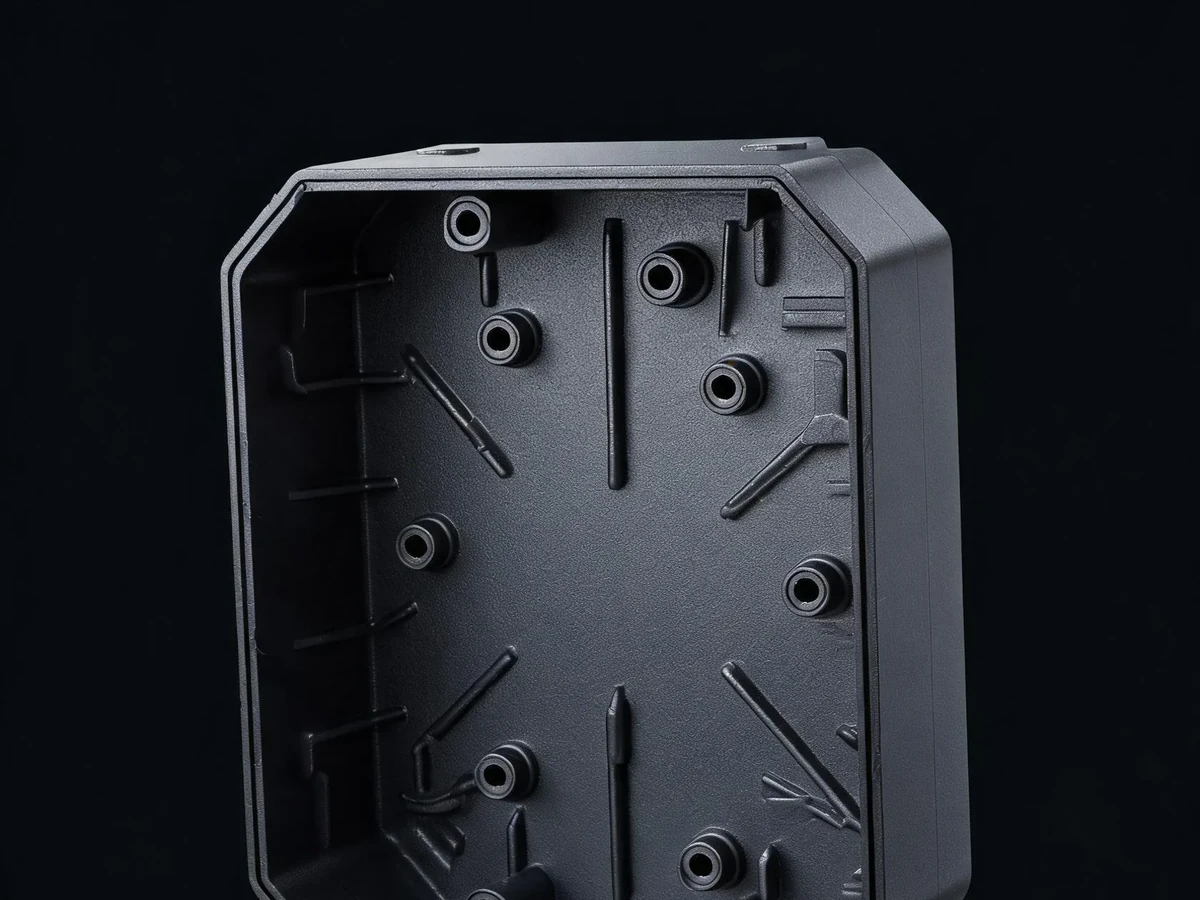
Steel. ABS carries no abrasive filler, so a pre-hardened block around 28 to 32 HRC is normal: P20 for the standard case, 718H when the tool has to hold a polish across a longer campaign or is being nitrided later. Stainless is not needed for corrosion reasons with ABS; it is chosen when the tool must hold a very high polish, when a mould release or flame-retardant additive leaves residue, or when the same base plate family has to serve a corrosive resin later. See the plate-steel choices on our P20 page.
Cooling. ABS wants a 40 to 80 °C mould, and the mistake is even channel spacing. Heat concentrates at bosses, rib intersections and the gate area, so that is where baffles or bubblers belong. A tool that cools a thin wall and a thick boss at the same rate will hold a flat part and still show a sink at the boss.
Venting. ABS fills fast, so vent at the flow front and at any deep rib or boss, roughly 0.02 mm deep for unfilled grades. Add a vent when you add a wall thickness change, because that is where the last air sits.
Gate and appearance. The gate is a cosmetic decision made too late on most projects. A pin gate leaves a small mark and belongs on a hidden face; a fan or tab gate spreads shear and reduces flow marks on a visible face; a submarine gate hides the witness but can mark a high-gloss surface as it shears. Put the gate on the thickest section that the pressure can reach and where the witness will not be seen.
Texture and draft, in the same conversation. ABS takes texture beautifully, which makes it tempting to specify a deep texture and a tight draw at once. Texture grips the part: plan on 1 degree of draft on a smooth wall and 1.5 to 2 degrees on a textured one, more as the texture depth increases.
Runner system. For ABS, a cold runner is often the right economic answer because the sprue and runners can be reground and put back into a non-cosmetic part, which is not true of every resin. A hot runner earns its cost on cycle, on colour-change waste and on multi-cavity balance, and it also creates the purge-and-residue conversation documented in our hot runner guide.
How do you decide what shrinkage to cut to, and what tolerance to sign?
Cut the tool at the middle of the band, then correct from measurement. For ABS that band is 0.4 to 0.7 percent, and the middle is not where your part lands.
The position inside the band is set by wall thickness, flow length, gate position, packing pressure, hold time and mould temperature. Thick sections shrink more, because there is more melt to contract. Long flow paths lose pressure before the cavity is packed, so the far end of the part shrinks more than the gate end — and on a long, thin housing, that gate-to-far-end difference can exceed the tolerance you are trying to hold on overall length. This is why "ABS is 0.5 percent" is not an engineering answer.
The practical rule we work to: agree which dimension governs before the steel is cut. A housing usually has one datum pair that matters (the mounting centres, or the seam where two shells meet) and a dozen dimensions that merely look important on the drawing. Put the tolerance on the governing feature and let the free dimensions float, because the tool can be corrected once, uniformly, and it cannot be corrected in two directions at the same time.
| 特徴 | Realistic held tolerance on ABS | コメント |
|---|---|---|
| Small local feature under 50 mm | plus or minus 0.05 to 0.10 mm | Close to the gate, well packed |
| Hole-to-hole spacing on a rib wall | plus or minus 0.10 mm | Correct after first measured shots |
| Overall length over 200 mm | plus or minus 0.30 to 0.60 mm | Flow-length dependent; do not demand 0.10 mm here |
| Boss position for a self-tapping screw | plus or minus 0.10 mm | Also controls the sink risk at the boss |
| Wall thickness | 0 to plus 0.15 mm | Set by the cavity, so it is the one thing you can promise |
| Flatness of a large thin panel | 0.5 to 1.5 mm over 200 mm | A packing and cooling outcome, not a steel dimension |
| Snap-fit engagement | plus or minus 0.05 mm | This is a functional dimension, budget for a correction iteration |
The measurement loop matters more than the prediction. We cut the first sample with a nominal allowance, run shots, measure on a CMM, then correct the cavity from what was measured rather than from a data-sheet range — and the record of that correction becomes the starting point for the next tool in the same family. Detail on how shrinkage couples to process settings is in our plastic shrinkage rate guide, and the flatness half of the problem is treated in warpage in large flat parts.
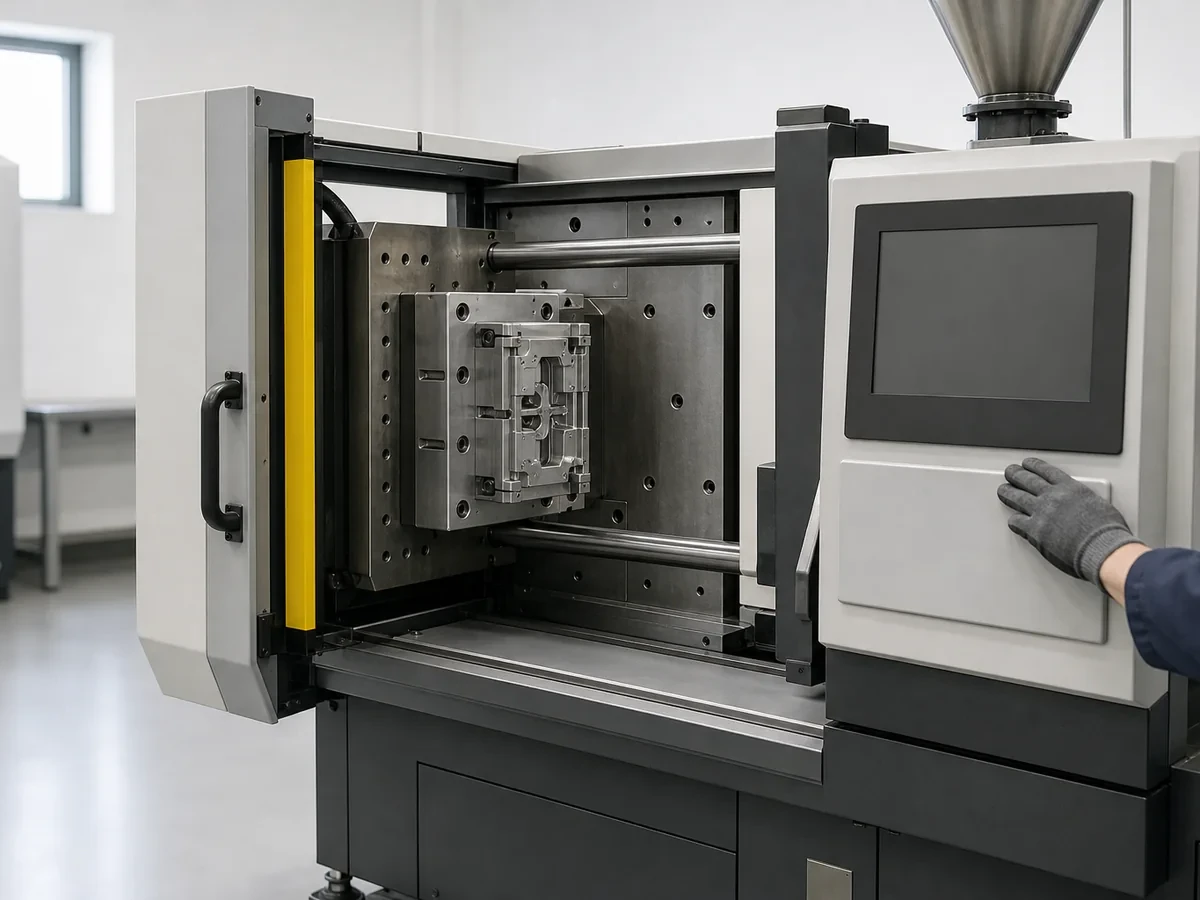
Where does ABS fail in the field, and what should be specified instead?
Four service conditions end the ABS conversation. Knowing which one you are in is worth more than any process setting in this article.
Continuous heat above roughly 80 °C. ABS softens gradually rather than melting sharply, and the long-term number is well below the short-term heat deflection figure. A part that runs at 90 to 110 °C is a PC/ABS or a high-heat grade question, and above that it is a PA, PBT or PPS question. The internal-stress half of this problem is documented separately in heat-resistant ABS and internal stress.
UV and weather. Standard ABS chalks and embrittles. ASA, or a UV-stabilised grade with a painted surface, is the answer, and the material cost is the price of not repeating the product recall.
Solvents, fuels, and cleaning agents. ABS dissolves in several common solvents, which is precisely why solvent welding works so well, and it is why an ABS part must not be specified for continuous contact with fuels, ketones, chlorinated cleaners or strong esters. The nastier failure is environmental stress cracking: a part that passes inspection, is cleaned or greased after moulding, and then craze-cracks from a residual-stress plus chemical combination weeks later. High-gloss parts reveal it first.
Static load on a small area. ABS creeps. A self-tapping screw loaded continuously in an ABS boss, or a snap holding a spring-loaded component, will relax. Use a metal insert, a larger bearing area, or a resin with better creep behaviour. Where the joint has to be metal-to-plastic, インサート成形 is usually the more honest engineering answer than a screw in a polymer boss.
A fifth condition belongs on the list even though it is not a field failure: flame rating with a cosmetic requirement. Many halogen-free V-0 packages limit the achievable colour range and can leave a surface bloom that a high-gloss ABS part cannot hide. Ask for the flammability data and the colour chip at the same time, not in two separate emails.
How does ABS compare with the resins people swap it for?
| Property or cost | ヒップス | ABS GP | High-heat ABS | PC/ABS | サ | PA6 plus 30 percent glass |
|---|---|---|---|---|---|---|
| Density, g/cm3 | 1.04-1.06 | 1.04-1.07 | 1.05-1.09 | 1.10-1.15 | 1.06-1.07 | 1.36-1.42 |
| Shrinkage, percent | 0.4-0.7 | 0.4-0.7 | 0.4-0.7 | 0.5-0.8 | 0.4-0.7 | 0.2-0.5 flow, 0.8-1.2 cross |
| Heat deflection at 1.8 MPa | 70-85 C | 85-95 C | 98-108 C | 100-120 C | 85-95 C | 200-230 C |
| ノッチ付きアイゾッド | 100-200 J/m | 180-260 J/m | 120-220 J/m | 400-700 J/m | 150-260 J/m | 50-90 J/m |
| UV and weather | 貧しい | 貧しい | 貧しい | 中程度 | とても良い | Moderate, needs stabiliser |
| Solvent sensitivity | 高い | 高い | 高い | 中程度 | 高い | 低い |
| Melt and mould temperature | 200-240 C, 40-60 C | 220-260 C, 40-80 C | 230-265 C, 50-80 C | 230-260 C, 50-90 C | 220-260 C, 40-80 C | 260-290 C, 80-100 C |
| Tool steel that is usually enough | P20 | P20 | P20 or 718H | 718H | P20 | H13 hardened, replaceable gates |
| Relative resin cost, ABS GP is 1.00 | 0.80-0.90 | 1.00 | 1.15-1.35 | 1.35-1.70 | 1.40-1.80 | 1.50-1.90 |
| 勝利を収める場所 | Internal, non-cosmetic, cheap | The default cosmetic housing | Warm interiors | Tough and warm, still mouldable | Outdoor housings | Stiffness and strength at temperature |
Read down the last two rows before reading the properties. Most ABS-versus-alternative decisions are not won by impact numbers on a datasheet; they are won by whether the part is indoors, whether it is seen, and whether the programme can afford a hotter mould and a harder tool.
When a defect appears, what do you change first?
ABS gives away its cause more readily than most resins, provided you look at where the defect is before you reach for a setting.
| 欠陥 | Where it sits | First thing to change | If that fails |
|---|---|---|---|
| Silver streak or splay | Fan from the gate, worse when injection slows | Dryer: temperature, dew point, residence, hopper feed | Melt temperature and residence; then vents |
| Weld line, visible and weak | After a hole, an insert or two flow fronts | Mould temperature up, then speed up | Re-gate, add a vent at the meeting point, thin the near wall |
| Sink mark | Over a boss, rib or thick corner | Packing pressure and time with a proper cooling at the boss | Rib thickness to 0.5-0.6 of wall, or gas assist on a qualifying part |
| Low gloss or dull patch | Broad area, often near the gate | Mould temperature and mould surface condition | Check for mould deposit, then material drying |
| Flow marks around the gate | Concentric rings from the gate | Gate and runner temperature, slower initial stage then faster | Enlarge the gate; see our gloss guide for ABS parts |
| Flash at the parting line | Along the joint, or at vents | Drop packing pressure, then clamp tonnage | Check steel damage and vent depth |
| Short shot | Last-filled corner | Speed first, then pressure, then melt temperature | Venting, or the wall is thinner than the flow ratio allows |
| Warpage after ejection | Corners lift, or the part curls out of flat | Mould temperature differential and cooling balance | Gate position, packing profile, and the wall-thickness map |
| Jetting, snake at the gate | Straight from the gate into open cavity | Smaller or subsurface gate, slower fill start | Re-gate; a jet that welds into the part becomes a weak line |
Two of those lines deserve to be read twice, because they are the ones people pay for twice. A visible, weak weld line is nearly always solved by mould temperature before it is solved by anything else, and the cheapest quality improvement in ABS is often the one that costs cycle time. And warpage measured after the part has cooled overnight is not the same part as the one measured hot off the machine; ABS parts continue to relax, so agree the measurement condition in the same paragraph as the tolerance.
What about regrind, colour changeovers and the recycled question?
ABS is one of the friendlier resins for internal recycle: the same-family sprue and runners from a non-cosmetic part can be reground and blended, and it is common to plan against 10 to 20 percent for a housings programme with a hidden face, holding a limit on the number of regrind cycles the material sees. The rules that decide whether that is safe — particle size, contamination, colour drift, the impact penalty that shows up only on a notched bar — are the subject of our 再研磨ガイド, and the honest position is that regrind belongs in a specification, not in a habit.
Colour changeover in ABS is a housekeeping job that gets cheaper the more you plan it. Dark to light needs a purge resin and a barrel temperature profile; a black-to-natural change on a cosmetic face is where a hot runner can be an advantage, because there is no cold-runner residue to dislodge. Flame-retardant grades plate out more, so a programme with FR grades in three colours is a scheduling problem before it is a moulding problem.
Recycled ABS, bought rather than in-house, is a real option on the rise, and it behaves the way all secondary material behaves: the mean properties are usually close, and the spread is wider. Ask for the notched impact distribution rather than the average, ask what the source stream is, and keep the recycled resin on a part whose failure is visible in your own factory rather than in the customer's hand.
Where does this sit in what Ideal Pro actually does?
ABS is the default resin in a lot of what we run: appliance and instrument housings, business-machine covers, consumer enclosures, internal carriers, and the plastic half of many insert molded そして overmolded assemblies, from single-cavity aluminium tools for prototypes through to hardened multi-cavity production tooling on the presses in our Huzhou facility. Our custom ABS moulding page covers the service, and the PC/ABS page covers the blend that takes over when ABS runs out of heat.
Send us the part, the service condition and what you are willing to change. We will come back with the grade family we would quote, the shrinkage allowance we would cut to, the process window we would hold it in, and the point at which a different polymer would be the cheaper decision — which, on an outdoor housing or a solvent-exposed part, is usually before the tool is cut.
Phone and WhatsApp: +86 156 0682 1288 · Email: [email protected] · お見積りのお申し込み
よくある質問
What is the best process window for ABS injection moulding?
Does ABS need to be dried before moulding?
What shrinkage should I design an ABS mould to?
Can ABS be used outdoors?
Is ABS or PC/ABS the better choice for an electronics housing?
Why does my ABS part look dull when the mould is polished?
What is the difference between ABS and ASA?
著者について

アレックス・ユー
アイデアル・プロ・マニュファクチャリング
アレックスはIdeal Proの共同創業者ですが、重要なプロジェクトの監督や技術チームの指揮をとっていないときは、長距離サイクリングを楽しんだり、街で一番おいしいコーヒーを探し回ったり、次の旅の計画を立てたりしている姿を見かけるでしょう。 国際貿易の営業やプロジェクト管理に20年以上の経験を持つ彼は、厳しい納期や厄介な技術的課題など、ありとあらゆる状況を経験してきました。彼は、素晴らしい仕事は十分な休息と一杯の美味しいコーヒーから生まれると信じており、その好奇心と細部へのこだわりを、手掛けるすべてのプロジェクトに注ぎ込んでいます。 オフィスにいないときは、たいてい屋外で、新しい場所を探索したり、皆と共有できるエピソードを集めたりしています。.

 English
 French
 Dutch
 German
 Japanese
 Korean