 Nederlands



Plastic Injection Molding products[^1] often require surface modification to enhance their aesthetic appeal, durability, or conductivity. The two primary methods for surface treatment are coating en plating.
However, plastics present unique challenges:
- Low Surface Energy: Most plastics have high crystallinity and low polarity, making adhesion difficult.
- Insulation: Plastics are non-conductive, preventing direct electroplating.
Therefore, rigorous pretreatment is essential to improve adhesion for coatings and to create a conductive base layer[^2] for plating.

1. Pretreatment for Coating Processes
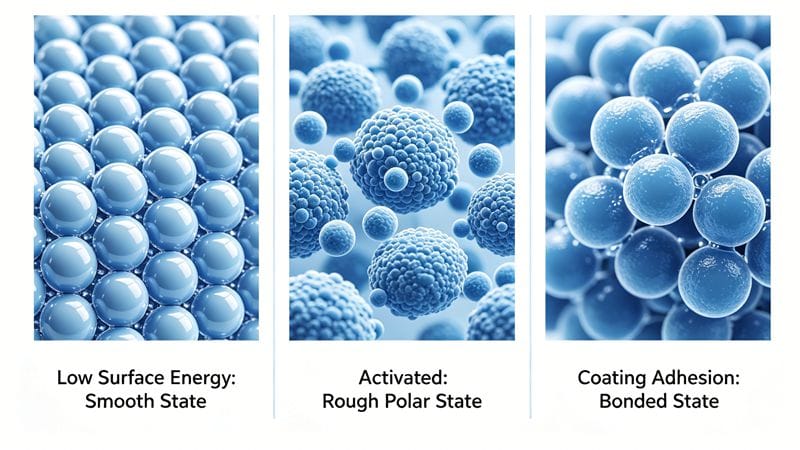
The goal of pretreatment for coatings is to remove contaminants and increase surface energy (wettability) to ensure the paint or coating adheres firmly.
1.1 Degreasing (Cleaning) Similar to metal treatment, the first step is removing oil, grease, and mold release agents.
- Organic Solvents: Used for removing paraffin, beeswax, and organic dirt. The solvent must not dissolve or swell the plastic. It should be volatile, non-toxic, and non-flammable.
- Alkaline Solutions: Suitable for alkali-resistant plastics. These solutions contain caustic soda, alkaline salts, and surfactants (e.g., OP series alkylphenol polyoxyethylene ether) which are low-foaming and leave no residue.
1.2 Surface Activation Activation introduces polar groups or roughens the surface to increase surface energy. Common methods include chemical oxidation, flame oxidation, solvent vapor etching, and corona discharge.
Chemical Oxidation (Chromic Acid Treatment) This is the most widely used method. A typical formulation involves a mixture of Potassium Dichromate, Water, and Concentrated Sulfuric Acid.
| Component | Percentage / Concentration |
|---|---|
| Potassium Dichromate | 4.5% |
| Water | 8.0% |
| Concentrated Sulfuric Acid (>96%) | 87.5% |
ABS Plastic Treatment: For high-quality coatings, ABS plastics can be etched after degreasing using a dilute chromic acid solution (Chromic acid 420g/L, Sulfuric acid 200ml/L) at 65°C–70°C for 5–10 minutes.
Opmerking: While chromic acid etching provides uniform treatment even on complex shapes, it poses safety hazards and environmental pollution risks.
2. Pretreatment for Plating Processes
The objective here is twofold: improve adhesion and create a conductive metal(base layer) on the insulating plastic.
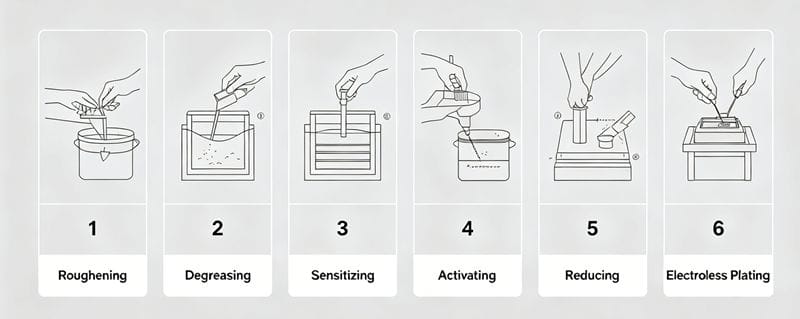
The process flow is: Mechanical/Chemical Roughing → Degreasing → Sensitization → Activation → Reduction → Electroless Plating
2.1 Roughening and Degreasing
- Mechanical vs. Chemical Roughening: Roughening increases the contact area. Mechanical roughening is generally less effective, providing only about 10% of the adhesion strength achieved by chemical roughening.
- Degreasing: Follows the same principles as the coating process described above.
2.2 Sensitization This step involves adsorbing easily oxidizable substances (like Stannous Chloride of Titanium Trichloride) onto the plastic surface. This prepares the surface for the subsequent activation step.
2.3 Activation The sensitized surface is immersed in a solution containing noble metal salts (oxidizing agents). The noble metal ions are reduced to metallic colloids (catalytic nuclei) which deposit on the surface. These nuclei act as catalysts for the plating reaction.
2.4 Reduction and Electroless Plating
- Reduction Treatment: Before plating, the part is dipped in a reducing agent (e.g., Formaldehyde for copper plating, Sodium Hypophosphite for nickel plating) to remove residual activator.
- Electroless Plating: This is the critical step. A thin layer of metal is chemically deposited onto the plastic, making it conductive. Once conductive, standard electroplating can proceed.
Summary of Process Differences
[Coating vs. Plating Pretreatment]
| Feature | Coating Pretreatment | Plating Pretreatment |
|---|---|---|
| Primary Goal | Improve wettability and adhesion | Create a conductive metal layer |
| Key Step | Surface Activation (Oxidation) | Electroless Plating (Metallization) |
| Conductivity | Not required | Essentieel (must be achieved before plating) |
| Complexity | Matig | High (Multiple chemical steps) |
[^1]: Explore this resource to understand effective surface treatment methods that enhance the quality and performance of plastic injection molding products. [^2]: Understand the necessity of a conductive base layer for successful electroplating.
Over de auteur

Alex Yu
Ideal Pro Manufacturing
Alex is medeoprichter van Ideal Pro, maar wanneer hij niet toezicht houdt op belangrijke projecten of leiding geeft aan het technische team, is hij waarschijnlijk bezig met een lange fietstocht, op zoek naar de beste koffie van de stad, of bezig met het plannen van zijn volgende reisavontuur. Met meer dan 20 jaar ervaring op het gebied van internationale handel en projectmanagement heeft hij het allemaal al meegemaakt: strakke deadlines, lastige technische vraagstukken en alles daartussenin. Hij is ervan overtuigd dat uitstekend werk voortkomt uit een uitgeruste geest en een goede kop koffie, en hij brengt diezelfde nieuwsgierigheid en oog voor detail mee in elk project dat hij aanneemt. Als hij niet op kantoor is, bevindt hij zich meestal ergens in de buitenlucht, waar hij nieuwe plekken verkent en verhalen verzamelt om te delen.
 English
 French
 Dutch
 German
 Japanese
 Korean