 한국어



Plastic Injection Molding products[^1] often require surface modification to enhance their aesthetic appeal, durability, or conductivity. The two primary methods for surface treatment are coating 그리고 plating.
However, plastics present unique challenges:
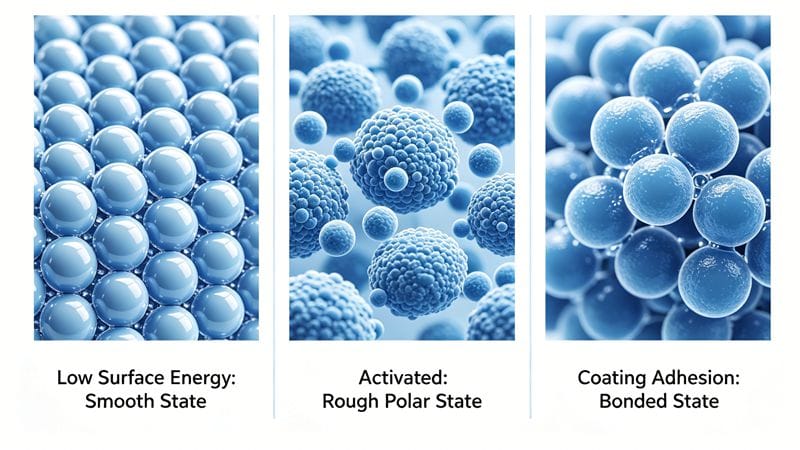
- Low Surface Energy: Most plastics have high crystallinity and low polarity, making adhesion difficult.
- Insulation: Plastics are non-conductive, preventing direct electroplating.
Therefore, rigorous pretreatment is essential to improve adhesion for coatings and to create a conductive base layer[^2] for plating.

1. Pretreatment for Coating Processes
The goal of pretreatment for coatings is to remove contaminants and increase surface energy (wettability) to ensure the paint or coating adheres firmly.
1.1 Degreasing (Cleaning) Similar to metal treatment, the first step is removing oil, grease, and mold release agents.
- Organic Solvents: Used for removing paraffin, beeswax, and organic dirt. The solvent must not dissolve or swell the plastic. It should be volatile, non-toxic, and non-flammable.
- Alkaline Solutions: Suitable for alkali-resistant plastics. These solutions contain caustic soda, alkaline salts, and surfactants (e.g., OP series alkylphenol polyoxyethylene ether) which are low-foaming and leave no residue.
1.2 Surface Activation Activation introduces polar groups or roughens the surface to increase surface energy. Common methods include chemical oxidation, flame oxidation, solvent vapor etching, and corona discharge.
Chemical Oxidation (Chromic Acid Treatment) This is the most widely used method. A typical formulation involves a mixture of Potassium Dichromate, Water, and Concentrated Sulfuric Acid.
| Component | Percentage / Concentration |
|---|---|
| Potassium Dichromate | 4.5% |
| Water | 8.0% |
| Concentrated Sulfuric Acid (>96%) | 87.5% |
ABS Plastic Treatment: For high-quality coatings, ABS plastics can be etched after degreasing using a dilute chromic acid solution (Chromic acid 420g/L, Sulfuric acid 200ml/L) at 65°C–70°C for 5–10 minutes.
참고: While chromic acid etching provides uniform treatment even on complex shapes, it poses safety hazards and environmental pollution risks.
2. Pretreatment for Plating Processes
The objective here is twofold: improve adhesion and create a conductive metal(base layer) on the insulating plastic.
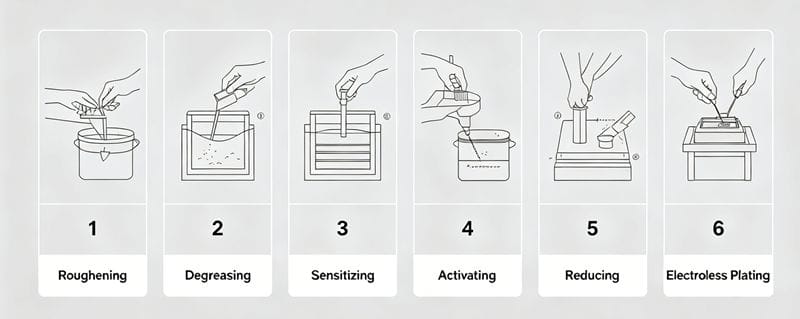
The process flow is: Mechanical/Chemical Roughing → Degreasing → Sensitization → Activation → Reduction → Electroless Plating
2.1 Roughening and Degreasing
- Mechanical vs. Chemical Roughening: Roughening increases the contact area. Mechanical roughening is generally less effective, providing only about 10% of the adhesion strength achieved by chemical roughening.
- Degreasing: Follows the same principles as the coating process described above.
2.2 Sensitization This step involves adsorbing easily oxidizable substances (like Stannous Chloride 또는 Titanium Trichloride) onto the plastic surface. This prepares the surface for the subsequent activation step.
2.3 Activation The sensitized surface is immersed in a solution containing noble metal salts (oxidizing agents). The noble metal ions are reduced to metallic colloids (catalytic nuclei) which deposit on the surface. These nuclei act as catalysts for the plating reaction.
2.4 Reduction and Electroless Plating
- Reduction Treatment: Before plating, the part is dipped in a reducing agent (e.g., Formaldehyde for copper plating, Sodium Hypophosphite for nickel plating) to remove residual activator.
- Electroless Plating: This is the critical step. A thin layer of metal is chemically deposited onto the plastic, making it conductive. Once conductive, standard electroplating can proceed.
Summary of Process Differences
[Coating vs. Plating Pretreatment]
| 특징 | Coating Pretreatment | Plating Pretreatment |
|---|---|---|
| Primary Goal | Improve wettability and adhesion | Create a conductive metal layer |
| Key Step | Surface Activation (Oxidation) | Electroless Plating (Metallization) |
| Conductivity | Not required | Essential (must be achieved before plating) |
| Complexity | 보통 | High (Multiple chemical steps) |
[^1]: Explore this resource to understand effective surface treatment methods that enhance the quality and performance of plastic injection molding products. [^2]: Understand the necessity of a conductive base layer for successful electroplating.
저자 소개

Alex Yu
아이디얼 프로 매뉴팩처링
알렉스는 Ideal Pro의 공동 창립자이지만, 주요 프로젝트를 총괄하거나 기술 팀을 이끌지 않을 때는 장거리 자전거 타기를 즐기거나, 동네에서 가장 맛있는 커피를 찾아다니거나, 다음 여행 계획을 세우는 모습을 볼 수 있습니다. 국제 무역 영업과 프로젝트 관리 분야에서 20년 이상의 경력을 쌓아온 그는 촉박한 마감 기한부터 까다로운 엔지니어링 문제까지, 그 사이의 모든 상황을 다 겪어보았습니다. 그는 훌륭한 성과는 충분한 휴식을 취한 마음과 맛있는 커피에서 나온다고 믿으며, 맡은 모든 프로젝트에 그와 같은 호기심과 세심한 주의를 기울입니다. 사무실에 있지 않을 때는 대개 야외 어딘가에서 새로운 장소를 탐험하며, 나중에 나눌 이야기를 수집하곤 합니다.
 English
 French
 Dutch
 German
 Japanese
 Korean