

When manufacturing Thermoplastic Elastomer (TPE) products with strict surface requirements, proper material preparation is non-negotiable. Before molding, TPE must be thoroughly dried to prevent moisture-related defects. You can check our full TPE molding processing guide for complete material pre-processing steps: The Ultimate Guide to TPR/TPE Injection Molding: Process, Parameters & Troubleshooting
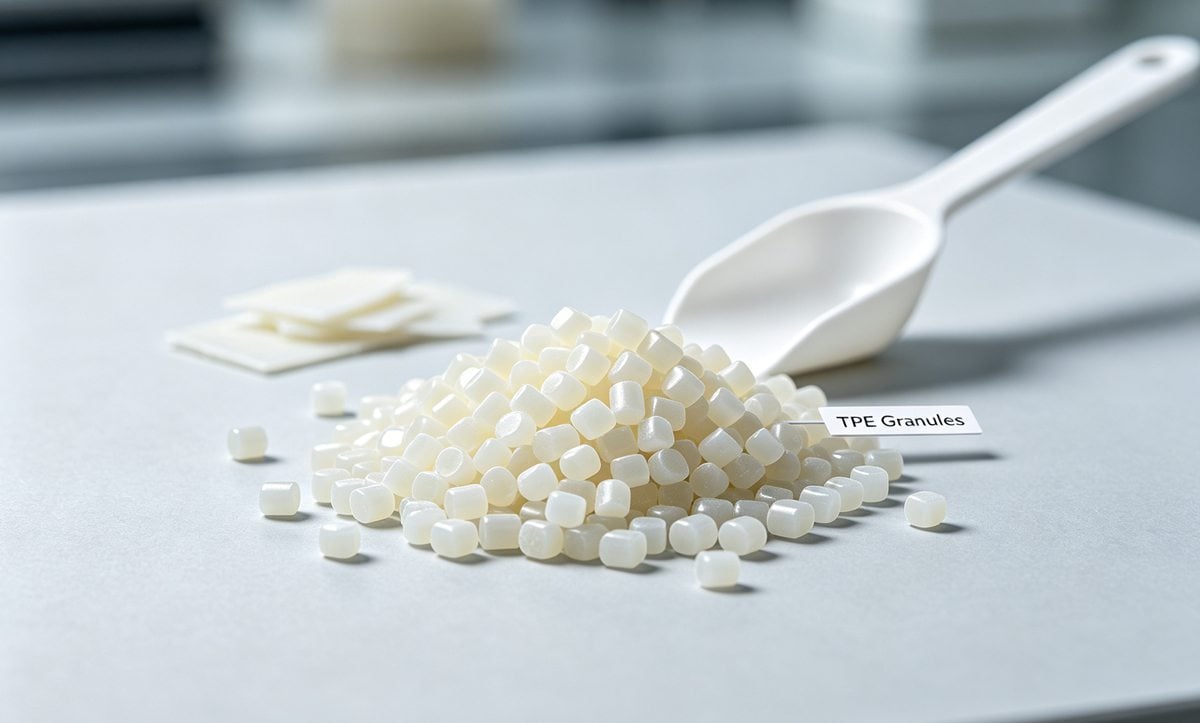
Recommended Drying Parameters:
- Hopper Dryer: 70–80°C for 2 hours
- Tray Dryer: 80–100°C for 1 hour (Note: Keep material layer thickness under 50mm. Tray drying is highly recommended).
💡 プロのアドバイス If you notice bubbles on the surface of the extruded strands, internal voids when cut, or radial silver streaks on the molded part, your TPE/TPR raw material contains too much moisture.
Even with proper drying, surface defects can occur. Below are the top 5 common TPE injection molding surface issues and expert solutions to resolve them.
Flow Marks
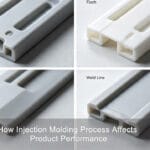
Flow marks appear as streaks with varying gloss levels on the molded surface. In resin injection molding, they typically manifest in three ways:
- Narrow, closely spaced streaks.
- Wider streaks with the same phase appearing vertically on the part.
- Narrow streaks with different phases appearing vertically.
For more universal flow mark troubleshooting across all plastic resins, refer to our defect reference article: 16 Common Injection Molding Defects: Root Causes & Solutions
✅ Solutions: The most effective fixes include increasing the injection speed and raising the mold temperature. Other adjustments include adding pure monomer resin, enlarging the gate, increasing resin/molding temperatures, or in some cases, reducing the injection speed.
Poor Ejection (Demolding Issues)
Poor ejection occurs when the molded part is difficult to remove from the mold or deforms during extraction. This is especially common with tacky TPE materials. It can also be caused by insufficient cooling (incomplete solidification).
✅ Solutions:
- Material & Mold: Add an internal mold release agent or apply an external release agent to the mold.
- Cooling: Ensure adequate cooling time for complete solidification.
- Mold Design: Increase the draft angle at the gate and widen the runner channel to prevent sticking. If you frequently struggle with stuck parts and ejection deformation, our dedicated ejection failure guide offers mold design and maintenance fixes: Injection Molding Ejection Problems, Solutions
Material Aging
Symptoms: Noticeable reduction in mechanical properties and degraded appearance. Cause: Compared to inorganic and metallic materials, polymers have lower heat and UV resistance, making them prone to aging over time.
✅ Solutions: Incorporate heat and weather-resistant stabilizers during compounding. Adding UV absorbers and light stabilizers can significantly inhibit the aging process.
Uneven Color Distribution
When using TPE pellets mixed with dry color masterbatch, color inconsistency is a frequent issue.
✅ Solutions: Increase the screw back pressure and enhance the mixing/kneading action during the plastication phase to ensure uniform pigment dispersion.
Blooming (Whitening)
Blooming occurs when additives (like stabilizers) migrate to the surface, creating a powdery white film. This is usually caused by excessive additive loading or poor compatibility with the polymer matrix.
✅ Solutions:
- Select stabilizers with high compatibility with the base polymer.
- Keep additive concentrations within the optimal range.
- Upgrade to high-molecular-weight stabilizers, which are less prone to migration.
- 注: For anti-static agents or lubricants designed to migrate, choose formulations that resist visible whitening. In harsh environments (high heat, humidity, outdoor exposure), adding specialized heat/weather stabilizers is crucial to prevent accelerated migration.
Quick Reference: TPE Surface Defects Cheat Sheet
| Surface Defect | Primary Cause | Recommended Solution |
|---|---|---|
| Flow Marks | Improper flow dynamics or temperature | Increase injection speed & mold temp |
| Poor Ejection | Tacky material, poor cooling, or bad draft | Add release agent, increase draft angle |
| Aging | UV/Heat exposure degrading polymer | Add UV absorbers & heat stabilizers |
| Uneven Color | Poor pigment dispersion | Increase screw back pressure & mixing |
| Blooming | Additive migration / incompatibility | Use high-MW stabilizers, optimize dosage |
 English
 French
 Dutch
Dutch German
 Japanese
 Korean