 Français



The first PEEK decision is not the grade, it is the form: a block of tan barstock in a CNC vise, or a near-net-shape part popping out of a hot mold. A buyer sent us a drawing for a glass-filled PEEK insulator, 1,200 pieces a year, quoted at \$128 each machined from plate. The molding route needed a \$55,000 tool and four months to first part, but it came to about \$9 a piece at volume. Somewhere between those two numbers is an honest crossover, and it moves with geometry far more than most quoting sheets admit. This article is the crossover math for PEEK machining vs injection molding: what the material forces on both routes, where each one actually wins, what molding PEEK takes to be repeatable, and which parts should stay on the mill no matter what the volume says.
| If your program looks like this | Usually the right route |
|---|---|
| Under a few hundred parts a year | Machine from stock |
| Thick sections (above ~12 mm) or oversize parts | Machine, or machine from molded near-net |
| 1,000 to 5,000 a year, wall under 6 mm | Mold, with the tool budgeted honestly |
| Tight bores and flatness on a complex body | Mold near-net, finish-machine the critical features |
| Prototype due in two weeks, spec may still move | Machine. Always. |
Why PEEK Refuses to Follow the Normal Plastics Playbook
PEEK (polyetheretherketone) is a semi-crystalline aromatics backbone that a machine shop meets as beige rod and plate and a molder meets as pellets costing \ to \ per kilo, twenty to forty times the price of PA66-GF30. The price is the headline; the processing window is the plot. Melt temperature sits around 360 to 400 °C and mold temperature around 180 to 220 °C, because PEEK’s properties (chemical resistance, dimensional stability, the strength you are paying for) depend on crystallinity developing at a hot mold, not on what you can get by chilling steel to save three seconds of cycle. Cool it like ABS and you get a glassy, under-crystallized part that measures fine on day one and moves in your solvent bath on day thirty.
Hydrolysis is the other tax. PEEK absorbs enough moisture to matter, and at 380 °C melt, wet resin undergoes chain scission that is permanent: parts can look perfect and fail at impact months later. Drying is to spec 150 °C-class desiccant, four hours or the datasheet’s number, verified below about 0.02% moisture before the first shot. Our resin drying guide covers the why of that number and how to prove it at the press instead of trusting the dryer timer. Add abrasive glass and carbon grades eating screws and gates, tooling that must hold 200 °C steel at temperature without warping its own parting line, and you get the practical consequence: fewer shops run PEEK molding well, while any competent three-axis shop can machine it. That asymmetry is exactly why the crossover question keeps coming up on RFQs, and why it deserves arithmetic instead of folklore.
What You Are Actually Buying When You Buy a PEEK Block
Stock shapes are made by extrusion or compression sintering, and the process signature rides along with every plate. Extruded rod and plate carry residual stress from being forced through a die and cooled under constraint, plus properties that differ along, across, and through the thickness; a plate is not isotropic, however nice the mill certificate looks. Cut aggressively into that plate and you release the stress unevenly, and the part you datum’d perfectly in the vise shows up flat at 0.15 mm out of flat after the final cut and a night on the shelf. Serious shops handle it the way aluminum guys handle 6061: a stress-relief step after roughing, light finishing passes, and critical features machined last, and they put the method on the drawing review instead of in the router’s memory.
Compression-sintered sheet, the other common source, has its own story: layer-line interfaces, sometimes lower and more variable mechanical properties through thickness, and a size ceiling that ends right where big molded near-nets begin. Grade matters in the other direction too: unfilled stock moves the most with stress relief and heat, GF grades hold dimensions better but murder your cutters faster, and CA grades sandblast your finish if you chase a cosmetic surface. None of this makes machining the wrong route. It makes it a route with costs that live outside the hourly rate, and those belong in your comparison.
Where Does the Money Cross Over?
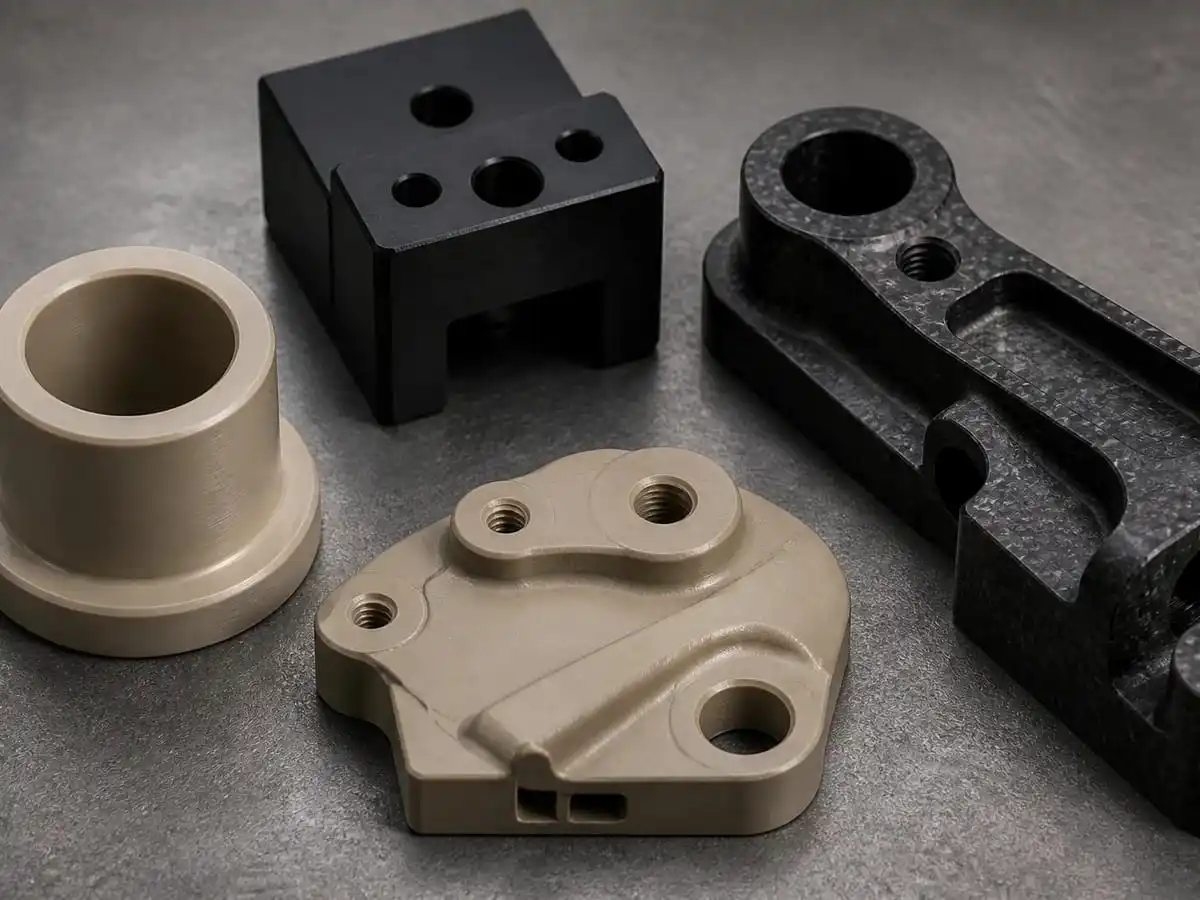
Natural, glass-filled, and carbon-filled PEEK parts machined from stock beside molded near-net examples, same material family.
Here is the arithmetic with its assumptions stated, so you can swap in your own numbers. Machined cost per part is stock volume in times price in times a chip fraction of 3 to 6 (the part you keep is the one number that lies about machining cost) plus CNC hours at your rate plus fixturing and stress relief. Molded cost per part is pellet price times part weight with regrind recoverable at a controlled ratio, times a sprue-loss fraction, plus a cycle at hot-mold machine rates, plus amortized tool. The tool is the expensive part of PEEK molding because everything about it is oversized: hot-runner nozzles rated past 400 °C, steel specified to hold 200 °C continuously, conformal or aggressively turbulent cooling to keep a hot cycle short.
| Example part (assumptions stated) | Machined each | Molded each | Tool | Rough crossover |
|---|---|---|---|---|
| GF-PEEK bushing, 22 g, from rod | \$55 to \$75 | \$3 to \$6 | \$35k to \$55k | 700 to 1,200 pcs |
| Insulator plate 80x50x6 mm, 24 g | \$110 to \$140 | \$7 to \$10 | \$45k to \$65k | 450 to 700 pcs |
| Connector bracket, 3 finish-machined bores | \$140 to \$170 | \$16 to \$22 hybrid | \$60k to \$90k | 500 to 900 pcs |
The band nobody publishes: for parts in the low hundreds per year, machining wins outright, and for five-figure annual volumes molding is not a cost question at all. The crossover for PEEK machining vs injection molding lives between roughly 500 and 2,000 per year, where a \$50k tool takes two to four years to pay back and the geometry call (wall thickness, bore count, flatness) decides who is right. If a quote on a 600-piece program shows molded pricing, someone amortized the tool on someone else’s program; ask which.
What Machining Wins Even After You Own a Mold
Thick sections are machinings home turf in any PEEK machining vs injection molding debate. A 20 mm boss molded into a PEEK part is a void and sink waiting to happen; the thick core freezes slowly and unevenly, shrinkage runs away from the datasheet, and you pay for it in 100% inspection. Homogeneous dense stock does not argue. Oversize parts: when projected area exceeds what a sensible press plus a hot mold can clamp, there is no crossover to calculate. Single-point features matter too: a one-off spacer, a prototype run whose design will move in three weeks, a repair batch for a machine already shipping, all route to the mill because a tool is a five-month commitment to a frozen drawing.
And there are two quieter wins people forget on the pro-molding spreadsheet. Weld lines: every hole and bypass feature in a molded body knits two flow fronts back together, and weld strength in PEEK runs maybe 60 to 80% of the bulk; a machined part has no weld line because it has no flow at all. Fiber direction: molded parts lock in a flow-frozen orientation pattern that makes properties directional by design, which is great when you planned it and a surprise when you did not; machining lets the designer pretend the part is quasi-isotropic, at chip cost. For safety-critical loaded parts with sketchy flow analysis, that pretend is sometimes the honest engineering choice.
What Molding Wins Beyond Price
Material utilization is the one that surprises buyers the first time they price a chip stream. Machining a 22 g bushing out of rod can send 60 to 80% of \$90-per-kilo stock into the chip bin; molding delivers the part at 105 to 115% of part weight with the sprue feeding a documented regrind loop. On PEEK, the regrind story is inverted from commodity economics: at these resin prices the loop is not cost-cutting, it is loss control, and it is exactly the case we make in our regrind guide where PEEK sits at the “run it with records” end of the spectrum. Lot-to-lot consistency is the second win: one qualified process window, cavity-level dimensional reporting, and shot-to-shot weights on a control chart beat a machined population that inherits every stress-relief day of the stock that month. The third win is geometry: live hinges, snap features, thin walls down to about 0.8 mm in good flow paths, molded-in threads, and metal-insert overmolding are simply not mill operations. For a medical housing with four stainless inserts, the molded answer is not cheaper, it is more possible.
What It Actually Takes to Mold PEEK Without Surprises
Bring a molder who can show the whole chain, because PEEK forgives nothing. Drying: desiccant at PEEK temperatures with dew point in the -40 °C class, moisture verified by analyzer before the first shot, not assumed from the timer. Machine: a barrel and screw with wear-hardened geometry for filled grades, dedicated or rigorously purged (contamination from a previous PC run steams out in the hot mold as a surface defect), clamp sized for the projected area with the hot mold and hot-runner controls rated for the duty. Mold: steel specified for continuous 200 °C service, cavity cooling designed for a hot process, vents generous because high-viscosity melt at short flow paths welds cold. Process: cavity-pressure or at minimum cushion-and-weight discipline, dimensional reports per cavity on conditioned (annealed where the drawing calls for it) parts, not hot-off-the-press vanity numbers. The crystallization-versus-cooling story and its dimensional consequences are the same physics we cover for semi-crystallines in our dimensional instability guide; PEEK just charges more per lesson learned.
A qualified PEEK cell is rare enough that its existence is a supplier-selection filter by itself. Ask for the last three PEEK programs’ capability studies with cavity breakdown. If the answer is a single averaged report, the cavities are not being separated, and you are buying the best cavity’s numbers.
Before You Pick a Route, Run the Hybrid
The honest answer for a lot of high-tolerance PEEK parts is a two-process recipe: injection mold the body near-net, then machine the three features that actually carry tolerance. Our connector-bracket example above is this: the body comes out of the tool at 1.6 mm stock on all faces, a fixture holds it once, and 1.5 hours of finishing cuts bring the optical bores to plus or minus 0.02 mm and the mounting face to 0.05 flatness. Per-part cost lands around \$18 at 1,500 a year, against \$150 fully machined, and the mold risk that kills pure-molded proposals (weld-line strength, core-shift on thin walls) never enters the budget. The hybrid also solves the timing trap: machine your first 100 from stock while the tool cuts, ship from week three, and switch the line to molded bodies when T1 parts clear inspection. Nobody in the quote comparison spreadsheet ever prices that option, which is exactly why it is worth asking for.
The Aerospace Bracket That Moved 1,500 Parts a Year to a Mold
An avionics supplier brought us a PEEK CA30 bracket machined for a decade: 200 pieces a year at \$310, tolerances mostly plus or minus 0.1 with one bore at 0.03, delivered from a job shop with a ten-week queue and a stock-supply headache. The program moved to a mid-single-thousand a year on a new build. Fully machined, that would run \$570k a year. The route we landed on: molded near-net body, machine the datum face and one bore, annualized cost at \$86 a part including tool amortization on the 78k, four-week lead, and per-lot dimensional reports the customer could file instead of argue about. Payback on the tool was under nine months of the new volume, and the part got better, because the molded body’s flow plan put fiber across the bore axis instead of letting the mill cut through whatever the plate happened to contain. One flag we raised in writing during the DFM: the old drawing carried a stress-relief note from the machining era that became meaningless in the molded world, and it took three change-control rounds to retire it. Retire the rituals, not just the process.
When You Should Refuse to Mold PEEK
The case against the route we sell, stated plainly. Below a few hundred pieces a year, a PEEK tool is money on a frozen design and machining is the right answer; we say so at RFQ and lose some jobs. Walls above roughly 15 mm belong on a mill or as a machined-from-molded blank unless the design reworks the thick feature into cored geometry. Drawings that ask plus or minus 0.01 mm everywhere will get machined, because molded semi-crystallines earn their tolerances zone by zone, not uniformly, and promising otherwise is how programs die in month six. Schedules that need 200 parts in six weeks have no tool in them. And if the molder cannot show a dedicated or verified-clean PEEK cell, cavity-separated reports, and a drying record culture, the cheap quote is the expensive one; walk, even if we are the ones saying it. Last honesty note: specify PEEK because the 250 °C continuous duty, the chemical immersion, or the wear requirement actually exists. A third of PEEK RFQs we quote are PA46 or hot PPS parts with a brand-driven spec, and the cheapest part is the one you do not pay polymer-giant prices for. If you want to check your application against a cheaper family first, our nylon engineering guide is written with the same unflattering honesty.
What to Bring Before Asking for a Machined-vs-Molded Quote
Five lines, and a quotation that answers them is an engineering document, not a price: name the exact grade and supplier (GF vs CA30 vs unfilled changes both routes’ costs), give real annual volume and its plausible range, flag the thick features and the killer tolerances explicitly (with which ones are functional), state the environment the part lives in (continuous temperature, media, wear pairing), and ask the supplier to write down which route they propose and why. Add the question this whole article exists to raise: what would the hybrid route cost? A shop that runs both sides of that comparison is a shop that has run it before. Bring the current machined cost per part, because the single fastest way to make a molding proposal decision-grade is to price it against the number you already pay, not against a competitor’s guess. And bring the annual range, not one figure; a tool sized for the optimistic volume and fed the pessimistic one is the most common way a good PEEK decision curdles into a sunk cost. Send us the drawing and the 24-hour DFM comes back with machined, molded, and hybrid priced side by side with the assumptions shown.
Résumé
PEEK machining vs injection molding is not a religion; it is a crossover calculation where geometry sets the slope and volume sets where you sit on it. Machine under a few hundred a year, over thick sections, or when the design is still moving; mold once volume justifies hot-runner tooling and the wall plan lets you; run the hybrid when the drawing demands machined bores on a molded body and nobody has priced that option. Whichever route wins, demand the same evidence trail: grade named exactly, melt or machining history tracked, dimensions measured on conditioned (annealed where specified) parts, and cavities or workpieces reported separately rather than averaged into one flattering number. The part that looks identical on the drawing can be two different purchasing problems depending on a dozen inputs, so price the crossover out loud, put the assumptions next to the unit cost, and let the measurement decide instead of the habit. If you want both quotes and the crossover point shown, send us the drawing.
FAQ
Le PEEK moulé par injection est-il aussi résistant que le PEEK usiné ?
En vrac, certes ; mais une pièce moulée en PEEK correctement cristallisée présente les mêmes propriétés de matrice que celles décrites dans la fiche technique. Les véritables différences sont d’ordre structurel : les pièces moulées présentent des lignes de soudure au niveau des trous et des passages (où la résistance n’atteint généralement que 60 à 80 % de celle du matériau en vrac) ainsi qu’une anisotropie induite par l’écoulement, tandis que les pièces usinées héritent de l’anisotropie du matériau d’origine et des contraintes résiduelles. C’est la caractéristique recherchée, et non le procédé utilisé, qui est déterminante.
À partir de quelle quantité le moulage du PEEK devient-il plus avantageux que l'usinage ?
Pour les pièces typiques de petite à moyenne taille, dont le coût d'outillage est compris entre 35 000 et 90 000 dollars, le seuil de rentabilité se situe approximativement entre 500 et 2 000 pièces par an, une fois que les déchets de copeaux et les heures de CNC ont été pris en compte de manière réaliste dans le calcul des coûts. Les pièces épaisses, surdimensionnées ou produites en quantités inférieures à dix unités peuvent ne jamais atteindre ce seuil.
Quel est le prix d'un moule d'injection en PEEK ?
Prévoyez entre 35 000 et 90 000 dollars pour un moule en acier de conception simple à modérée destiné à la fabrication de pièces en PEEK avec canal chaud ; le coût sera plus élevé pour les moules médicaux à plusieurs cavités. Le surcoût par rapport à un moule de type ABS s'explique par l'utilisation d'un canal chaud, le choix de l'acier et du revêtement, ainsi que par un système de refroidissement conçu pour un moule fonctionnant à 200 °C.
Le PEEK peut-il être usiné selon des tolérances serrées ?
Oui, à condition de respecter certaines règles : décharge de contrainte après l'ébauche, passes de finition légères et enchaînement des opérations de manière à ce qu'aucune ne soit terminée avant que la pièce ne cesse de se déplacer. Sans cette étape de décharge, les pièces en PEEK peuvent se déformer de quelques dixièmes de millimètre après l'usinage de finition, ce qui explique en partie les coûts cachés liés au plan vieux de dix ans de notre étude de cas.
Le PEEK moulé doit-il être recuit ?
Souvent, oui. Un recuit post-moulage à une température inférieure au point de fusion permet de relâcher les contraintes résiduelles et d'achever la cristallisation, ce qui stabilise les dimensions et le comportement chimique. La combinaison exacte temps-température doit figurer sur le plan ou dans le procédé approuvé par le fournisseur, et le rapport doit préciser dans quel état la mesure a été effectuée.
L'utilisation de matière recyclée est-elle acceptable pour les pièces en PEEK ?
C'est plus qu'acceptable, c'est la norme : avec une résine à ces prix-là, un circuit de rebroyage documenté permet de limiter les pertes. Ce qu'il vous faut dans le contrat, c'est le plafond, le nombre de cycles de fusion et la vérification de l'indice de fluidité par lot, soit les six mêmes clauses de bon de commande que pour toutes les autres résines.
Pourquoi le PEEK usiné coûte-t-il si cher alors que la plaque de PEEK n'est pas si chère que ça ?
En effet, lorsque vous achetez la plaque, vous payez les 60 à 80 % de celle-ci qui sont transformés en copeaux, les heures-machine nécessaires pour usiner le reste, les étapes de détente thermique, ainsi que le taux de rebut lié au travail manuel. La partie que vous conservez ne représente peut-être qu'un tiers du coût réel de l'opération.
Ideal Pro peut-il établir un devis pour les deux itinéraires concernant la même pièce ?
Yes, that is the honest way to buy PEEK at crossover volumes. Send the drawing and the free 24-hour DFM prices machined, molded, and hybrid routes side by side with the assumptions written out.
À propos de l'auteur

Alex Yu
Ideal Pro Manufacturing
Alex est le cofondateur d’Ideal Pro, mais lorsqu’il ne supervise pas des projets clés ou ne dirige pas l’équipe technique, vous le trouverez sans doute en train de faire une longue balade à vélo, à la recherche du meilleur café de la ville, ou en train de planifier sa prochaine aventure de voyage. Fort de plus de 20 ans d’expérience dans le commerce international et la gestion de projets, il a tout vu : délais serrés, problèmes techniques complexes et tout ce qui se trouve entre les deux. Il est convaincu qu’un travail de qualité naît d’un esprit bien reposé et d’une bonne tasse de café, et il apporte cette même curiosité et ce même souci du détail à chaque projet qu’il entreprend. Lorsqu’il n’est pas au bureau, il se trouve généralement en plein air, à explorer de nouveaux endroits et à glaner des anecdotes à partager.
 English
 French
 Dutch
 German
 Japanese
 Korean