 Français



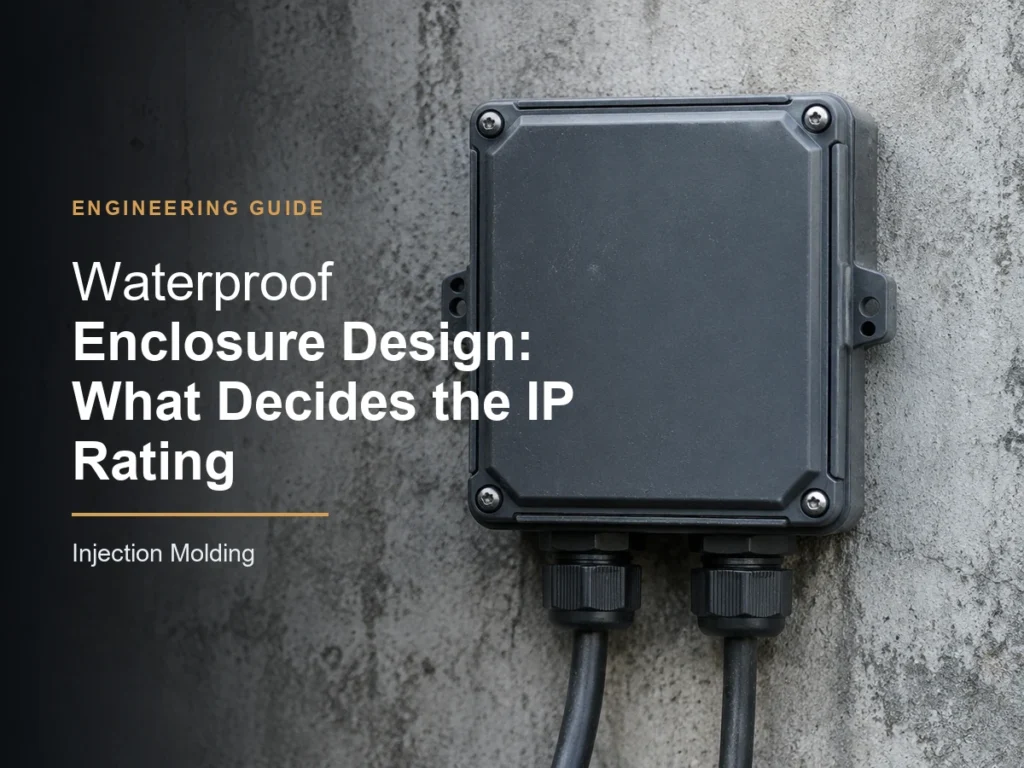
An IP rating is the result of a test, not a design parameter. That distinction is where most molded enclosure programs lose money: the drawing says IP67, the CAD carries no sealing geometry that could survive production tolerances, and the failure shows up on the third sample round — after the tool has been cut. This article is about the handful of numbers that actually decide the outcome: seal compression, warp, sealing-land width, screw pitch, and the pressure your enclosure generates every time the sun comes out.
What does an IP water rating actually test?
The water digits come from IEC 60529, and each one is a specific rig with specific parameters. If you are specifying a rating, you are specifying a test you agree to submit to.
| Notation | The water test | Duration and geometry | What it does not prove |
|---|---|---|---|
| IPX3 | Spraying at up to 60 degrees from vertical | Oscillating spray, roughly 10 cm per minute per square meter | Anything about standing water |
| IPX4 | Splashing from any direction | Around 10 liters per minute, all faces | Sealing under continuous flow |
| IPX5 | A water jet from a 6.3 mm nozzle | 12.5 liters per minute at about 30 kPa, roughly 2.5 to 3 m away, at least 3 minutes | Long immersion or pressure cycles |
| IPX6 | A heavier jet, 12.5 mm nozzle | Around 100 liters per minute at about 100 kPa, same distance and duration rule | Anything below the waterline |
| IPX7 | Immersion | 30 minutes with the lowest point 1 m below the surface | Repeated immersion, warm water, or waves |
| IPX8 | Immersion beyond 1 m | Agreed between manufacturer and customer, and it must be more severe than X7 | Unless the agreement says so: cyclic pressure |
| IPX9K | High-pressure, high-temperature steam cleaning | 80 °C water at 8 to 10 MPa at 14 to 16 liters per minute | Outdoor aging at all |
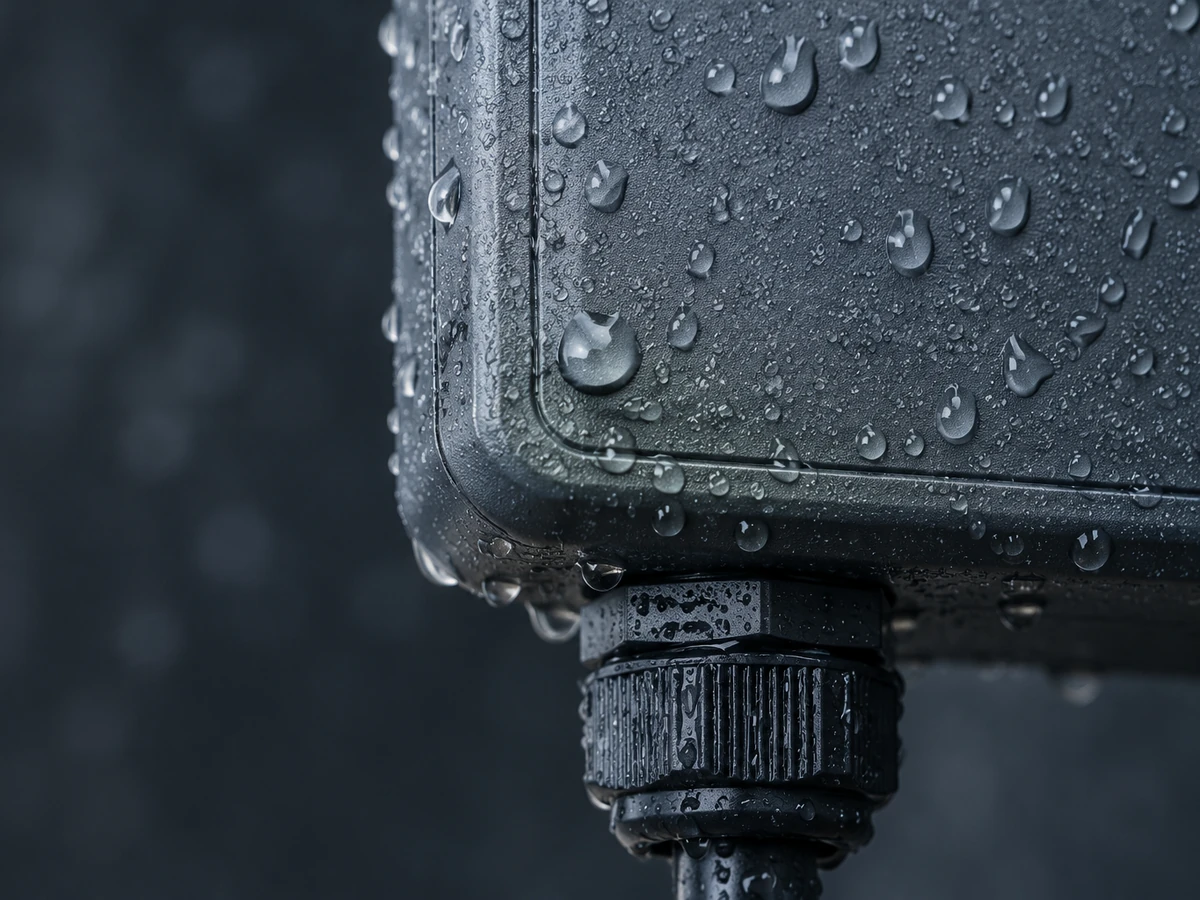
Read the last column twice. None of these tests includes a temperature cycle, and none of them includes the thing that destroys field enclosures: the breathing cycle created by daytime heating and night-time cooling, which actively pumps moisture through whatever path is easiest. A gasket that passes IPX7 on a bench at 20 °C can fail in a year on a south-facing wall.
The dust digit is usually the harder engineering requirement for a molded part, because it is about gaps you cannot see: the interface at a cable gland, the bore around a pushbutton shaft, and the parting line of a cover held by four screws with a 0.4 mm step between them.
Which sealing architecture should you model in CAD?
This choice is made in the model, not in the assembly. Once you have chosen it, everything downstream — the tool, the tolerances, the bill of materials, the assembly labor — follows.
| Architecture | Realistic ceiling | Sensitive to | Assembly and service | Typical use |
|---|---|---|---|---|
| Flat land plus flat-cut gasket, held by screws | IP65 to IP66, IP67 with careful flatness | Cover warp and gasket thickness tolerance | Cheap, but every opening re-seats the gasket | Sensor housings, junction boxes |
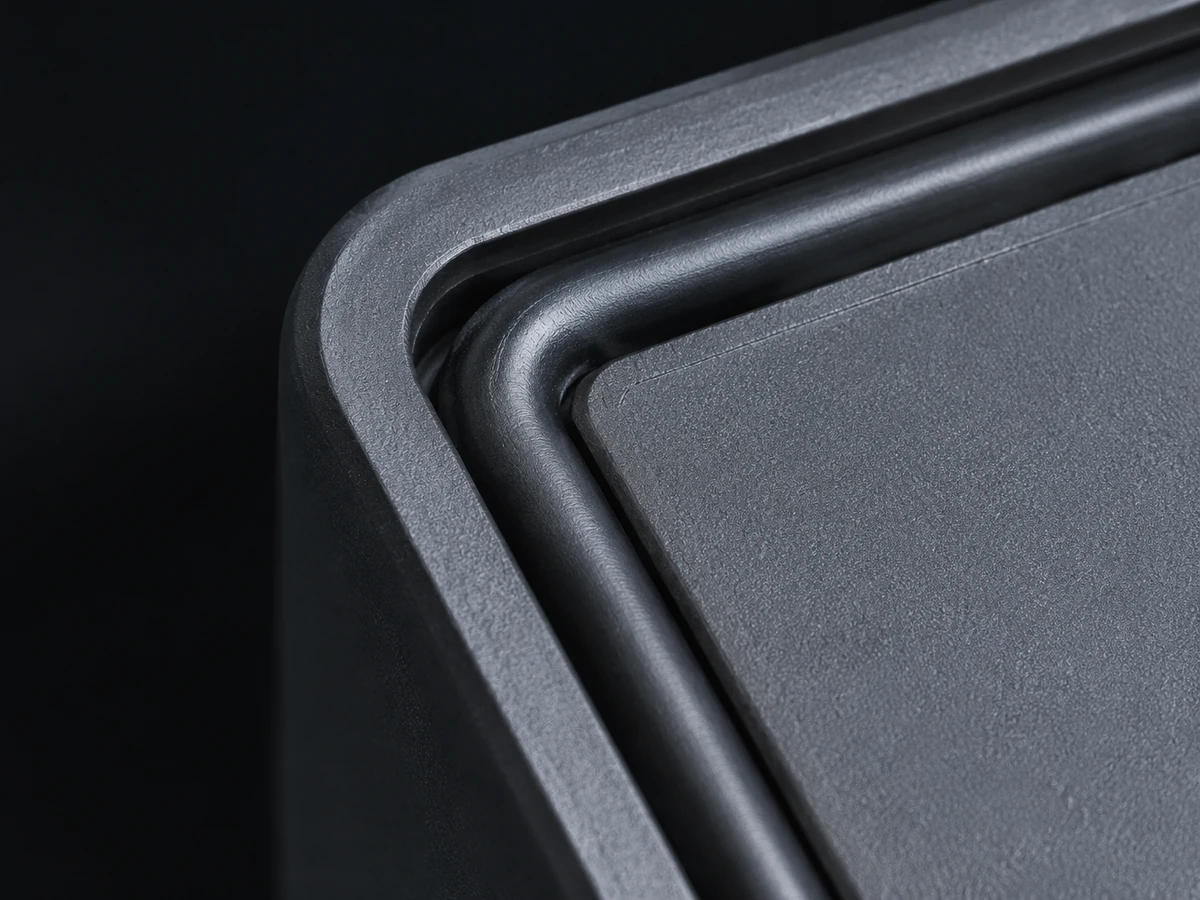
| molded cord in a closed groove | IP67 to IP68 for static water | Groove depth tolerance, cord diameter tolerance, corner lifting | Reliable if the groove is closed and continuous | Meter housings, outdoor controllers |
| Tongue and groove with a soft lip | IP66 to IP68 | Tongue-to-groove clearance, and whether the tongue bottoms out | Self-centring, tolerant of hand assembly | Mains-powered outdoor enclosures |
| Formed-in-place gasket, dispensed foam | IP54 to IP66 realistically | Dispense path repeatability and adhesion | Fast in production, weak if the joint is flexed | Consumer outdoor devices, lighting |
| Ultrasonically welded or heat-sealed shell | IP67 and above, effectively permanent | Weld energy consistency, joint design, part cleanliness | No field service without destroying the seam | Disposable or sealed-for-life modules |
| Overmolded TPE or LSR seal on a rigid shell | IP67 to IP68 with fewer parts | Bond between materials, flash at the parting line | Best part count, worst tooling cost and rework | Handhelds, wearables, power tools |
| Potting or low-pressure encapsulation | IP68 equivalent internally, plus shock | Thermal expansion mismatch, rework is impossible | Highest protection, zero serviceability | Bare electronics in wet locations, see our PCB encapsulation guide |
Most programs that overshoot pick the last two rows when the third row was enough. Most programs that fail pick the first row and hope.
How much compression does a molded seal actually need?
The starting equation is simple enough to do on the back of an envelope during a design review:
squeeze percent = (free cord height minus assembled gap) divided by free cord height, times 100.
For an elastomer seal in a static joint, the practical design target sits between 15 and 30 percent deflection, with roughly 20 to 25 percent the nominal aim for molded silicone and EPDM cords. Below that band the sealing pressure is too low to bridge the surface texture of the two faces; above it the cord is being squeezed so hard that the polymer takes permanent set, and the second time anyone opens the enclosure you have a flat ribbon where a round cord used to be.
Then the force arithmetic, because this is what tells you how many screws you need. Take an outdoor controller cover, 160 by 110 mm, with a continuous 2.0 by 1.5 mm silicone cord running a perimeter of about 480 mm.
| Étape | Working | Valeur |
|---|---|---|
| Free cord cross-section | 2.0 mm wide by 1.5 mm high | 3.0 square mm |
| Target squeeze at 22 percent | 1.5 mm times 0.78 | assembled gap 1.17 mm |
| Contact pressure needed to bridge molded texture | commonly quoted in the 0.3 to 0.8 MPa band for soft elastomers | use 0.5 MPa |
| Sealing contact area | 1.5 mm land width times 480 mm | 720 square mm |
| Ideal clamp load | 0.5 N per square mm times 720 | about 360 N |
| Per unit length | 360 N over 480 mm | about 0.75 N per mm |
| Screws, if each boss is comfortable at 60 to 80 N before creep becomes a problem | 360 divided by 70 | about 5 to 6 M4 or ST3 bosses |
Those numbers are an order-of-magnitude design method, not a substitute for a gasket vendor's compression curve, but they explain the two rules that matter. First, the sealing force you need is proportional to perimeter, so a big flat cover is a boss-count problem, not a wall-thickness problem. Second, if you halve the sealing land from 1.5 mm to 0.8 mm, the same load produces roughly double the contact pressure — which is why a narrow rib is a better sealing surface than a broad flat shelf, provided the two faces stay parallel.
What do molding tolerances do to a sealing land?
A sealing joint is a stack-up of parts that shrink. Here is the honest budget on a common geometry: an ABS cover, 160 by 110 mm, 2.0 mm nominal wall, with a molded cord on the cover and a flat land on the body.
| Contributor | Realistic range on this part | Effect on the joint |
|---|---|---|
| Cover flatness across the diagonal | 0.2 to 0.6 mm, worse if ribs are asymmetric | Gap opens at the corners, closes at the middle |
| Wall thickness variation across the part | 0.05 to 0.15 mm | Localised shrink differences, adds to warp |
| Gasket cord height tolerance from molding | plus or minus 0.05 to 0.10 mm | Directly shifts the squeeze percent |
| Groove depth as-shrunk | plus or minus 0.05 to 0.10 mm | Same direction as cord error, so they can add |
| Screw boss height variation | plus or minus 0.10 mm | Bosses, not the gasket, set the final gap |
| Insert or connector protrusion | whatever it is | A connector 0.2 mm tall at one corner creates a leak path |
Worst case here sums to something near 1.0 mm of gap variation — three times the elastic budget of a 1.5 mm cord. You fix this by design, not by inspection:
| Countermeasure | How it works | Coût |
|---|---|---|
| Hard stops beside the seal | Bosses or stop ribs carry the clamp load, so screw torque cannot crush the cord | Tool complexity only, no unit cost |
| Keep sealing-land flatness inside 0.15 mm by ribbing the cover, not thickening it | Rib placement controls sink and warp far better than extra wall | Same cycle time if ribs are under 60 percent of wall |
| Put the seal on the part with the better flatness, or the one you can shim | Moves the tolerance burden | Free if decided before the model is frozen |
| More bosses at 50 to 70 mm pitch around the perimeter | Reduces local gap opening between fixings | Assembly time, roughly 10 to 20 seconds per screw |
| Metal insert bosses where torque is high | Stops creep relaxation that lets preload decay | Insert cost plus placement, and possible cracking if the surround is thin |
| Compressible spacer or controlled torque in the work instruction | Preload becomes repeatable | Process discipline, effectively free |
If you are designing the cover and the body at the same time, the tolerance conversation belongs in the model, not in the supplier's e-mail. Our write-up on CAD decisions that change tooling cost covers where to put the tight class.
Why does an enclosure that passes IP67 still fill with water after a year?
Because the field applies a pressure cycle the laboratory never does. Work it out for a sealed, roughly rigid housing with 1.2 liters of internal air volume, closed at 20 °C.
| État | Absolute internal pressure if nothing equalises | Gauge pressure relative to outside |
|---|---|---|
| Sealed at 20 °C, 293 K | 101.3 kPa | 0 |
| Interior reaches 60 °C in afternoon sun, 333 K | about 115 kPa | plus 14 kPa, pushes air and any trapped moisture out |
| Interior drops to minus 20 °C at night, 253 K | about 88 kPa | minus 14 kPa, pulls outside air back in |
Fourteen kilopascals of vacuum is the equivalent of about 1.4 meters of water head — deeper than the IPX7 test immersion, applied slowly, several hundred times a year, through whatever path offers least resistance. That path is almost never the main gasket. It is the cable gland that was specified too soft, the unused connector hole plugged with a cap that was not rated, the vent hole somebody forgot to add, or the thread of a breather screw that runs straight through the wall.
Here is what that breathing actually carries in. Cooling from 20 °C to minus 20 °C draws back roughly 13 percent of the internal volume, so about 160 ml of outside air. Ambient air at 25 °C and 80 percent relative humidity holds close to 18 grams of water per cubic meter. So each night inhales about 3 milligrams of water, and three hundred nights inhale about 0.9 grams. That is why the classic field failure is not a puddle but a bead of condensation sitting on a connector, every morning of a cold season, from a box that passed its dip test.
The practical consequences:
| Exigence | What the arithmetic says | Design response |
|---|---|---|
| Equalise the breathing cycle | Flow demand is small: about 1 to 5 ml per minute for a housing of this size | A small hydrophobic membrane vent is enough; you select it on water-entry pressure, not flow |
| Block liquid water at the vent | Water must not pass the membrane under the test jet or immersion depth | Specify the vent's rated water entry pressure above your worst case, and place it where pooled water cannot sit on it |
| Handle the residual humidity | About a gram per year in this example | A 5 gram desiccant charge inside a serviceable enclosure covers several years |
| Avoid thermal stress on the seal | The cover bulges and relaxes each day | Keep the cord in its elastic band with hard stops, so cyclic movement does not walk the seal |
A vent is not a hole in your IP rating; an unpotted cable entry is. The most common combination we see specified is an IP67 gasket with an IP44 gland on the cable entry, which makes the assembly IP44 and the gasket a waste of money.
Where do waterproof molded enclosures actually fail in the field?
Ranked roughly by how often we see them, with the countermeasure that costs least.
| Failure point | Mechanism | Cheapest countermeasure |
|---|---|---|
| Cable and conduit entries | Gland compression range does not match the cable jacket; or a spare port left uncapped | Specify glands against the actual cable OD range, and mold spare-port plugs as part of the tool |
| Screw bosses | Over-torque cracks the boss, or creep relaxes the preload and the gap reopens | Metal insert bosses, controlled torque, and boss geometry designed for the torque, not for the screw |
| The sealing land itself | Warp, sink over ribs, flash, or a gate vestige sitting under the cord | Keep the land flat within 0.15 mm, put no gate or ejector pin under it, and check flash at the parting line |
| Connectors and user controls | The component interface, not the enclosure, is the weak point | Specify the mating connector's own IP rating and design the bezel to it |
| Vent or drain strategy | Water enters a low point and stays there | Add drain paths and put the vent at the highest practical point |
| Cold-weather impact | The material embrittles and the housing cracks at a screw boss when dropped or torqued at minus 20 °C | Choose the resin for the low-temperature impact spec, not the room-temperature datasheet; our cold-weather housing failure analysis is the same problem |
| UV and surface chalking | The seal lip and the outer shell age at different rates | Use a UV-stable resin for the seal, and consider ASA or coated exterior faces |
How many fasteners does a sealing joint actually need, and how far apart?
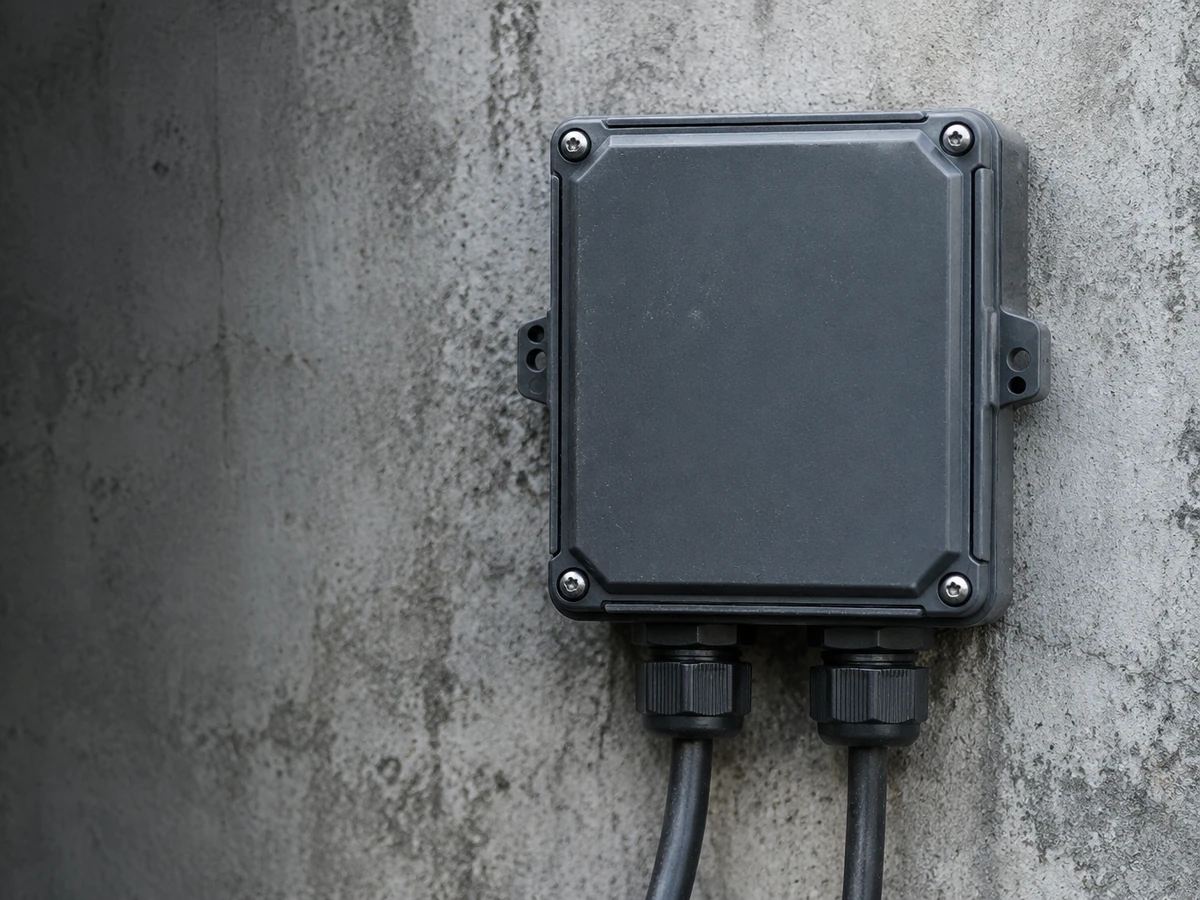
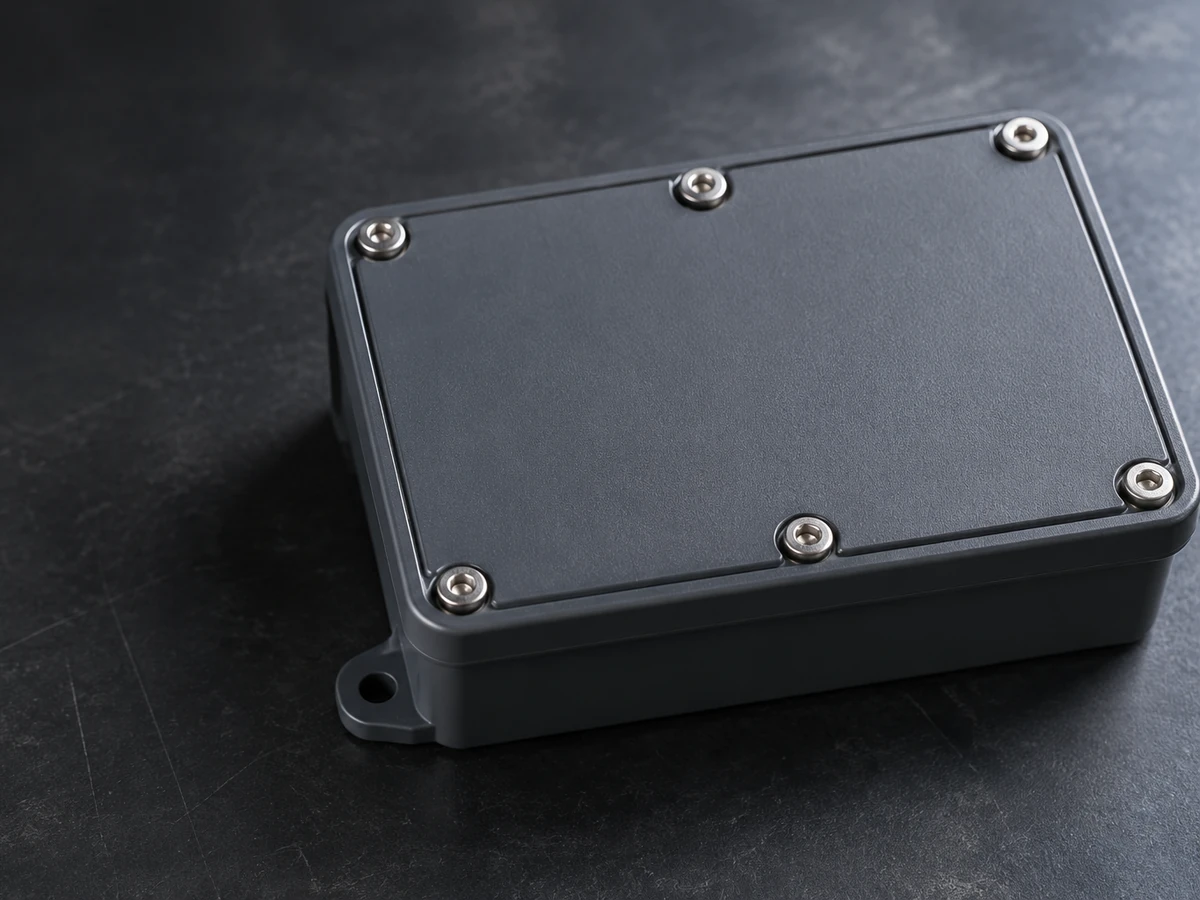
Screw pitch is a leak path, not a styling choice. Between two bosses, the cover bows away from the body under internal pressure and bows toward it under vacuum, and the amount of movement grows quickly with the unsupported span.
Take the same 160 by 110 mm cover with a 480 mm seal perimeter. If you use four bosses, the average spacing along the perimeter is 120 mm. With six it is 80 mm, and with eight it is 60 mm. A practical rule for a gasketed plastic cover is to keep the unsupported span between fixings at 50 to 70 mm, which puts this cover at eight to ten M4 or ST3 positions. That is also why a rectangular cover with two bosses on the long sides leaks in the middle of the long runs and passes the corner inspection.
Then check what each boss can actually hold. A molded boss in ABS with a properly designed surround, 6 mm diameter and 12 mm deep, is commonly torqued to 60 to 100 N of clamp before creep becomes a multi-year concern; a thin boss sitting on a corner rib can fail at a fraction of that during assembly. So the arithmetic is a balance, not a maximization:
| Design choice | What it does to the joint | Combien cela coûte-t-il ? |
|---|---|---|
| More bosses at 60 mm pitch | Higher local clamp pressure, smaller unsupported spans | Assembly time, and more places for a boss crack to start |
| Hard stops 0.1 mm proud of the seal land | Preload stops depending on screw torque alone | Nothing, if modeled before the tool |
| Insert bosses on the four corners only | Raises peak torque capability locally, does nothing between them | Insert cost with little sealing benefit |
| Thicker cover wall to resist bowing | Reduces span deflection | Sink marks, cycle time, weight, usually more than the bosses would have cost |
What does over-engineering the seal cost?
Protection level is a bill-of-materials decision, and the increment is not linear. Same housing, same 1,000-piece run.
| Design decision | Added unit cost | Added non-recurring cost | Added risk |
|---|---|---|---|
| Flat gasket, four screws, no vent, cut from sheet | 0.30 to 0.60 USD | none | Warp-sensitive, only honest at IP54 to IP65 |
| molded cord on the cover plus six bosses | 0.40 to 0.90 USD | 3,000 to 7,000 USD for a second tool or insert for the cord | Cord compression set if stops are omitted |
| Two-shot overmolded seal, no separate gasket | 0.15 to 0.35 USD per piece at volume | 9,000 to 20,000 USD extra tooling for the second shot and its parting | Bond failure and a much harder tool repair |
| Adding a membrane vent | 0.60 to 1.80 USD | none | Small, provided the vent is placed correctly |
| Moving from four to six bosses to control the gap | 0.05 to 0.10 USD plus 15 to 25 seconds assembly | small insert change | Cycle and assembly labor |
| Ultrasonic weld for a sealed-for-life shell | 0.10 to 0.25 USD | 2,000 to 8,000 USD for the fixture | No serviceability, and a scrap rate you must monitor |
The trap is the second-shot line. It looks like elegance — one part instead of two, no loose gasket in assembly — and for a high-volume handheld it is right. For a 1,000-piece outdoor controller it is usually the most expensive wrong decision available, because the tool complexity is paid once and the volume never amortises it.
Which tests should you require before you approve the tool?
Ask for these on the sample round, in this order. They are cheap, and each one catches a different class of failure.
| Test | How it is run | Pass criterion to specify |
|---|---|---|
| Dimensional check of the sealing joint | Measure cord height, groove depth, boss height, and cover flatness across the diagonals | Flatness within 0.15 mm, all heights inside plus or minus 0.10 mm |
| Vacuum decay with the assembly under water | Pull a modest vacuum of roughly minus 20 kPa, submerge, release and watch | No continuous bubble stream from any joint |
| Immersion dip | 30 minutes with the lowest point 1 m down, then weight check after 24 hours drained | No measurable mass gain |
| Jet check | Simulated IPX5 duty on the assembled unit with cable glands fitted | No ingress at glands, bezels or the cover perimeter |
| Thermal breathing cycle | Minus 20 °C for 4 hours, plus 60 °C for 4 hours, ten cycles, then repeat the dip | Still no ingress, and the cord shows no flat set |
| Torque-to-failure on bosses | Increase torque until the boss cracks, on five samples | Record the margin over the specified assembly torque; the weak end of the population must be at least 1.5 times it |
| Low-temperature impact | Condition at the rated minimum, then drop or impact as the application implies | No cracking, especially at bosses and corners |
The reason to run the breathing cycle before the dip, rather than after, is that it is the cycle that reveals the failure the certificate will never show.
When should you not design your own waterproof enclosure?
If your product needs repeated submersion beyond 1 m, pressure washing, or anything close to a life-safety or electrical-safety claim, buy a certified enclosure and modify it — machining, glands, brackets — rather than designing the sealing system from scratch. The tooling saving is illusory once you add the test rig time, the second tool correction, and the liability. Design your own when the shape or user interface is genuinely differentiated, when volumes justify the tool, and when you can specify a seal architecture you can actually test.
What should you do next?
Send us three things: the target IP number with the real installation environment written in plain words, the internal volume and the temperature range, and the current model with the cover and the entry points visible. From those three, the seal architecture, the boss count and the tolerance class can be fixed in one review, before the tool is cut rather than after.
- Email: [email protected]
- Phone and WhatsApp: +86 156 0682 1288
FAQ
Is IP66 better than IP67?
Can a molded plastic enclosure really reach IP68?
Does the gasket have to be a separate part?
Why do I need a vent if the box is sealed?
Should the sealing land be wide or narrow?
À propos de l'auteur

Alex Yu
Ideal Pro Manufacturing
Alex est le cofondateur d’Ideal Pro, mais lorsqu’il ne supervise pas des projets clés ou ne dirige pas l’équipe technique, vous le trouverez sans doute en train de faire une longue balade à vélo, à la recherche du meilleur café de la ville, ou en train de planifier sa prochaine aventure de voyage. Fort de plus de 20 ans d’expérience dans le commerce international et la gestion de projets, il a tout vu : délais serrés, problèmes techniques complexes et tout ce qui se trouve entre les deux. Il est convaincu qu’un travail de qualité naît d’un esprit bien reposé et d’une bonne tasse de café, et il apporte cette même curiosité et ce même souci du détail à chaque projet qu’il entreprend. Lorsqu’il n’est pas au bureau, il se trouve généralement en plein air, à explorer de nouveaux endroits et à glaner des anecdotes à partager.

 English
 French
 Dutch
 German
 Japanese
 Korean