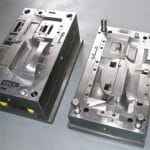
Moule à injection
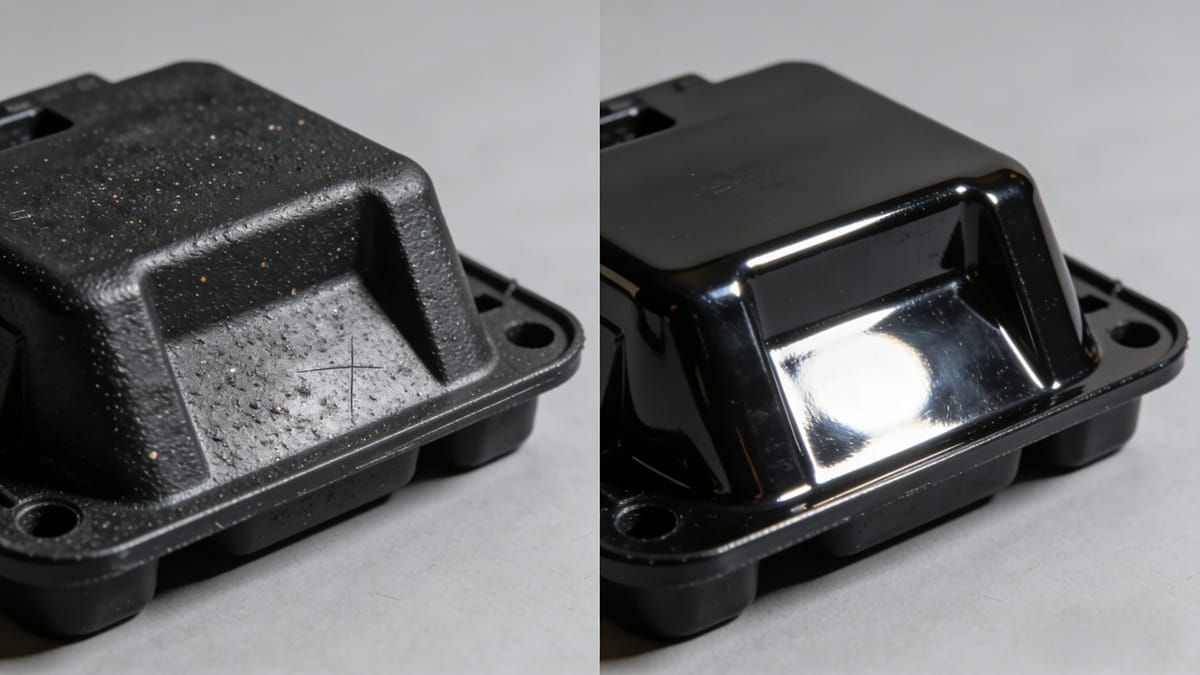
- Un mauvais usinage de la cavité du moule (rayures, micropores, usure et surfaces rugueuses) se traduira directement par une moindre brillance des pièces en plastique. Pour résoudre ce problème, usinez soigneusement le moule pour obtenir une faible rugosité de surface et polissez ou chromatez la cavité si nécessaire.
- La présence d'huile, de taches d'eau ou d'une quantité excessive d'agent de démoulage sur la surface de la cavité peut rendre la surface du plastique terne et non brillante. Nettoyez rapidement les taches d'huile et d'eau et utilisez l'agent de démoulage avec modération.
- Un angle de dépouille insuffisant entraîne un démoulage difficile ou une contrainte excessive lors de l'éjection, ce qui nuit à la brillance de la surface. Augmentez l'angle de dépouille en conséquence.
- Une mauvaise ventilation des moules retient l'excès de gaz à l'intérieur de la cavité, ce qui entraîne un manque de brillance. Inspectez et améliorez le système de ventilation du moule.
- Une section transversale de l'opercule ou de la glissière trop petite ou changeant brusquement crée une force de cisaillement élevée et un écoulement turbulent, ce qui réduit la brillance de la surface. Agrandissez correctement la section transversale de l'opercule et de la glissière.
Moulage par injection1 Processus
- Une faible vitesse d'injection donne une surface non dense et peu brillante. Augmentez la vitesse d'injection de manière appropriée. vitesse d'injection2.
- Un refroidissement insuffisant des pièces à parois épaisses entraîne une surface floue et terne. Optimisez le système de refroidissement3.
- Une pression de maintien insuffisante et un temps de maintien court entraînent une faible densité et une mauvaise brillance. Augmentez la pression de maintien et prolongez le temps de maintien.
- Une température de fusion basse réduit la fluidité et entraîne une mauvaise brillance. Augmentez correctement la température de fusion.
- Pour les pièces fabriquées à partir de résines cristallines telles que le PE, le PP et le POM, un refroidissement irrégulier entraîne une mauvaise brillance. Améliorez le système de refroidissement pour obtenir un refroidissement uniforme.
- Une vitesse d'injection trop élevée combinée à un portillon sous-dimensionné crée une zone terne près du portillon. Réduisez la vitesse d'injection et agrandissez la section de la porte.
Conclusion
En résumé, l'obtention d'une brillance supérieure pour les produits moulés par injection4 nécessite un équilibre entre la finition précise de la surface du moule et l'optimisation des paramètres de moulage par injection. En s'attaquant à des problèmes tels qu'une mauvaise ventilation, un refroidissement insuffisant et une vitesse d'injection incorrecte, les fabricants peuvent améliorer considérablement l'esthétique et la qualité de leurs produits. Ce guide constitue une référence pratique pour résoudre les problèmes courants de brillance en production.
Explorez cette ressource pour découvrir des techniques essentielles et des idées qui peuvent améliorer votre processus de moulage par injection et la qualité de vos produits. ↩
L'étude des effets de la vitesse d'injection peut vous aider à optimiser vos processus pour améliorer l'esthétique de vos produits. ↩
L'optimisation de votre système de refroidissement est cruciale pour obtenir une qualité et une brillance uniformes des produits moulés par injection. ↩
Explorez cette ressource pour découvrir des techniques d'experts qui améliorent la qualité et l'esthétique des produits moulés par injection. ↩