 Français




Polycarbonate is bought for one of two reasons: it has to be clear, or it has to not break. Both of those promises are real. Both come with a bill that is paid in process discipline rather than in resin price, and most of the bill arrives as one of three invoices — moisture, internal stress, and notch sensitivity.
This is the decision layer on top of our PC material page and the older processing overview in mastering PC injection moulding. Numbers are planning bands for grade selection, cross-checked against the resin supplier's TDS before a tool is released. Where a figure is our own working assumption rather than a measurement, it says so.
Why Trust This Polycarbonate Guide?
What we are entitled to say: we mould PC for guards, housings and optical parts, and we have watched the three failures in this article cost real money, which is why the moisture and residual-stress sections are written as process requirements rather than as advice. Bands are planning values for selection and are labelled as such. Author: Alex Yu, co-founder of Ideal Pro, 20+ years across injection moulding and tooling programmes, Huzhou facility.
Why is polycarbonate so tough, and why does it still crack?
PC is a bisphenol-A polycarbonate: rigid aromatic rings linked by carbonate groups. The chains cannot pack into an ordered structure, so the material is amorphous, which is why it is transparent and why it shrinks modestly and evenly. Amorphous also means there is no sharp melting point; the polymer softens through a range, and its glass transition sits around 145 °C, which is where the famous heat deflection temperature of 130 to 136 °C at 1.8 MPa comes from.
The toughness is molecular: below the glass transition, the chains can still move locally, and that motion is what absorbs impact energy that would shatter a brittle polymer. Typical unfilled PC sits around 55 to 65 MPa tensile strength, 2.3 to 2.4 GPa flexural modulus, density 1.20 g/cm3 and notched Izod in the 600 to 900 J/m range. That combination is why PC is used for riot shields, machine guards, face screens and power-tool housings.
So why does it crack? Because the same free volume that gives it toughness makes it sensitive to two things: stress frozen into the part et chemicals that get into that free volume. A PC part that has been moulded cold, sheared hard and packed aggressively contains residual stress that a polariscope will show you as bright bands. That part is dimensionally fine and passes a drop test. Then it is wiped with a cleaning agent, or a solvent-based marker is used on it, or a screw inserts a hoop stress into a boss, and it crazes weeks later. The cracking is not a defect in the material; it is the material returning a stress it was never allowed to relax.
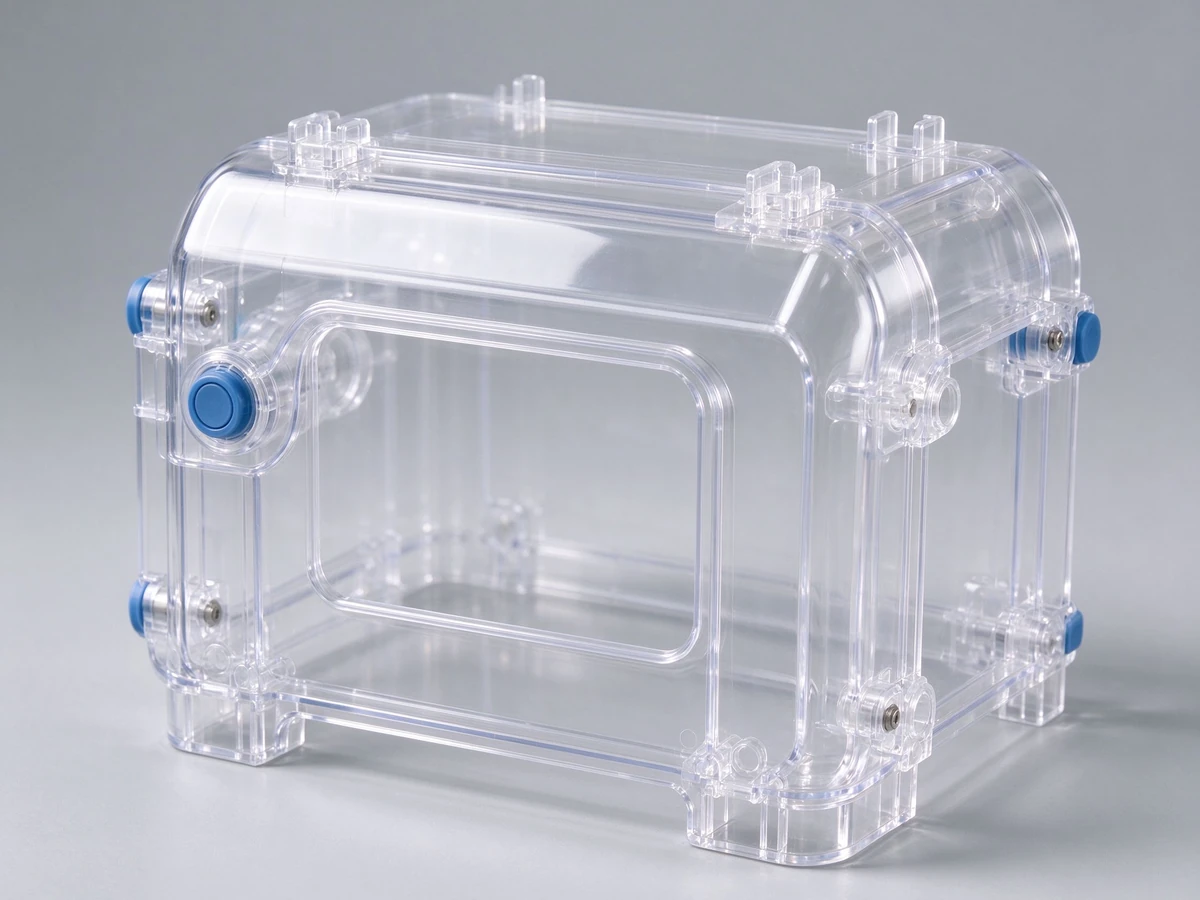
Is moisture a surface problem or a chemistry problem?
With ABS or nylon, wet resin gives you a cosmetic defect. With PC it gives you a chemistry defect, and that difference is the single most important fact in this article.
Polycarbonate is hygroscopic, and the water it holds does not just boil during injection. At melt temperature, water hydrolyses the carbonate linkage: it cuts the polymer chains. Molecular weight falls, and molecular weight is what PC's toughness is built on. The part can look excellent — clear, glossy, dimensionally right — and have lost a large fraction of its impact strength. This is the failure mode that survives a cosmetic inspection and dies in a drop test three months into a product's life, or in a safety guard at the first real impact.
The practical consequence is a number that ABS programmes rarely need: target moisture in the resin at the nozzle of roughly 0.02 percent or less, achieved with a desiccant dryer at 120 °C for 3 to 4 hours with a dew point of about minus 30 to minus 40 °C. PC also re-absorbs moisture quickly once dry, so a hopper feed from a dehumidifying dryer is not a nice-to-have; a batch that dried at 08:00 and sat in a funnel at 15:00 in a humid shop has already failed the specification.
Two rules follow from this. First, dry avant the machine, not more hot on the machine: raising barrel temperature to chase the visual symptoms of wet resin accelerates the hydrolysis you are trying to avoid. Second, if you are allowed to, verify: a loss-on-drying check or a moisture analyser on the resin at the hopper is a cheap instrument compared with a warranty claim on a safety part. Our resin drying guide covers the dryer-side arithmetic; regrind deserves its own paragraph later in this article because for PC it is a moisture question twice over.
What does the process window look like, and what does each edge cost?
Plan against melt 280 to 320 °C, mould 80 to 110 °C, shrinkage 0.5 to 0.7 percent. That looks like a wide window until you see what each boundary takes away.
Melt viscosity in PC is high and strongly shear-thinning: the resin flows better the faster you push it, which is why short shots in PC tempt you into higher speeds rather than higher temperature — and higher speed means higher shear heating, higher residual stress, and in transparent parts, visible flow and orientation. Above about 330 to 340 °C, or after a long residence in an oversized barrel, PC begins to degrade and you get both discolouration (a yellow cast in a clear part) and the same molecular weight loss you get from water.
Mould temperature is the parameter that most changes the part you cannot see. A cold mould gives you a fast cycle and a clear-looking part with high frozen-in stress and weak weld lines. A hot mould at 95 to 110 °C slows the cycle by several seconds and gives you lower birefringence, better gloss, better weld strength, better clarity in thick wall, and better resistance to solvent crazing in service. On optical and safety parts we would rather buy the cycle time than the field failure.
| Paramètres | Planning band | Cost of running high | Cost of running low |
|---|---|---|---|
| Température de fusion | 280-320 C | Yellow cast, haze, degradation, hydrolysis, longer purge | Short shot, high internal stress, visible weld line, poor clarity in thick wall |
| Mould temperature | 80-110 C | Longer cycle, sticking and drag on undercuts, sink at thick sections | Frozen-in stress, crazing risk, weak welds, gloss loss |
| Injection speed | Two or three stages, faster through the thin sections | Shear heating, orientation, flow marks, gate blush | Freeze-off, weld lines at every rib intersection |
| Holding pressure and time | Until gate freeze, typically 60-80 percent of peak | Orientation stress, ejection difficulty, dimensional instability | Sink, void at bosses, weight and dimension drift |
| Screw speed | Moderate, with back pressure just enough for colour | Degradation and hot spots | Colour and melt inhomogeneity |
| Residence time | Keep the barrel sized to the shot | Degradation at every additional minute | Not a real risk |
| Séchage | 3-4 h at 120 C, dew point minus 30 to minus 40 C | Practically none; over-drying is not the failure mode | Hydrolysis, impact loss, silver streak, haze |
The machine-selection consequence is often missed in RFQs: PC's high injection pressures and viscosity mean a press needs both clamping margin and plasticising capacity. A machine that is comfortable on ABS will show it on a 3 mm PC part in the form of a shot-to-shot cushion that cannot be stabilised.
How much internal stress is in the part, and how do you find out?
This is where a PC programme either becomes engineering or stays folklore, because residual stress is invisible on an accepted part and decisive in the field.
Three practical checks, in increasing order of rigour:
Solvent immersion. A controlled dip or swab in a solvent that PC does not dissolve but that promotes crazing in stressed regions — the classic laboratory route uses a hydrocarbon/alcohol blend, done as a witnessed test with defined exposure and a documented pass rule rather than as an improvised shop trick. Stressed areas whiten and craze within seconds to minutes. It is fast, cheap and brutally honest, and it is the test we ask for when a client wants to change a moulding supplier on an existing PC part.
Polariscope or cross-polarised inspection. Two polarising filters, part between them, and the stress appears as coloured fringes. You get a map, not a yes/no, and it is the best tool available for settling an argument about gate position or packing profile. On transparent parts this is the method that shows you the stress ring around every screw boss.
Differential scanning or heat-recovery. Less common in a shop setting: heat the part above its transition and watch it move. If the part moves, the dimension you signed was a temporary dimension.
If the stress is too high, the fixes are in this order of cost-effectiveness: raise mould temperature, reduce holding pressure and extend holding time at lower pressure, increase gate size to lower shear, and then consider a relief (annealing) cycle — typically 110 to 125 °C for one to four hours with slow cooling, held well below the transition temperature and scheduled by wall thickness. Annealing reduces crazing risk and improves dimensional stability; done too hot or too long, it distorts the part or surface-marks it, and on a clear part it can cost you the optical class. It is a real tool, not a default. The design half of stress cracking is treated in how to prevent stress cracking in plastic product design.
Where PC is the wrong material, whatever the process does?
- Sustained contact with strong alkalis, amines, or ammonia-based cleaners. PC is attacked chemically; a bathroom or kitchen cleaning regime will do to a PC part what no impact would.
- Hydrocarbons, ketones, chlorinated solvents and many adhesives and inks — the crazing list. If the part is marked, glued, painted or cleaned after moulding, the chemistry of that step belongs in the material decision.
- Repeated steam autoclaving. Standard PC hydrolyses in steam; if the part must be sterilised, grade selection becomes the whole problem, and for many medical parts the industry has moved to alternatives.
- Long UV exposure uncoated. PC yellows and loses surface toughness outdoors. Hard-coated PC, or PMMA, solves it.
- Abrasive cleaning with a clear requirement. PC scratches far more easily than glass or PMMA. If the part will be wiped with a rough cloth, a hard coat is not optional.
- Food contact with fatty or hot contents in some jurisdictions. Bisphenol-A migration is a live regulatory question for PC in food-contact use; several markets have tightened it sharply. If the part touches food, this is a compliance decision to make with the destination market's rules in front of you, not a moulding decision.
- Notched, thin, high-stress geometry with a safety consequence. PC is tough in a moulded wall; it is notch-sensitive, which is why a sharp corner, an under-cut or a screw-cut thread changes the failure mode.
How clear is clear, and what does the mould have to do about it?
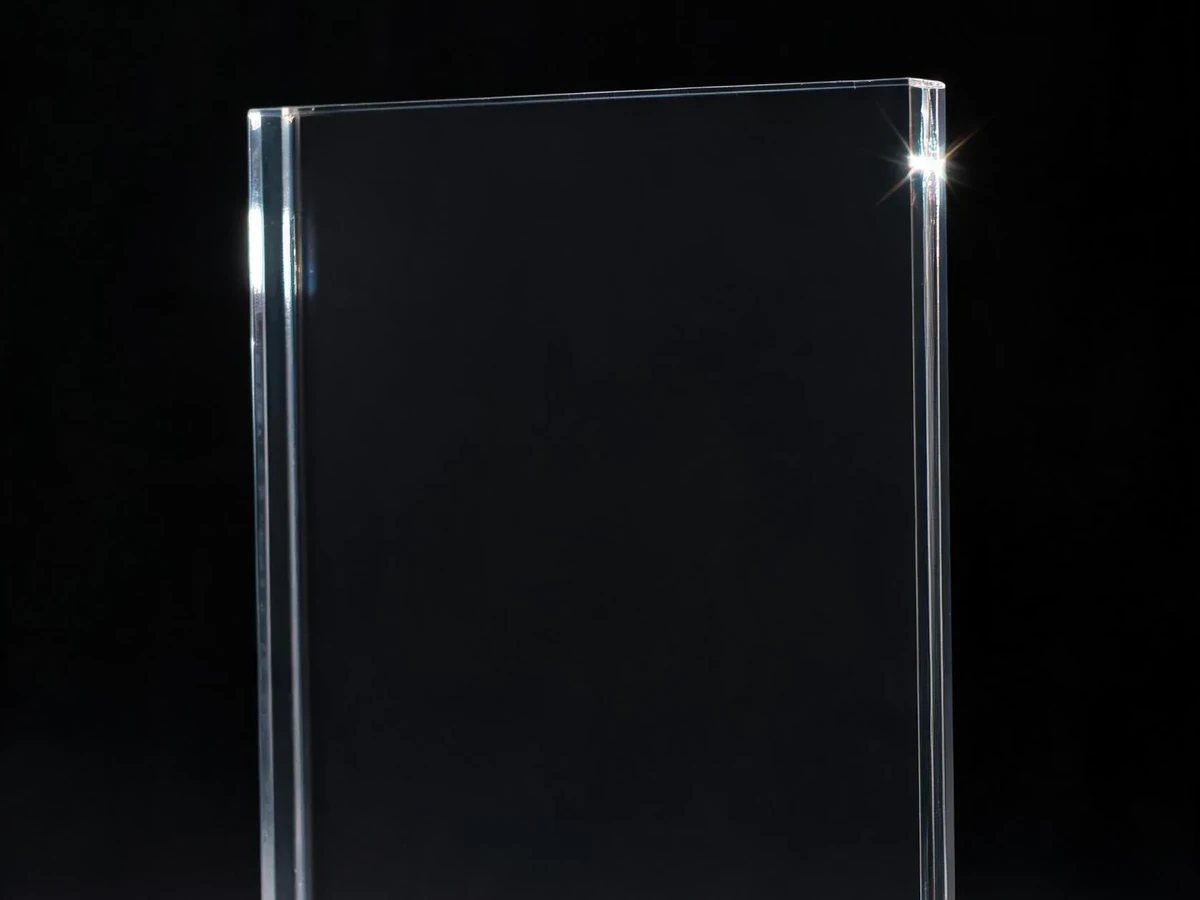
A good moulded PC part transmits roughly 88 to 90 percent of visible light with haze under about 1 percent. Glass is around 91 to 92 and PMMA reaches 92, so PC is already the compromise when clarity is the only requirement — it is chosen over PMMA when the part must also survive impact, and it loses on scratch and on UV.
| Propriété | PC | PMMA | Glass, for scale |
|---|---|---|---|
| Visible transmittance | 88-90 percent | 92 percent | 91-92 percent |
| Haze, well moulded | under 1 percent | under 1 percent | very low |
| Notched impact | Very high, 600-900 J/m | 10-20 J/m, brittle | fails |
| Heat deflection at 1.8 MPa | 130-136 C | 75-100 C | very high |
| UV without coating | Poor, yellows | Bon | none |
| Scratch resistance | Poor, needs hard coat | Modéré | good |
| Chemical crazing risk | Haut | Lower, but solvent-sensitive | none |
| Typical use | Guard, lens, face screen, lamp | Display, daylight lens, signage | optics with weight penalty |
On the mould side, clarity is bought with four decisions: a polished and corrosion-resistant cavity (mirror-polished stainless, typically S136 class for clear work, see our S136 page), gas escape at every last-to-fill point so the air does not compress into a burn or a haze spot, mould hot enough that the melt does not freeze skin-first, and a gate geometry that does not jet. A visible witness line at the gate on a lens is not a cosmetic preference argument, it is an optical defect that shows up as scatter.
What haze actually is, and the six causes behind it, are documented in our haze on high-gloss surfaces article; the clear-parts process discipline as a whole, including drying and contamination control, is in our transparent and translucent parts guide.
What does PC ask of the part design?
The design rules for PC are the standard moulding rules with two words added: no stress concentrators, no trapped stress.
| Design feature | PC-specific rule | Why it is stricter on PC |
|---|---|---|
| Wall thickness | 1.5 to 4.0 mm, uniform; steps graded, never abrupt | Thick clear sections trap sinks and show orientation; abrupt steps concentrate stress and read optically |
| Internal radii | Minimum 0.5 times wall, prefer full wall thickness | PC is notch-sensitive; a sharp corner is where a crack starts, not where it travels |
| Ribs | 0.5 times wall thickness, height under 3 times wall, radius the root | Rib roots are the classic crazing origin, and ribs on a clear face sink visibly |
| Les patrons | 0.6 times wall, cored, with a gusset, height under 2.5 times diameter | A self-tapping screw puts permanent hoop stress in a PC boss, and that is a slow crack waiting for a solvent |
| Screw threads in PC | Prefer a moulded thread insert or a threaded bush, not a self-tapper | Forming a thread displaces material and leaves stress; PC remembers it |
| Snap fits | Moderate deflection strain, generous radius, avoid sharp corners at the root | PC takes a snap well at room temperature but poorly at a cold one, and poorly with a notch |
| Projet | 1 to 1.5 degrees smooth, 2 to 3 degrees textured | PC grips a polished cavity; sticky ejection marks and whitening come from insufficient draft |
| Gate selection | Fan, tab or film on visible and clear parts; keep the gate on the thickest feedable section | Small gates mean high shear, orientation and stress at the gate, visible under polarised light |
| Weld lines | Position them where load does not cross them; expect 50 to 70 percent of base strength at best | A weld in PC is a notch as far as impact is concerned |
| Tolérances | plus or minus 0.05 to 0.10 mm on local features; do not demand it over 200 mm | Shrinkage is modest at 0.5 to 0.7 percent but residual stress keeps moving large parts |
The boss rule is the one worth defending in a design review, because it is where the cheap assembly decision meets the expensive field failure. A sheet-metal screw driven into a PC boss is fast and free at the assembly station; a moulded brass insert, a threaded bush or a ultrasonically staked boss costs a few cents and removes the stress from the joint. Our moulure d'insertion scope exists for exactly this class of joint, and where the insert must also carry a bond or a seal, the overmolding bond design guide covers what actually holds.
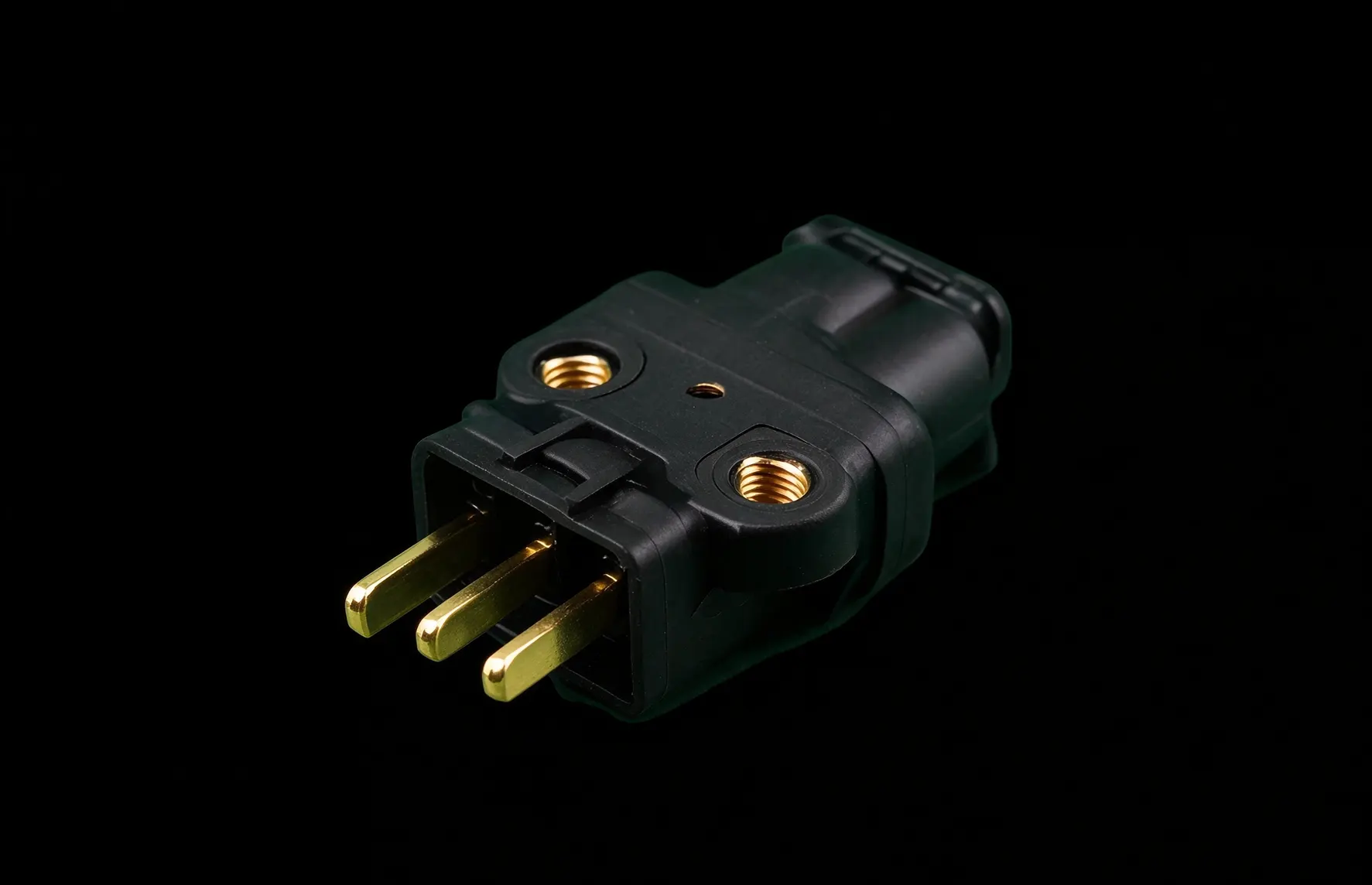
What does the tool have to be made of, and how is it vented?
Steel. PC moulds are usually run in hardened or pre-hardened tool steel with a corrosion-polish capability: H13 where the tool is hot-runner fed and life is long, S136 or a comparable stainless for clear parts and for moulds that must survive a polish between campaigns. Our pages on H13 et S136 cover the property differences; the practical rule is that a clear part is a stainless-cavity decision and a glass-filled PC part is a hardened-gate-insert decision.
Venting. PC's viscosity means the air in front of the flow does not get pushed aside gently — it gets compressed, and it burns. Vent the parting line at every last-fill point and at the ends of ribs, 0.020 to 0.025 mm deep for PC, and treat a persistent burn at a fixed location as a venting problem before you treat it as a temperature problem.
Cooling. A mould that must sit at 80 to 110 °C with even temperature across a large cosmetic face needs conformal or closely-spaced cooling at the thick features; a cold spot opposite a hot spot is a sink mark with a schedule attached. Sink control on PC bosses is covered in our sink mark guide.
Ejection. PC sticks to polished steel more than most amorphous resins, especially at high mould temperature. Polish direction matters, draft matters more, and a mould release agent is a last resort on a clear part because it plate-out onto the cavity and becomes a haze source three hundred shots later.
Hot runner. For PC, hot runners are common and behave well, with two cautions: the material's residence sensitivity makes colour changeover a planned operation, and every dead corner becomes a char source that shows up as a black speck in a transparent part.
Can PC be reground, and what about recycled PC?
Only on the same terms that PC is dried: strictly. Clean, single-family sprue and runners from a non-critical part can go back at a modest proportion, commonly 10 to 15 percent by planning assumption and confirmed by trial, but every regrind cycle adds surface area, which means faster moisture pickup, which means more hydrolysis at the nozzle. Ground flake that has sat open in a shop for a day is worse than virgin resin from a sealed bag.
Post-consumer PC is available and improving, and the honest engineering position is the same as for any secondary material: the average numbers look close, the scatter is wider, and PC's whole value proposition is toughness, which is the property most sensitive to molecular weight history. Ask for notched impact distribution, colour lot consistency, and the source stream. If the part is a safety guard or a lens, run the regrind question as a test programme rather than a substitution. Our regrind guide sets out the arithmetic for how many cycles a resin can be given.
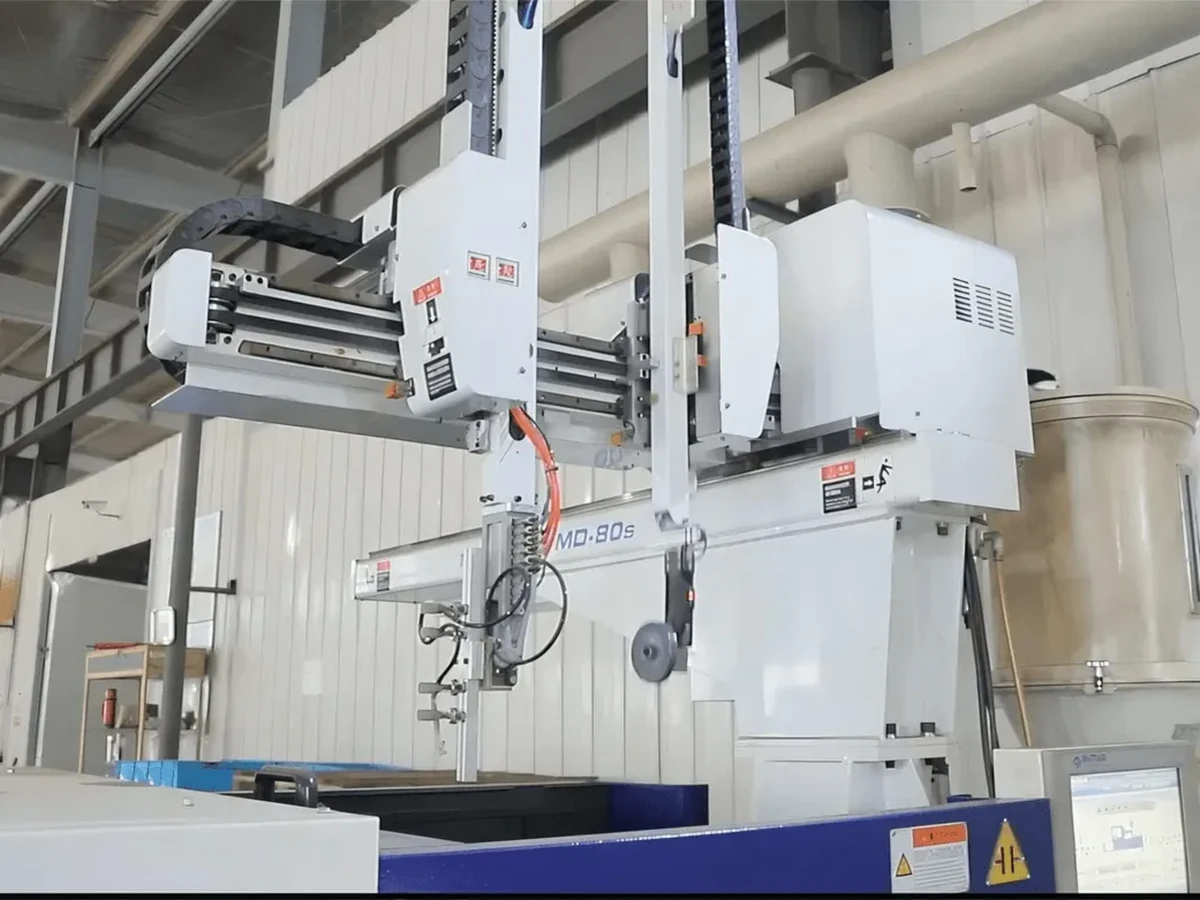
How is a PC part inspected before it ships?
Four checks, and only one of them is the drop test.
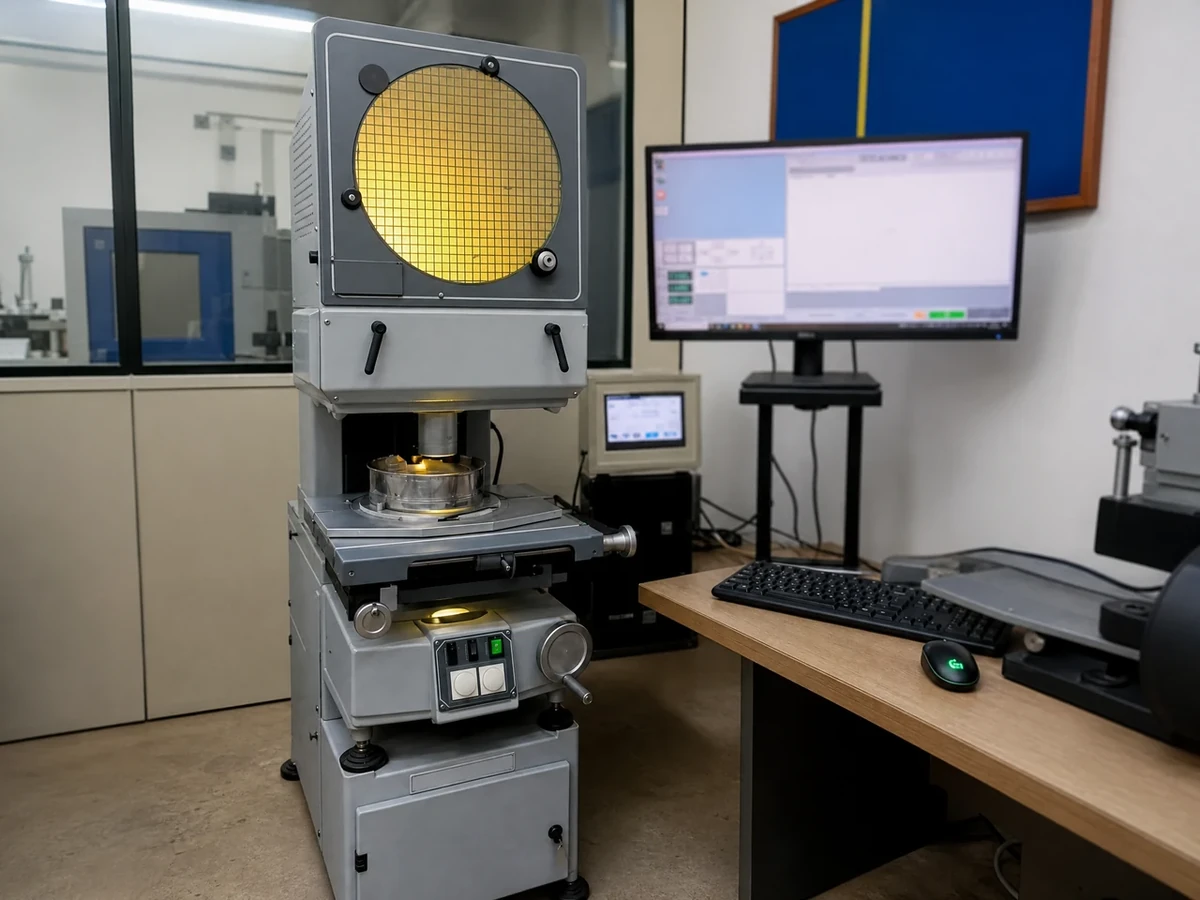
Optical, on the parts that need it. Transmittance and haze measured with an integrating-sphere instrument to a stated standard, against a limit, on a stated sampling plan — not compared to a sample on the desk. Where a specification says "clear, no visible defects", nobody has specified anything. Our transparent parts guide argues the same point from the drawing side, a measured number, not an opinion, is where that argument ends.
Residual stress. Polariscope map on the first article, plus the solvent test with an agreed pass rule, on any part that will see a chemical, a coating, an adhesive or a screw.
Impact, on the actual geometry. Test the moulded shape, not a dumbbell. A PC enclosure can pass on a test bar and fail at its own screw boss, because the boss is the notch.
Dimensional, after a condition soak. Measure PC parts after they have rested at room temperature, and after any annealing cycle, because a dimension taken hot off the machine is a promise the part does not intend to keep. PC's shrinkage behaviour and the reasons a measured part moves are treated in uneven shrinkage and warpage.
Where PC earns its price, and where a blend is the better buy?
PC is chosen when the part must be see-through and survive being hit, or must be structural and survive heat and impact in the same wall: machine guards and enclosure windows, face screens and protective visors, lamp lenses and lighting diffusers, power-tool housings, medical device housings and diagnostic components, electrical connectors and insulating parts, instrument bezels, and the transparent covers on everything from ticket machines to charging cabinets.
| If the real requirement is | Reach for | Because |
|---|---|---|
| Maximum clarity, low cost, indoor | PMMA | Higher transmittance, better UV, far cheaper, and it shatters |
| Clarity plus impact | PC or hard-coated PC | The only economical clear option that survives a dropped tool |
| Heat plus toughness, opacity acceptable | PC/ABS or PC/PBT | Easier to mould, less notch-sensitive, cheaper than PC |
| Chemical attack from alkalis or fuels | PBT, PA with care, or metal | PC will craze or hydrolyse |
| Repeated steam sterilisation | PP, PES, or a dedicated grade | Standard PC hydrolyses in steam |
| Stiffness at temperature, weight not critical | PC plus glass, or PBT plus glass | Higher modulus, but abrasion changes the tool |
| Outdoor clear part with no coating | PMMA or coated PC | Uncoated PC yellows |
The blend worth knowing best is PC/ABS: it keeps much of PC's heat and impact behaviour, moulds at 230 to 260 °C in a 50 to 90 °C mould instead of PC's 280 to 320 °C and 80 to 110 °C, shrinks at a similar 0.5 to 0.8 percent, costs less per part on a fast cycle, and is dramatically less notch-sensitive. A large fraction of the parts that are specified as PC are better served by PC/ABS, and the ones that are genuinely impact-critical or optically clear are the ones that need PC. Our PC material page has the grade-level data, and if you are deciding between the families the plastic alloys overview is the shortest route through the blend landscape.
How does this sit inside what Ideal Pro does?
We mould PC and PC blends from the same line that runs ABS, nylon, POM, PMMA and the TPE families, in single-cavity and multi-cavity tooling, with hardened or stainless cavities where clarity and campaign length demand it, and with drying and contamination control treated as process parameters rather than as good intentions. That includes the mixed-material work PC usually ends up in: overmolded seals on a PC housing, metal inserts for repeated assembly, and two-shot and insert assemblies where the plastic and the hardware have to arrive together.
Tell us three things when you send the part: whether it has to be optically clear, what chemicals and temperatures it will meet in service, and what happens when it is dropped. From those three answers we can tell you whether PC is the right resin at all, what shrinkage we would cut to, what drying and stress-control regime the part implies, and where an annealing cycle would have to be scheduled. That conversation is free; a re-cut cavity is not.
Phone and WhatsApp: +86 156 0682 1288 · Email: [email protected] · Request a quote
FAQ
What is the process window for polycarbonate injection moulding?
Why must PC be dried better than other resins?
How do I stop polycarbonate parts cracking after moulding?
Is PC or PMMA better for a clear part?
Can PC be used in a dishwasher or with steam sterilisation?
Does PC shrink much, and can it hold tight tolerances?
Is recycled PC acceptable?
À propos de l'auteur

Alex Yu
Ideal Pro Manufacturing
Alex est le cofondateur d’Ideal Pro, mais lorsqu’il ne supervise pas des projets clés ou ne dirige pas l’équipe technique, vous le trouverez sans doute en train de faire une longue balade à vélo, à la recherche du meilleur café de la ville, ou en train de planifier sa prochaine aventure de voyage. Fort de plus de 20 ans d’expérience dans le commerce international et la gestion de projets, il a tout vu : délais serrés, problèmes techniques complexes et tout ce qui se trouve entre les deux. Il est convaincu qu’un travail de qualité naît d’un esprit bien reposé et d’une bonne tasse de café, et il apporte cette même curiosité et ce même souci du détail à chaque projet qu’il entreprend. Lorsqu’il n’est pas au bureau, il se trouve généralement en plein air, à explorer de nouveaux endroits et à glaner des anecdotes à partager.

 English
 French
 Dutch
 German
 Japanese
 Korean