 Deutsch



Black oxide is the cheapest black finish on steel and the one most often specified for the wrong reason. The drawing says "black", the RFQ says "black oxide", the parts arrive black, and six weeks later the ones in the warehouse are spotted with rust while the ones in the assembly are perfectly fine. Both batches passed. The difference was what nobody wrote down: which black oxide process ran, and what was put on top of it.
This guide is written for the person who has to make that call. It is deliberately narrow about what black oxide can do, because the finish's real value is dimensional honesty, low glare and low cost — not corrosion protection. We mold and machine mixed assemblies for clients whose steel inserts and their plastic housings have to arrive finished at the same time, so the numbers below are the ones we plan against, and every working assumption is labelled as one.
Why Trust This Black Oxide Guide?
What we are entitled to say: we route steel hardware to hot black oxide on production work, so the failure modes below are ones we have had to explain to a client, not ones we read about. Numbers given as bands are planning values for finishing selection and are labelled as such; the specification revision called out on your drawing always outranks them. Author: Alex Yu, co-founder of Ideal Pro, 20+ years across injection moulding, machining and finishing programmes, Huzhou facility.
What actually forms on the steel when it is blackened?
Nothing is deposited onto the part. That is the single most important fact about the finish and the reason it behaves the way it does.
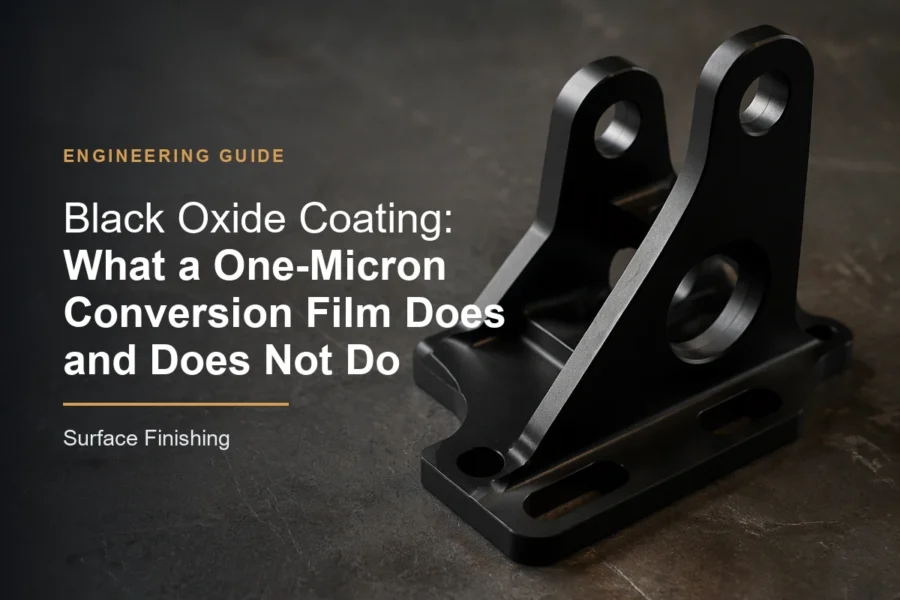
Black oxide is a conversion coating: the alkaline salt bath reacts with the iron in the surface and turns the outermost layer of your part into magnetite, Fe3O4. The film grows out of the substrate rather than sitting on it, which is why it does not peel, why it does not change a fit in any measurable way, and why it cannot be "thickened up" on request. On a properly run hot bath the film is typically 0.2 to 1.5 micrometres; on a room-temperature process it is commonly under 1 micrometre. A human hair is 60 to 80 micrometres. You are working with a layer that is roughly one fiftieth of a hair.
Magnetite is also why the finish looks black rather than grey: it absorbs most of the visible light that reaches it and, because the surface it forms on is microscopically rough, it scatters what little it reflects. That is the anti-glare property that makes black oxide the default on surgical instruments, optical hardware and instrument brackets.
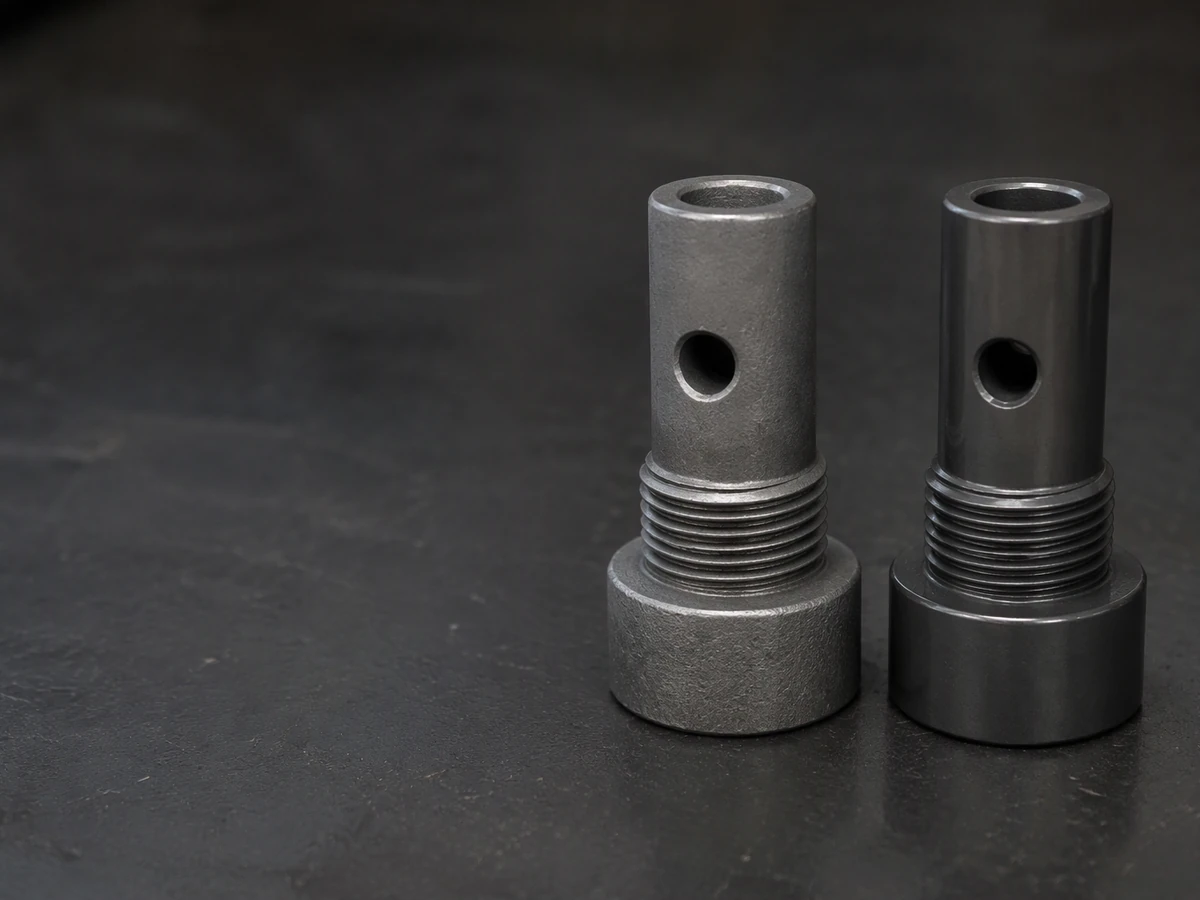
The catch is porosity. Magnetite is not a continuous barrier; the converted layer is spongy at the microscale, and that same porosity is what makes the oil or wax supplement work — the carrier soaks in and the film holds it. It is also why a part that leaves the bath without a supplement will begin to flash-rust within hours in a humid shop. If you have ever seen a black part arrive dry and dull-grey rather than black, that is an unsealed film that was never oiled, or was washed and re-dried without going back through the supplement.
| What you are specifying | Typical film thickness | What it is made of | Barrier behaviour |
|---|---|---|---|
| Hot black oxide, oiled | 0.5 to 1.5 um | Magnetite (Fe3O4) grown from the substrate | Thin, porous; corrosion value comes mostly from the oil |
| Mid-temperature black oxide, oiled | 0.3 to 1.0 um | Magnetite | Same mechanism, usually less dense, more dependent on supplement |
| Room-temperature black oxide | 0.2 to 0.8 um | Mixed oxide/selenide conversion product | Easiest to rub through, weakest abrasion behaviour |
| Black zinc plating (for contrast) | 5 to 25 um zinc + chromate | Metallic layer deposited on the part | True barrier, sacrificial to the steel |
| Zinc phosphate + oil (for contrast) | 5 to 15 um | Crystalline phosphate conversion layer | Deliberately porous, built to hold oil and paint |
Read that table as the whole decision in miniature: black oxide buys you geometry, appearance and a little protection. If the part needs a barrier, a barrier process is what it needs.
Why do engineers choose black oxide over a thicker finish?
Because on a machined steel part, thickness is not free.
Fit survives. A shaft at 6 mm h7 carries a tolerance of roughly plus 0 / minus 8 micrometres. A 10 micrometre plating on that diameter is larger than the entire tolerance band, so plated functional diameters are usually machined undersize, plated, then measured with the knowledge that the fit was never as-built. Black oxide at 0.5 to 1.5 micrometres disappears inside that band. Threads behave the same way: a blackened M6x1 bolt still screws into a nut that was not re-tapped, which is exactly why fasteners, dowel pins, guide posts, ejector sleeves and punch shanks are the classic black oxide population. In our own shop the same logic applies in reverse: a molded-part cavity dimension cannot be corrected after the fact, so we are allergic to finishes that lie about size.
No masking tax on small features. Where a plating needs holes and threads stopped out with wax or caps, black oxide is generally processed as-painted-by-immersion, so the cost line does not carry a masking operation for every internal bore. Where masking is genuinely needed — a bonded face, a bearing surface, an adhesive zone — you pay for it explicitly, and you should.
No hydrogen-embrittlement argument. Electroplated zinc on a part hardened above roughly 1000 MPa tensile (many socket-head screws, springs, punch components) creates a real risk of delayed hydrogen embrittlement failure, and the standard answer is a bake within a few hours. A chemical conversion process does not cathodically charge the part with hydrogen, so high-strength hardware that cannot be baked can often be blackened safely. That alone settles some RFQs.
Conductivity and grounding stay usable. The film is far thinner than a plating, so a earth path across a blackened mating surface usually remains within the resistance band designers accept. If your drawing demands a specific milliohm figure, measure it on finished parts — do not assume either direction.
Cost and lead time. Immersion blackening is one of the lowest line-items in the finishing catalogue on a per-kilogram basis, it runs in barrels in volume, and it rarely becomes the thing that holds a shipment.
What it is not: a wear coating, a barrier coating, or a cosmetic clearcoat. Magnetite burnishes off on a rub-through contact, and it will not stop a salt spray test on its own.
How much corrosion protection is really there?
Enough for indoor handling and assembly, not enough for weather, and the honest answer depends almost entirely on the supplement.
Unsealed black oxide in a humid shop will show flash rust within a day or two. That is not a defect; that is the film. With a properly applied oil or water-displacing supplement, a blackened part comfortably survives normal indoor storage and the humidity of a shipping container — that is the reason the finish exists on tools, machine hardware and internal brackets. Push past that envelope and you are relying on a consumable that is slowly leaving the part.
The number most buyers want is an ASTM B117 salt-spray hour count. Here is the disciplined way to think about it: black oxide has no meaningful intrinsic salt-spray rating, and any hour figure you are given belongs to a specific supplement tested on a specific steel with a specific porosity. Two suppliers both quoting "black oxide, 96 hours" may be describing one with a wax supplement and a dense mid-temperature film and one with a light dip oil. Ask what the hours are after, and what the acceptance criterion is (red rust? 5 percent red rust? white rust?).
Where a real number matters, we would rather hold the buyer to a test than to a finish name: specify the supplement, then specify the damp-heat or B117 exposure and the pass rule, and run the test on production parts, not on a coupon.
| What is actually on the part | Realistic indoor behaviour | What to write on the drawing | What it will not do |
|---|---|---|---|
| Black oxide, no supplement | Flash rust in a day or two | Never specify this, not even "temporary" | Survive a week of humidity |
| Black oxide + rust-preventive oil | Months of indoor storage and handling | "Black oxide, oil supplement, non-drying" | Survive wash-down, UV, condensation cycles |
| Black oxide + wax or dried-film supplement | Better container-shipping behaviour, fingerprints more visible | Name the supplement type and whether it must be removed before assembly | Bond, paint or plate without removal |
| Black oxide + painting over a cleaned surface | Real barrier, this is the combination that lasts | "Black oxide for appearance, paint over, degrease before coating" | Be cheap — you now pay twice |
| Black phosphate + oil (alternative) | Similar look, better oil reservoir | Specify phosphate if the goal is wear/oil retention, not appearance | Hold a cosmetic black |
One consequence people get caught by: the oil that protects the part is the same oil that ruins a glue joint, a paint coat or a wire-bonded terminal. If the part is downstream of an adhesive or coating operation, say so on the drawing and ask for a no-supplement or removable-supplement route with an immediate assembly step, or the failure will be a peel test and not a rust test.
Hot, mid or room-temperature — which one is on the quotation?
Three processes are sold under one name, they do not produce the same part, and the price gap between them is often smaller than the performance gap.
Hot black oxide runs an alkaline bath of nitrate/nitrite salts at roughly 135 to 145 °C, near the boiling point of the solution. The parts are dipped, converted, rinsed hot, then oiled. Because conversion happens on a hot, clean, wet surface, the film is the most consistent of the three, the colour is the deepest, and throughput on barrel loads of small hardware is excellent. The cost that is not visible on the invoice is the drag-out: every part carries hot caustic solution into the rinse tank, so the rinse cascade and the waste treatment are what separate a good job shop from a cheap one.
Mid-temperature black oxide sits around 90 to 120 °C, needs no boiling bath, fumes far less, and is chosen by shops that cannot justify the ventilation and fume handling of a hot line. Done well, the appearance is close to hot black. Done without control, the film is thinner, the colour browns under a lamp, and the corrosion behaviour leans harder on the oil.
Room-temperature black oxide works at 20 to 40 °C with a chemically different bath (selenium-based products are common). It is the version that can be done in a small workshop or a repair shop, and it is the version most likely to be what you actually received when nobody told you. The colour can be excellent on day one. The film is the least abrasion-resistant of the three: rub the same edge ten times with a thumb and a cold-blackened part shows bright metal earlier.
How to ask, in one line on the drawing: "hot alkaline black oxide, magnetite conversion, oil supplement; no room-temperature substitution without written approval." If the shop quotes mid-temperature and you accept it, that is fine — but it should be a decision, not an accident.
| Attribute | Hot (135-145 C) | Mid (90-120 C) | Room temperature (20-40 C) |
|---|---|---|---|
| Conversion product | Magnetite | Magnetite | Mixed oxide/selenide |
| Colour depth and uniformity | Best | Gut | Good at first |
| Rub-through resistance | Best of the three | Mitte | Weakest |
| Corrosion help from film alone | Niedrig | Niedrig | Very low |
| Blind-hole salt carry-over risk | Highest (hot drag-out) | Mitte | Lowest |
| Batch economics on small hardware | Ausgezeichnet | Gut | Poor at volume |
| Where you usually meet it | Fasteners, tooling, production hardware | Job shops without boiling lines | Repair, one-offs, hobby and field work |
Which materials can be blackened and which cannot?
The process family is ferrous. Everything else is an adaptation, and the adaptations are where the surprises live.
Carbon and alloy steels are the home ground: 1045, 4140, 4340, 8620, O-1 and A-2 tool steels all convert cleanly to magnetite and take a uniform black. Surface condition matters more than alloy: a ground or polished surface blacks deeper than a heavily scaled one, and a part that has been tumbled to a smear finish can come out grey-patched because the media closed the surface.
Cast iron converts, but the graphite flake network underneath does not convert with it. Grey iron parts frequently come out with a faintly mottled, slightly grey-black appearance, and the graphite can leave a smut that wipes off as black dust. If the appearance of the iron casting matters, tell the finisher what the material is — do not let them find out from the swarf.
Stainless steel is the most common misunderstanding. The chromium oxide passive layer that makes stainless corrosion-resistant is exactly what refuses to convert in a standard blackening bath. Black stainless is real, but it needs a dedicated activated process (often sulphide-based rather than the alkaline nitrate bath) — the aerospace way to describe the requirement is to call out the black oxide specification for stainless rather than the plain steel one, and to name the revision. Cost is higher, the film is thinner still, and corrosion behaviour is no better than on carbon steel. If someone quotes you "black oxide" on 304 at carbon-steel prices, ask which bath.
Copper and copper alloys (brass, bronze) blacken to cupric oxide in their own cold or warm solutions; the finish is attractive and used on hardware and instrument parts, corrosion value again comes from a supplement, and electrical contact resistance changes — which matters on terminals.
Zink can be blackened in a dedicated zinc blackening solution, typically warm rather than hot, and this is often confused with black zinc plating. They are not the same thing: plating deposits 5 to 25 micrometres of zinc with a black chromate on top and brings genuine sacrificial protection; zinc blackening converts the existing zinc surface and gives you mostly colour.
Aluminium cannot be black oxidised in any practical sense, and nobody should try. The black finish on an aluminium part is black anodising: an electrochemically grown oxide, typically 5 to 25 micrometres, dyed and sealed. It is a better finish in almost every performance respect, costs more, and adds enough growth that a close fit can change. If your drawing says "black oxide" on an aluminium feature, that is a drawing error and the shop has to ask.
Plated and hardened-with-oxide surfaces do not blacken predictably. Nickel-plated, chrome-plated, zinc-plated and passivated surfaces have no free iron to convert, so the part either stays bright or takes a smoky stain that washes off.
| Substrat | What forms | Practical verdict | Watch out for |
|---|---|---|---|
| Carbon / alloy steel | Magnetite | Straightforward, the default case | Scale, smeared tumble finish |
| Cast iron | Magnetite over graphite | Acceptable, colour is softer | Graphite smut, mottling |
| Tool steel | Magnetite | Good, common on punches and dies | Recent grinding burns take colour differently |
| Stainless 303 / 304 / 316 / 17-4 PH | Mixed oxide or sulphide, dedicated process | Yes, but only with the stainless process named | Cheap quote usually means the wrong bath |
| Brass / bronze | Cupric oxide | Good appearance finish | Contact resistance on terminals |
| Zinc die-cast or plated zinc | Zinc oxide, warm process | Colour only, not protection | Confusion with black zinc plating |
| Aluminium | Nothing useful | Use black anodising instead | Drawing that says "black oxide" on aluminium |
| Nickel or chrome plated | No conversion | Not viable | Smoke that wipes off |
How does black oxide compare with the other finishes on the same RFQ?
This is the table we wish appeared on more drawings, because most black-oxide arguments are really finish-selection arguments in disguise.
Cost bands below are relative, not prices: L is the cheapest practical route for a barrel of small steel parts, M adds either process steps or materials, H adds masking, fixtures or multiple passes.
| Finish | Build on the part | Corrosion, honestly stated | Appearance | Cost band | Fit-critical parts |
|---|---|---|---|---|---|
| Black oxide (hot, oiled) | 0.2 to 1.5 um | Low; supplement-dependent | Deep matte black | L | Yes, no re-sizing |
| Black phosphate + oil | 5 to 15 um | Low to moderate, good oil reservoir | Dark grey to black | L to M | Marginal |
| Black zinc plating + black chromate | 5 to 25 um | Good, sacrificial | Satin black, sometimes iridescent | M | No — machine undersize |
| Zinc flake (Geomet-type) | 5 to 15 um | Very good, no embrittlement issue | Silver-grey to black | M to H | Usually yes, thin variants |
| Electroless nickel | 5 to 25 um | Very good | Bright to satin | H | No |
| Powder coating | 50 to 150 um | Very good | Any colour, textured options | M | No, and threads must be masked |
| Passivation (stainless) | Under 1 um, no added film | Restores the stainless passive layer | No colour change | L | Yes |
| Black anodising (aluminium only) | 5 to 25 um growth, roughly half in, half out | Gut | Black, matte to satin | M | Borderline, check fits |
| Oil only / no finish | Nil | Days | Grey | L | Yes |
The short version: black oxide loses to black zinc on corrosion and beats it on dimensional honesty, on high-strength hardware that cannot be baked, and on price. Where the part will be painted, phosphate is the better skeleton under the paint because it holds more oil and grips the coating.
What has to go on the drawing so black oxide arrives right?
A black oxide callout that consists of the words "black oxide" leaves every real decision to whoever happens to run the batch. Six lines cost nothing and remove most of the arguments.
| Line on the drawing | What to write | Why it earns its place |
|---|---|---|
| Prozess | Hot alkaline black oxide, magnetite conversion; room-temperature substitution only by approval | Fixes film type, colour durability and rub-through behaviour |
| Standard and revision | The customer-facing spec name and revision, or your own internal standard | A revision change can move the pre-treatment, not just the colour |
| Supplement | Oil type or "no supplement, ship within N days, assembly is within M days of finishing" | Decides both corrosion and whether the part can be bonded or painted |
| Masking / protected features | List every bore, thread, glue face, bearing surface, witness mark and gauge diameter | Anything unlisted gets the same finish, including the surface that must stay bare |
| Radii and edges | Deburr radius, no sharp edges on handled faces | Sharp edges carry smut and wipe bright first |
| Blind features | Vent or drain holes for every blind hole; state max depth or require through holes where possible | Trapped bath and rinse chemistry is the source of the rust that appears a week later from inside a hole |
| Inspection | Visual against an approved first article plus functional gauge after finishing | A gauge check after finishing is the only real proof that the fit survived |
Two of those lines are worth expanding because they cause the expensive failures.
Blind holes. Barrel-processed parts swallow bath solution and rinse water. A 4 mm hole 20 mm deep with no vent will hold caustic solution inside it after the part looks dry, and the corrosion that follows appears after assembly, which is the worst possible time. If the geometry is yours to change, a through hole or a small cross-drilled vent costs nothing at the CAD stage and saves a field complaint.
Protected faces. The list of faces that must stay bare is longer than most designers expect: bonded or welded areas, the tapered seat of a locating pin, a ground bore that a bush press-fits into, witness marks, resistance-welding contacts, and anything that sees a two-part adhesive. Specify them and expect masking. Note that moulding meets the same problem from the other side - Einlegeleiste exists because a machined or plated steel insert can be locked into the plastic instead of bonded to it afterwards, and the finish on that insert then governs pull-out strength as much as corrosion.
Where is black oxide the wrong answer?
It is faster to list the disqualifiers than the applications.
- Outdoor exposure with no topcoat. UV, rain and condensation cycles will remove the oil and the flash rust will start at the edges. Use black zinc, zinc flake, powder, or paint over a cleaned conversion surface.
- Marine or de-icing salt. Do not argue with it. Specify a barrier system and test it.
- Wear faces and galling-prone contacts. The film is a micrometre or two; a sliding contact burnishes through it and the released oxide can act as an abrasive in a tight slide. If the requirement is anti-galling on a sliding steel pair, a lubricant or a different material combination is the answer.
- Any downstream bonding, overmolding, painting or printing. The protective oil is a release agent from the point of view of an adhesive. If the steel part is going into a mould to be overmolded, or is going to be glued into a housing, either ask for a no-oil route with immediate use, or plan a degrease and verify bond strength on finished parts. The adhesion mechanics are covered in our overmolding bond-design guide.
- A-class cosmetic surfaces that will be handled. Black oxide with an oil supplement shows fingerprints, and the colour is not as stable as a coating under repeated handling.
- Food contact, skin contact in a regulated device, or anything requiring a biocompatibility route. The film plus the oil is not a compliant surface; the finish is also not cleanable to a validated state.
- Aluminium. Black anodising, full stop.
- Parts that must be welded after finishing. The conversion film and the oil both poison a weld and the resulting porosity; weld first, finish after, or mask the weld zone.
How is black oxide inspected and accepted?
Colour is subjective and rust is not, so separate the two checks.
Visual. Agree a first-article reference before production and keep the physical sample, because "uniform black" cannot be adjudicated from a word. Legitimate variation exists on a barrel load: parts against the barrel wall can be slightly lighter where they shielded each other. Reject blotchy, rainbow, brown or grey patches, and reject any visible red rust, which means either no supplement or a bath that ran out of conversion capacity.
Wipe test. A firm wipe with a white tissue should not lift black powder. A light grey shadow is normal for a loose surface residue; a black smear that comes off in quantity means a weak, poorly converted or over-consumed film.
Dimensional. Measure the critical features after finishing, with the functional gauge where there is one. Threaded parts should be gauge-checked post-process, since swarf, smut and film can all sit in a thread.
Corrosion, when the requirement is real. Fix the supplement, then run the stated test — ASTM B117 exposure or a damp-heat cycle — with a written pass rule. Also confirm what happens after a solvent wipe, because that approximates handling and cleaning in the field far better than a virgin coupon.
The one that surprises people: rub-through on the assembly line. Ask for the part to be handled by an operator in gloves for ten minutes and look at the finish on the highest-wear edge. If the wear pattern matters, the finish is wrong and you want a plating or a coating, not a tighter AQL.
| What you see | Usual cause | What to change |
|---|---|---|
| Red rust spots on arrival | No or insufficient supplement, damp packing, trapped rinse water | Name the supplement; add vent/drain; VCI packing, dry desiccant |
| Brown or olive tint | Weak bath, low temperature, exhausted conversion salts | Require hot process and bath control records |
| Grey patches on a tumbled part | Smear layer closed the surface | Change deburr method or add a light etch/blast before blackening |
| Rainbow sheen | Rinse residue or reaction with a previous bath | Better rinse cascade, check drag-out between tanks |
| Black powder wipes off | Over-conversion, smut, missing rinse | Reduce conversion time, add rinse, require wipe test |
| Bright wear at edges | Handling after finishing | Racking instead of barrel, packing protection, or a harder finish |
| Blind hole rusts from inside a week later | Trapped chemistry | Vent or drain the feature, or specify through-holes |
What does it cost and what does it do to the schedule?
Black oxide is one of the cheapest line items in a finishing package, and the honest structure of the quote is worth understanding so you can read the number rather than argue with it.
The base charge tracks batch volume and weight, not piece count: a barrel of 5,000 small brackets is cheaper per piece than a barrel of 200 of the same brackets half-filled, because the tanks, the labour and the waste treatment are per load. Above the base you pay for three things: racking (a part too delicate, too large or too blind-holed for a barrel has to hang on a rack, and that is per part), masking (per piece, per feature, and the most common reason a black oxide line doubles), and the supplement (cheap as a material, but a dried-film or military-grade supplement can add a dwell, a bake and a handling step).
Sequence it properly. Heat treatment before blackening, always; grinding and lapping before blackening if the surface has to be sound; and any inspection of critical dimensions after blackening, because that is the last point at which the part is as-shipped. If the parts are also going to be CNC machined or formed in Blechbearbeitung before they go to the finisher, the deburring standard agreed before finishing matters more than the finishing itself.
Schedule-wise, a barrel load adds a handling hand-off, so plan a few working days at the finishing supplier plus transit both ways; in practice the variability comes from that hand-off, not from the bath, which takes minutes. Where a mixed bill of materials has to land together - steel brackets, machined inserts, moulded housings - one party owning the finishing routing beats three suppliers each holding a piece of the date. The plastic-side equivalent of this conversation is our surface finishing for plastics white paper.
How does black oxide sit inside Ideal Pro's scope?
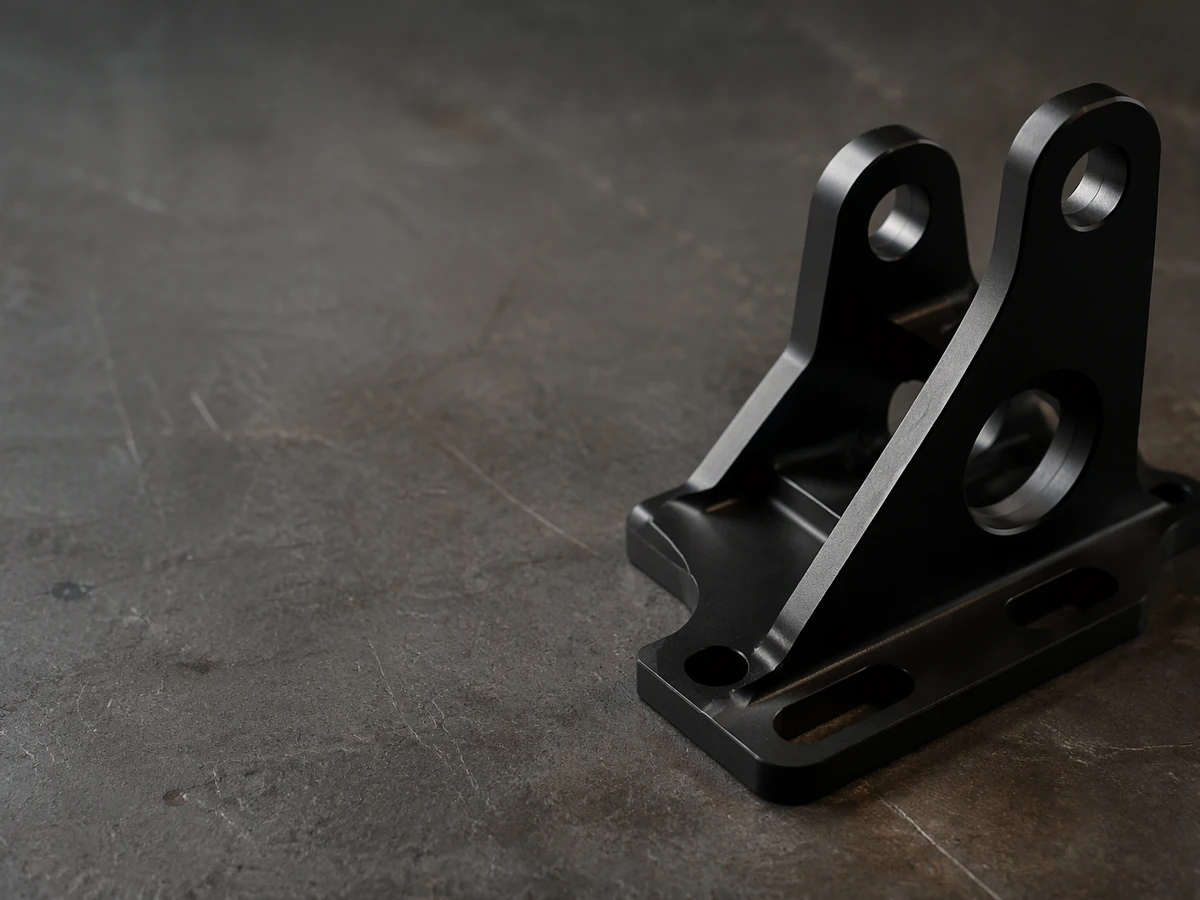
We offer black oxide as a hot alkaline conversion process for steel and iron, delivered against CNC-Bearbeitung und Blechbearbeitung work, listed with the rest of the finishing options on the surface finishing page alongside anodising, alodine, passivation, plating, powder coating, painting, electrophoresis, SPI moulding finishes and the rest. The parts we blacken most often are the hardware inside an assembly: bracket plates, shafts, spacers, press-fit and overmolded inserts, fixture frames and optical instrument housings where glare is a defect.
Send us the drawing with the six callout lines above filled in, plus the material and the quantity per batch, and say what the part touches in service — indoor rack, wash-down area, coastal site, adhesive joint, or nothing at all. We will come back with whether black oxide is the right finish at all, which supplement we would specify, what has to be masked, and the price as a separate line from the machining so you can see what the colour actually costs.
Phone and WhatsApp: +86 156 0682 1288 · Email: [email protected] · Angebot anfordern
Häufig gestellte Fragen
Is black oxide a coating or a conversion treatment?
How thick is a black oxide finish?
Does black oxide prevent rust?
Can you blacken stainless steel?
What is the difference between black oxide and black zinc plating?
Can you paint or glue over black oxide?
How do I write a black oxide requirement on a drawing?
Über den Autor

Alex Yu
Ideal Pro Manufacturing
Alex ist Mitbegründer von Ideal Pro, doch wenn er nicht gerade wichtige Projekte beaufsichtigt oder das technische Team leitet, trifft man ihn wahrscheinlich auf einer langen Radtour, auf der Suche nach dem besten Kaffee der Stadt oder bei der Planung seines nächsten Reiseabenteuers. Mit über 20 Jahren Erfahrung in den Bereichen internationaler Vertrieb und Projektmanagement hat er schon alles gesehen – enge Fristen, knifflige technische Probleme und alles, was dazwischen liegt. Er ist davon überzeugt, dass großartige Arbeit von einem ausgeruhten Geist und einer guten Tasse Kaffee entsteht, und er bringt dieselbe Neugier und Liebe zum Detail in jedes Projekt ein, das er übernimmt. Wenn er nicht im Büro ist, befindet er sich meist irgendwo im Freien, erkundet neue Orte und sammelt Geschichten, die er gerne weitergibt.
 English
 French
 Dutch
 German
 Japanese
 Korean