

Polycarbonaat wordt een populaire keuze in de productie, maar hoe gebruikt u het effectief?
Polycarbonaat (PC) is een veelzijdige thermoplast die bekend staat om zijn sterkte en helderheid. In deze gids vertel ik u alles wat u moet weten over het spuitgieten van PC.

Spuitgieten met polycarbonaat vereist goed nadenken. Inzicht in het materiaal en het proces is van cruciaal belang om de beste resultaten te behalen en dure fouten te vermijden.
Wat is polycarbonaat (PC)?
Polycarbonaat, vaak afgekort als PC, is een hoogwaardige thermoplast. Het staat bekend om zijn uitstekende sterkte en transparantie. Dit materiaal is niet meer weg te denken uit veel industrieën, van de auto-industrie tot elektronica. Ik waardeer de duurzaamheid en het lichte gewicht.
PC is een sterke, transparante kunststof die in diverse toepassingen wordt gebruikt, waardoor het een uitstekende keuze is voor spuitgieten.

De helderheid en taaiheid van polycarbonaat maken het een uitstekende keuze voor producten die zowel zichtbaar als sterk moeten zijn. Het wordt veel gebruikt voor het maken van lenzen, veiligheidsuitrusting en zelfs onderdelen voor voertuigen. Dankzij de veelzijdigheid van PC kunnen fabrikanten complexe ontwerpen maken die hun structurele integriteit behouden.
Wat zijn de verschillende soorten PC-materialen?
Polycarbonaat is verkrijgbaar in verschillende soorten en kwaliteiten. Elk type heeft unieke eigenschappen die geschikt zijn voor specifieke toepassingen. Gangbare soorten zijn onder andere:
- Polycarbonaat voor algemeen gebruik: Goed voor alledaagse toepassingen.
- Hoge temperatuur polycarbonaat: Geschikt voor omgevingen die blootstaan aan grote hitte.
- UV-gestabiliseerd polycarbonaat: Ontworpen om UV-straling te weerstaan.
- Slagvast polycarbonaat: Biedt verbeterde duurzaamheid tegen schokken.
Verschillende soorten PC-materialen voorzien in verschillende behoeften bij de productie, en bieden elk specifieke voordelen voor verschillende toepassingen.

De keuze van het juiste type polycarbonaat is cruciaal voor uw project. Als u bijvoorbeeld een product moet maken dat aan zonlicht wordt blootgesteld, is UV-gestabiliseerd PC de beste keuze. Aan de andere kant zullen toepassingen bij hoge temperaturen baat hebben bij PC van hoge temperatuurkwaliteit. Inzicht in dit onderscheid kan u helpen bij het selecteren van het juiste materiaal voor uw behoeften.
Wat zijn de kenmerken van PC?
Polycarbonaat heeft verschillende belangrijke eigenschappen, waardoor het ideaal is voor veel toepassingen. Enkele prominente eigenschappen zijn:
- Hoge slagvastheid: PC kan een aanzienlijke kracht weerstaan zonder te breken.
- Transparantie: Het kan tot 90% licht doorlaten, waardoor het een uitstekend alternatief is voor glas.
- Thermische stabiliteit: PC behoudt zijn eigenschappen over een breed temperatuurbereik.
- Chemische weerstand: Het is goed bestand tegen veel chemicaliën.
De eigenschappen van polycarbonaat, zoals hoge slagvastheid en transparantie, maken het een aantrekkelijke optie voor fabrikanten.
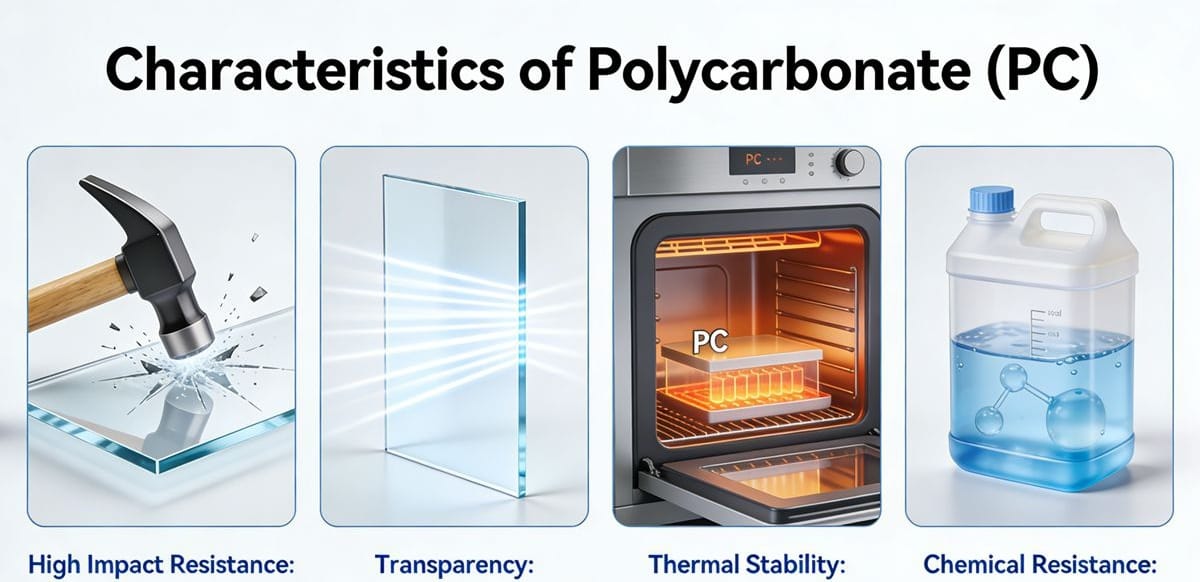
Deze eigenschappen maken polycarbonaat tot een veelgebruikt materiaal in verschillende toepassingen. Helmen van PC bieden bijvoorbeeld bescherming terwijl ze toch licht blijven. Op dezelfde manier worden heldere PC-panelen gebruikt in veiligheidsschilden en ramen. Inzicht in deze eigenschappen helpt bij het afstemmen van uw productieproces op uw specifieke behoeften.
Wat zijn de eigenschappen van PC?
De eigenschappen van polycarbonaat dragen bij aan de populariteit ervan. Hier zijn enkele essentiële eigenschappen:
- Dichtheid: Over het algemeen lager dan glas, waardoor producten lichter zijn.
- Flexibiliteit: Het kan buigen zonder te breken, waardoor creatieve ontwerpen mogelijk zijn.
- Elektrische isolator: PC is een uitstekende isolator, waardoor het geschikt is voor elektrische toepassingen.
- Gemakkelijk te verwerken: Het kan gemakkelijk in verschillende vormen worden gegoten.
De indrukwekkende eigenschappen van polycarbonaat, zoals flexibiliteit en elektrische isolatie, maken het een veelzijdige keuze voor verschillende industrieën.
Deze eigenschappen verbeteren de doeltreffendheid van polycarbonaat in echte toepassingen. De flexibiliteit maakt ingewikkelde ontwerpen mogelijk, terwijl de lage dichtheid helpt om producten licht te houden. Bovendien is de elektrische isolatie goed voor elektronische onderdelen, waardoor veiligheid en efficiëntie gewaarborgd zijn.
Kunnen PC-materialen spuitgegoten worden?
Ja, polycarbonaat kan spuitgegoten worden, en het is een van de meest gebruikte methoden om dit materiaal te verwerken. Het proces bestaat uit het smelten van PC en het in een mal spuiten om de gewenste vorm te creëren.
Spuitgieten is een haalbare en effectieve methode om onderdelen van PC-materialen te maken, waardoor nauwkeurige en efficiënte productie mogelijk is.

Bij het spuitgieten van PC moet u een paar essentiële factoren in gedachten houden. Een goede temperatuurregeling is cruciaal, omdat PC specifieke temperaturen nodig heeft om effectief te smelten en te vloeien. Ervoor zorgen dat het matrijsontwerp geschikt is voor de eigenschappen van polycarbonaat kan ook de kwaliteit van het eindproduct aanzienlijk beïnvloeden.
Wat zijn de belangrijkste overwegingen voor het spuitgieten van PC?
Bij het spuitgieten van PC's kunnen verschillende belangrijke overwegingen het succes van uw project beïnvloeden:
- Temperatuurinstellingen: De juiste temperaturen voor smelten en koelen zijn van vitaal belang.
- Injectiesnelheid: Dit kan de oppervlakteafwerking en integriteit van het onderdeel aantasten.
- Vochtgehalte: PC kan vocht absorberen, wat tot defecten kan leiden als er niet goed mee wordt omgegaan.
- Vormontwerp: De matrijs moet rekening houden met de vloei-eigenschappen van PC om problemen tijdens de productie te voorkomen.
Bij het spuitgieten van PC zijn temperatuur, snelheid, vochtgehalte en matrijsontwerp allemaal cruciale factoren die uw resultaten kunnen beïnvloeden.
Als u zich op deze aspecten concentreert, verloopt het spuitgietproces soepeler. Het handhaven van de juiste vochtigheidsgraad helpt bijvoorbeeld om defecten zoals luchtbellen of verkleuring in het eindproduct te verminderen. Een goed ontworpen matrijs zorgt ervoor dat het polycarbonaat correct vloeit en alle gebieden vult, wat leidt tot afgewerkte producten van hoge kwaliteit.
Conclusie
Kortom, inzicht in polycarbonaat en de eigenschappen ervan is essentieel voor succesvol spuitgieten.
 English
 French
 Dutch
Dutch German