

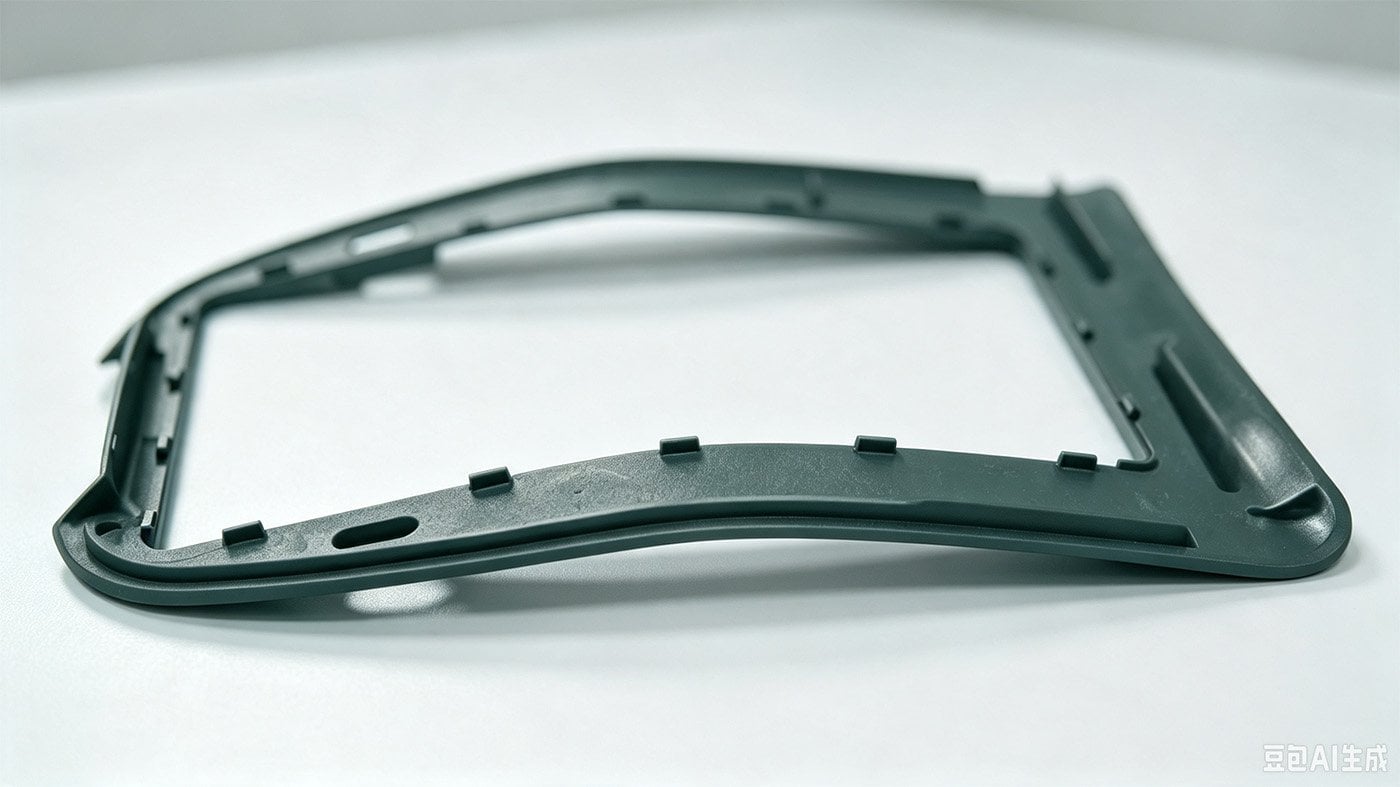
Large, flat injection molding parts are notoriously difficult to manufacture. Due to their expansive surface area, these parts experience significant shrinkage. When combined with severe molecular orientation and uneven mold cooling, the shrinkage rates vary across different directions. This inconsistency frequently leads to warpage and twisting, especially in thin-walled large panels.
Furthermore, if a flat part features support ribs on one side, the differential cooling and shrinkage will inevitably cause the part to warp toward the ribbed side.
Completely eliminating warpage in large flat parts is a complex challenge. However, through extensive production experience, we have identified four highly effective strategies to mitigate this issue and improve dimensional stability.
Related reading: Injection Molding Warpage: Causes, Prevention, and Correction Methods
Optimize Gating with Multi-Point Injection
The first line of defense is mold design. Transitioning to a multi-point gating system (typically using a 3-plate mold) is highly recommended. For large flat parts requiring injection molding machines of 24 oz (or equivalent tonnage) and above, aim for at least 4 gate points.
This balanced filling pattern significantly reduces the degree of molecular orientation and minimizes the gap between shrinkage rates in different directions, resulting in a much flatter final part.
Learn more about gate design best practices: The Advantages of Using Small Gates in Injection Molding: A Complete Guide
Increase Mold Temperature for Uniform Cooling
Rapid cooling is a primary culprit for warpage. By properly increasing the mold temperature, you can slow down the cooling rate and reduce thermal gradients that cause deformation.
For example, when molding ABS, maintain the mold temperature at 60°C (140°F) or higher. This not only prevents warpage caused by rapid quenching but also helps relax the molecular orientation within the polymer matrix.
Maximize Packing Pressure and Hold Time
Arguably the most critical processing parameter is packing pressure and hold time. Increasing the injection/packing pressure and significantly extending the hold time forces more material into the cavity to compensate for volumetric shrinkage.
As a standard industry practice, extending the hold time by 10 to 15 seconds is a highly effective method to increase part dimensions, reduce overall shrinkage, and dramatically improve flatness.
Full parameter tuning reference: Injection Molding Parameters Tuning Guide
Post-Mold Jigging and Thermal Fixturing
If the first three measures do not yield the desired flatness, post-mold fixturing (jigging) is your final solution. While effective, this technique requires precision and practice.
The key is to eject the part early while it is still at an elevated temperature (it should still be quite hot to the touch). Immediately place the part into a custom-designed fixture on a workbench to lock in its shape.
⚠️ Critical Considerations for Jigging
- Fixture Design: The jig must be precisely engineered to match the target geometry.
- Springback Compensation: Plastic exhibits elastic recovery (springback) as it cools. You must design the fixture to over-correct the part.
- Cooling Time: Springback typically stabilizes after about 12 hours.
- Ejection Temperature: The lower the ejection temperature, the greater the springback. Always calculate the required "over-bend" amount based on your specific material and cooling parameters.
Quick Reference: Warpage Reduction Strategies
To help you troubleshoot on the production floor, here is a quick summary of our recommended solutions:
| Strategy | Key Action | Primary Benefit |
|---|---|---|
| Multi-Point Gating | Use 4+ gates for large parts | Reduces molecular orientation & uneven shrinkage |
| 금형 온도 | Keep ABS molds ≥ 60°C | Prevents thermal shock & relaxes polymer chains |
| Packing Parameters | Increase pressure & hold time (+10-15s) | Compensates for volumetric shrinkage |
| Thermal Fixturing | Jig part while hot; over-correct | Forces dimensional stability during cooling |
Final Thoughts
Achieving perfect flatness in large injection-molded parts requires a holistic approach, combining smart mold design, precise thermal management, optimized processing parameters, and careful post-mold handling.
Have you encountered severe warpage in your flat panel projects? What techniques worked best for you? Share your experiences in the form below!



 English
 French
 Dutch
Dutch German
 Japanese
 Korean