 한국어



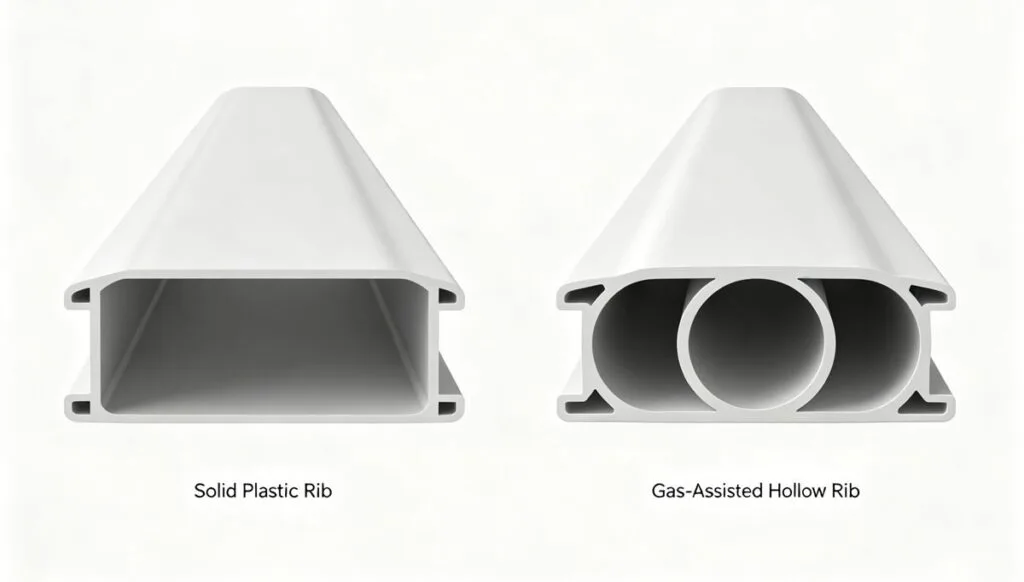
Gas-Assisted Injection Molding (GAIM) is a revolutionary manufacturing process that offers superior aesthetics, significant material savings, shorter cycle times, and reduced internal stress. However, because GAIM is a relatively advanced technology, it can be challenging to master. Inexperienced operators often face a steep learning curve, leading to increased scrap rates during the initial setup and debugging phases.
This comprehensive guide breaks down the GAIM process, structural design principles, and actionable solutions for common molding defects.
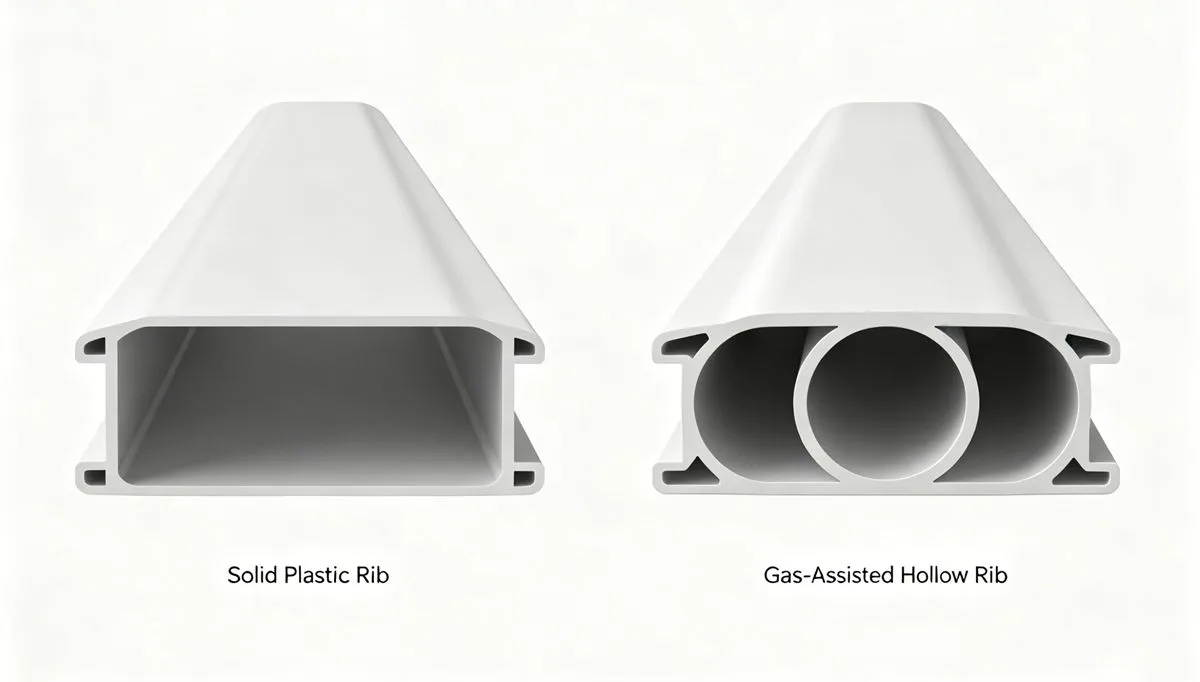
How Gas-Assisted Injection Molding Works
At its core, GAIM involves injecting high-pressure inert gas (usually nitrogen)[^1] into the mold cavity after the plastic melt has filled 90% to 99% of the volume. The gas pushes the remaining melt to fill the cavity and acts as a holding pressure mechanism, replacing traditional plastic packing.
The process creates a hollow cross-section within the thickest parts of the part, driving the melt to complete the filling and holding phases efficiently.
Top 8 Advantages of GAIM
Why are manufacturers switching to gas-assisted molding? The benefits span across product quality, cost, and equipment longevity:
- Reduces Residual Stress & Warpage: The internal gas channel effectively transmits pressure, lowering internal shear stress and minimizing post-molding warpage.
- Eliminates Sink Marks: Gas pressure forces the plastic to shrink from the inside out, completely eliminating sink marks behind thick ribs and boss structures.
- Lowers Clamping Force: Reduced holding pressure requirements can decrease clamping force needs by 25% to 60%.
- Shortens Flow Lengths: Thicker gas channels guide the plastic flow, reducing the need for complex external runner systems and helping control weld line placement.
- Saves Material: GAIM can reduce material usage by up to 35%, depending on part geometry. It also significantly reduces sprue and runner waste.
- Shortens Cycle Time: Hollow internal structures cool much faster than solid thick sections[^2], reducing both holding and cooling times.
- Extends Mold Life: Lower injection and clamping pressures reduce flash formation at the gate, significantly decreasing mold maintenance frequency.
- Reduces Machine Wear: Lower mechanical stress extends the lifespan of critical injection molding machine components like tie-bars, toggle mechanisms, and platens.
Key Mold Design Considerations
Proper mold design is critical for GAIM success. Keep these structural guidelines in mind:
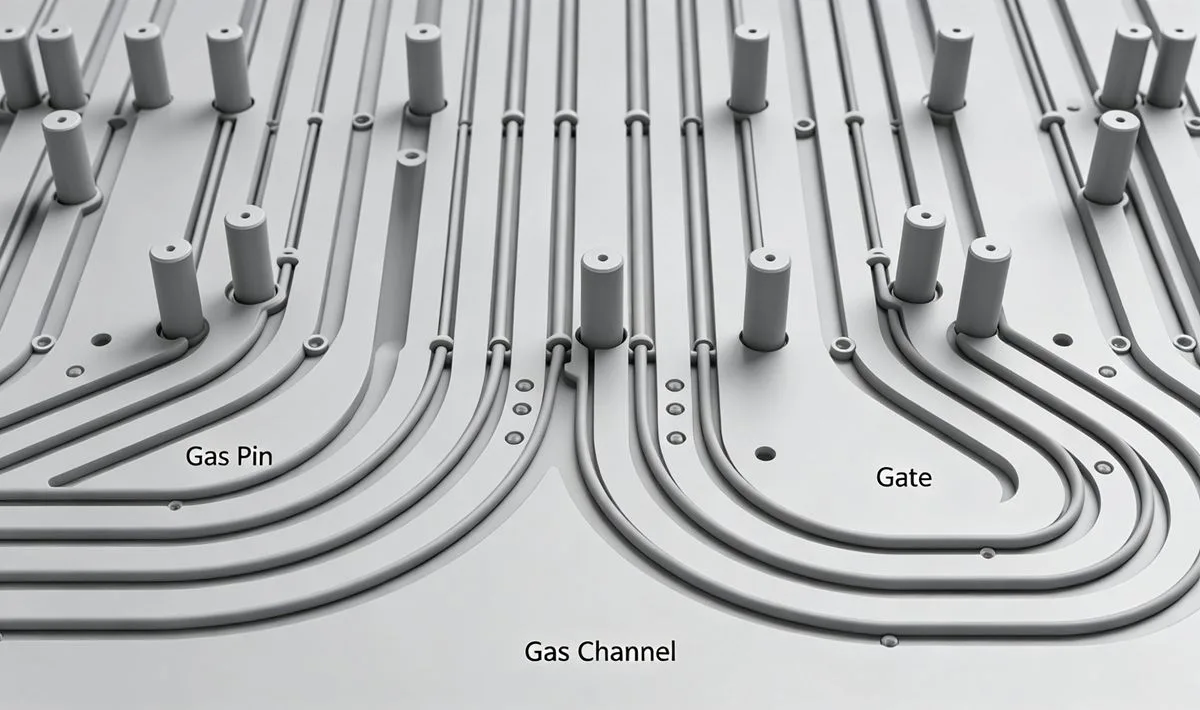
- Gas Channel Geometry: Channels are typically semi-circular. The diameter should be 2 to 3 times the wall thickness and remain as consistent as possible. Use large radii for transitions.
- Strategic Placement: Position gas channels at the roots of reinforcing ribs and self-tapping screw bosses to act as secondary channels for packing.
- Gas Pin Precision: 그리고 fit clearance of the gas pin must be less than 0.02mm[^3] to prevent melt intrusion. Always use high-temperature resistant seals.
- Gate Proximity: Keep gas pins away from the gate. The melt near the gate has the highest temperature and lowest viscosity, increasing the risk of melt entering the gas pin gap.
- Runner & Gate Sizing: Since GAIM eliminates the need for secondary injection compensation, you can use fewer gates. However, runners and gates should be enlarged to ensure fast mold filling. Submarine gates are typically around 1.5mm in diameter.
Process Tuning & Debugging Tips
During the debugging phase, pay close attention to these critical factors:
- Gas Pin Balance: For panel molds with gas pins, unbalanced gas injection during venting is a common issue causing sink marks. Always check gas flow smoothness during venting.
- Melt Temperature Sensitivity: GAIM is highly sensitive to temperature. Excessive nozzle temperatures cause splay or burn marks, while low temperatures cause cold slugs that block gas pins.
- Shut-off Nozzle Maintenance: Manually check for melt leakage during the retraction phase. If the shut-off pin fails to seal, high-pressure gas will flow back into the barrel, causing severe splay and burns at the sprue. Adjust the pull rod length if necessary.
- Sensor Calibration: Ensure gas-assist proximity sensors are highly responsive to prevent costly production errors.
- Compensating for Shrinkage: Since GAIM relies on gas for packing, you can reduce the plastic shot size to compensate for shrinkage. This lowers internal pressure and allows the gas to penetrate thicker sections more easily.
Troubleshooting Common GAIM Defects
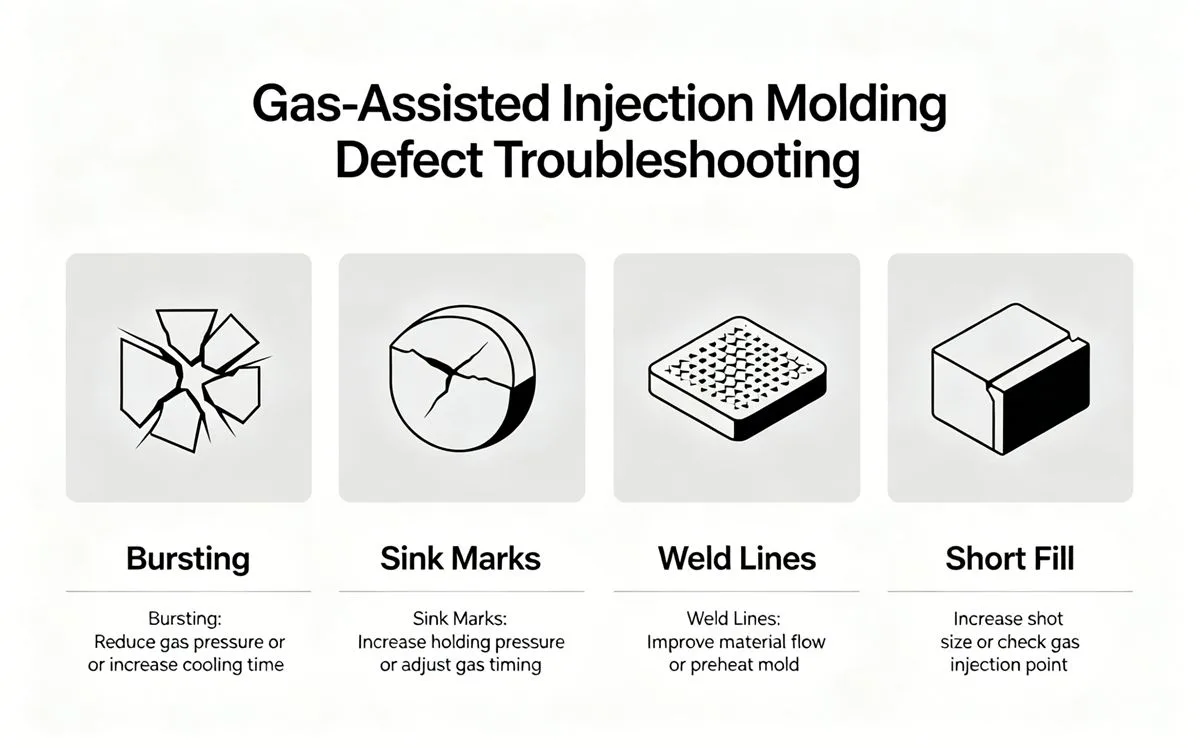
Even with perfect setup, defects can occur. Use this quick-reference guide to diagnose and resolve issues:
| Common Defect | Probable Causes & Recommended Solutions |
|---|---|
| Gas Penetration (Blow-through) | Increase pre-fill %, raise melt temp, shorten gas delay time, or use higher-flow resin. |
| No Cavity / Small Cavity | Decrease pre-fill %, increase gas pressure/temp, extend gas hold/vent time, or enlarge gas channels. Check for pin blockages. |
| 싱크 자국 | Decrease pre-fill % and melt temp, increase gas pressure, shorten gas delay, or enlarge gates/runners. Adjust gas pressure curve. |
| Unstable Part Weight | Reduce injection speed, increase back pressure, improve mold venting, or relocate/enlarge gates. |
| Thin Channel Walls | Lower injection speed, barrel temp, and gas pressure. Extend gas delay time or enlarge the gas channel. |
| Fingering Effect | Increase fill %, lower injection speed/temp/pressure, extend gas delay, use lower-flow resin, or reduce wall thickness. |
| Gas Entering Screw Barrel | Increase plastic hold pressure/time, lower nozzle temp/gas pressure, shorten gas hold time, or reduce gate size. |
| Post-Ejection Bursting | Lower gas pressure, extend hold time, adjust gas pressure curve, reduce gas volume, or check for blocked gas pins. |
결론
Gas-Assisted Injection Molding is a powerful tool for producing high-quality, lightweight, and cost-effective plastic components. By understanding the underlying mechanics, adhering to precise mold design principles, and knowing how to troubleshoot common defects, manufacturers can maximize their ROI and minimize scrap.
Are you struggling with a specific GAIM defect in your production line? Share your challenges in the comments below, or contact our engineering team for expert consultation!
[^1]: "Gas-Assisted Injection Molding - Xometry", https://www.xometry.com/resources/injection-molding/gas-assist-injection-molding/. A polymer processing reference describes gas-assisted injection molding as using pressurized inert gas, commonly nitrogen, to displace melt and maintain pressure during molding. Evidence role: definition; source type: education. Supports: GAIM involves injecting high-pressure inert gas, usually nitrogen, during the molding process.. Scope note: The source may define the gas type and function without validating every process parameter in the article. [^2]: "A Study on Thin Cooling Layers Between the Cooling Channel and ...", https://pmc.ncbi.nlm.nih.gov/articles/PMC12608826/. Heat-transfer and polymer-processing references show that cooling time increases with section thickness and that removing material from thick regions can reduce the thermal mass that must cool before ejection. Evidence role: mechanism; source type: education. Supports: Hollow internal structures cool faster than equivalent solid thick sections.. Scope note: The source supports the thermal rationale; actual cycle-time reduction also depends on mold cooling layout, resin, and ejection criteria. [^3]: "Gas-Assisted Injection Molding - Xometry", https://www.xometry.com/resources/injection-molding/gas-assist-injection-molding/. A technical standard, patent literature, or academic mold-design reference addressing gas-pin construction can support the need for tight gas-pin clearance to prevent melt intrusion during gas-assisted molding. Evidence role: expert_consensus; source type: other. Supports: Gas-pin fit clearance should be less than 0.02 mm to prevent melt intrusion.. Scope note: The exact 0.02 mm threshold may be a shop-specific or design-specific tolerance unless a source states it directly.
저자 소개

Alex Yu
아이디얼 프로 매뉴팩처링
알렉스는 Ideal Pro의 공동 창립자이지만, 주요 프로젝트를 총괄하거나 기술 팀을 이끌지 않을 때는 장거리 자전거 타기를 즐기거나, 동네에서 가장 맛있는 커피를 찾아다니거나, 다음 여행 계획을 세우는 모습을 볼 수 있습니다. 국제 무역 영업과 프로젝트 관리 분야에서 20년 이상의 경력을 쌓아온 그는 촉박한 마감 기한부터 까다로운 엔지니어링 문제까지, 그 사이의 모든 상황을 다 겪어보았습니다. 그는 훌륭한 성과는 충분한 휴식을 취한 마음과 맛있는 커피에서 나온다고 믿으며, 맡은 모든 프로젝트에 그와 같은 호기심과 세심한 주의를 기울입니다. 사무실에 있지 않을 때는 대개 야외 어딘가에서 새로운 장소를 탐험하며, 나중에 나눌 이야기를 수집하곤 합니다.




 English
 French
 Dutch
 German
 Japanese
 Korean