

Einführung
PVC products often suffer from "whitening" or loss of transparency after exposure to water immersion, outdoor sunlight, or mechanical stress (bending/stretching). While many factors contribute to this, the choice of PVC stabilizer1 plays a critical role.
Below, we analyze the three major types of whitening—Water Immersion, Weathering, and Stress—from the perspective of stabilizer chemistry.
Water Immersion Whitening
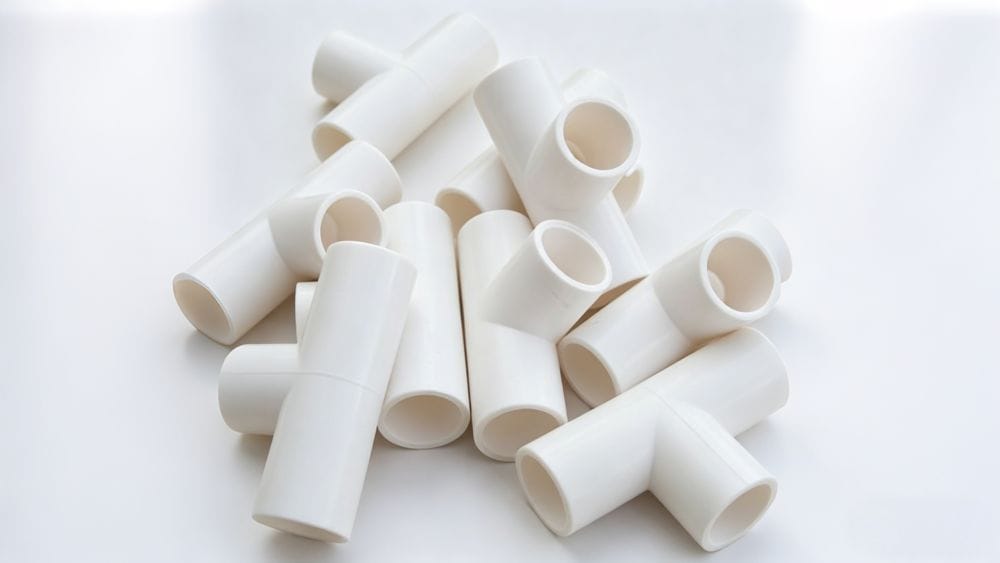
Many transparent PVC products develop a foggy, white, turbid appearance after prolonged contact with water or steam. This is often more severe in soft products than in rigid ones.
- The Mechanism: This phenomenon is generally attributed to hydratable additives within the formula. Specifically, water permeation causes the stabilizer to migrate to the surface and undergo hydration, forming water-complex precipitates that scatter light and ruin transparency.
- Reversibility: Interestingly, this process is often reversible. Once the water is removed, the product remains white. However, if the temperature is raised, the compatibility of the stabilizer is restored, and the product returns to a transparent state.
- Stabilizer Impact:
- High Risk: Formulas containing alkaline earth metal salts, particularly Barium (Ba) und Calcium (Ca), are prone to this issue. Cadmium (Cd) and Zinc (Zn) salts can also occasionally cause it.
- Low Risk: Organotin stabilizers generally do not exhibit this water-induced whitening.
Weathering (Sun Exposure) Whitening
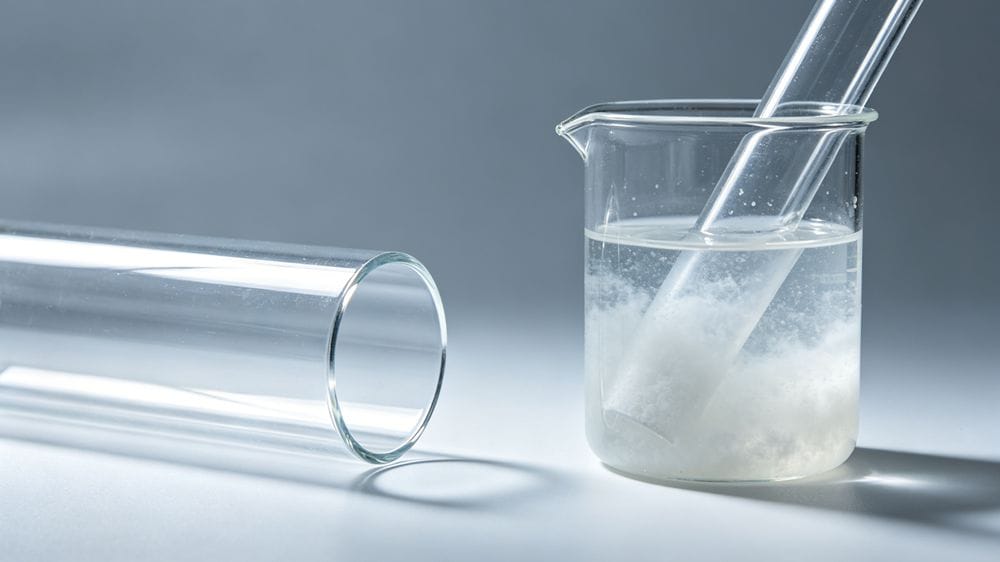
PVC products exposed to outdoor conditions will also exhibit whitening. This is closely tied to the compatibility of the stabilizer with the PVC matrix.
- Metal Soaps: Among metal soap stabilizers, Benzonates (which have better compatibility with PVC) show less whitening compared to Stearates.
- Organotins: These are highly resistant to weathering whitening. The ranking for effectiveness is: Sulfur-containing Organotins2 (Best) > Laurates > Maleates.
- Zusatzstoffe: The addition of light stabilizers, phosphites, and liquid composite stabilizers can help prevent or mitigate weathering whitening to some extent.
Stress Whitening
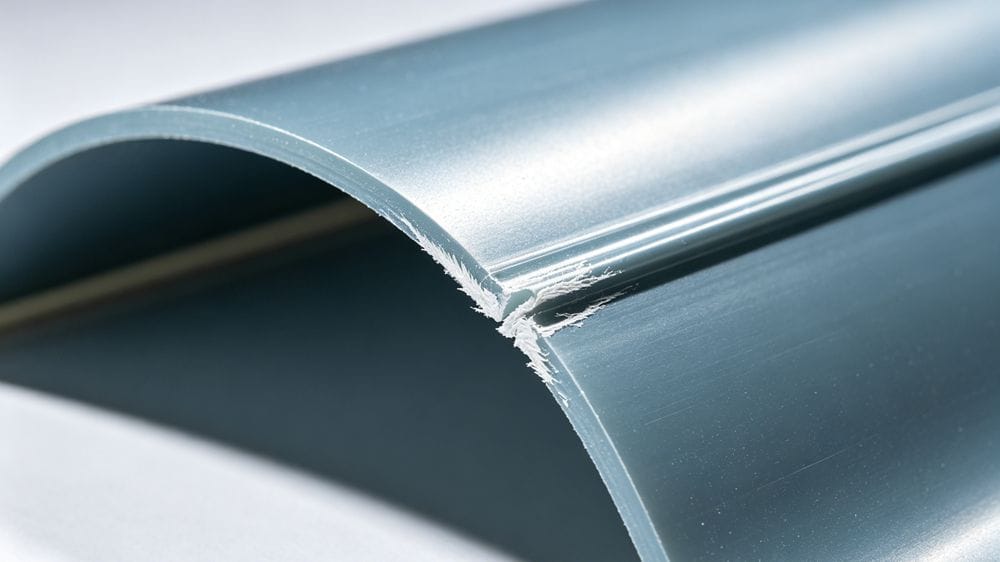
Stress whitening occurs in rigid PVC products when subjected to mechanical forces, such as bending or stretching. You will often see white marks at the bend or stress points.
- The Mechanism: External force alters the molecular structure, causing polymer chains to orient and the PVC density to change. This creates microscopic voids (gaps) between molecules. These voids cause light scattering, making the area appear white.
- The Solution: Experts suggest that adding high-surface-energy stabilizers can help fill the voids created by chain orientation.
- Stabilizer Choice: Using Organotin stabilizers can reduce this phenomenon. Specifically, combining them with Maleate Organotins yields even better results.
Quick Comparison: Stabilizer Performance
To help you choose the right additive for your Spritzgießen3 needs, here is a summary of how different stabilizers perform against these whitening factors:
| Stabilizer Type | Water Immersion Resistance | Weathering Resistance | Stress Whitening Resistance |
|---|---|---|---|
| Barium/Calcium (Ba/Ca) | Low (Prone to hydration) | Mäßig | Mäßig |
| Zinc/Cadmium (Zn/Cd) | Low/Moderate | Mäßig | Mäßig |
| Organotin (General) | Hoch | Hoch | Hoch |
| Sulfur-Organotin | Hoch | Sehr hoch | Hoch |
| Maleate-Organotin | Hoch | Hoch | Sehr hoch |
Fazit
When designing a formulation for transparent PVC injection products, the stabilizer selection is not just about thermal stability—it is about the final appearance under stress and environmental exposure. For high-clarity applications requiring resistance to water, UV, or physical stress, Organotin-based systems (particularly Sulfur or Maleate variants) are generally the superior choice over metal soaps.
Explore this link to understand how different PVC stabilizers can enhance product clarity and longevity. ↩
Learn how Sulfur-containing Organotins can enhance the durability and appearance of PVC products. ↩
Explore this resource to understand key techniques and innovations in injection molding that enhance product quality and performance. ↩
 English
 French
 Dutch
Dutch German
 Japanese
 Korean