 English



Upload a STEP file, choose a resin and a quantity, and a number appears in ninety seconds. Instant injection molding quotes are now normal, and they are not a trick: the geometry-to-cost pipeline underneath them is real engineering mathematics, run fast. What most of them do not tell you is which of the inputs they inferred rather than read, because a price built on inferred inputs is a price for a slightly different part. The engineering-reviewed quote that takes 24 to 48 hours is not more accurate because a human is smarter than the algorithm on wall thickness. It is more accurate because a human reads the drawing note, the regulatory requirement, the cosmetic class and the forecast — the four things that actually decide the money.
This article quantifies the gap. We will decompose what an automated estimator can and cannot see, run one worked part from a budget price to a firm price with every delta itemized, set out the error bands you should assume by part class, and finish with the fourteen checks that make any quote comparable — from either kind of supplier.
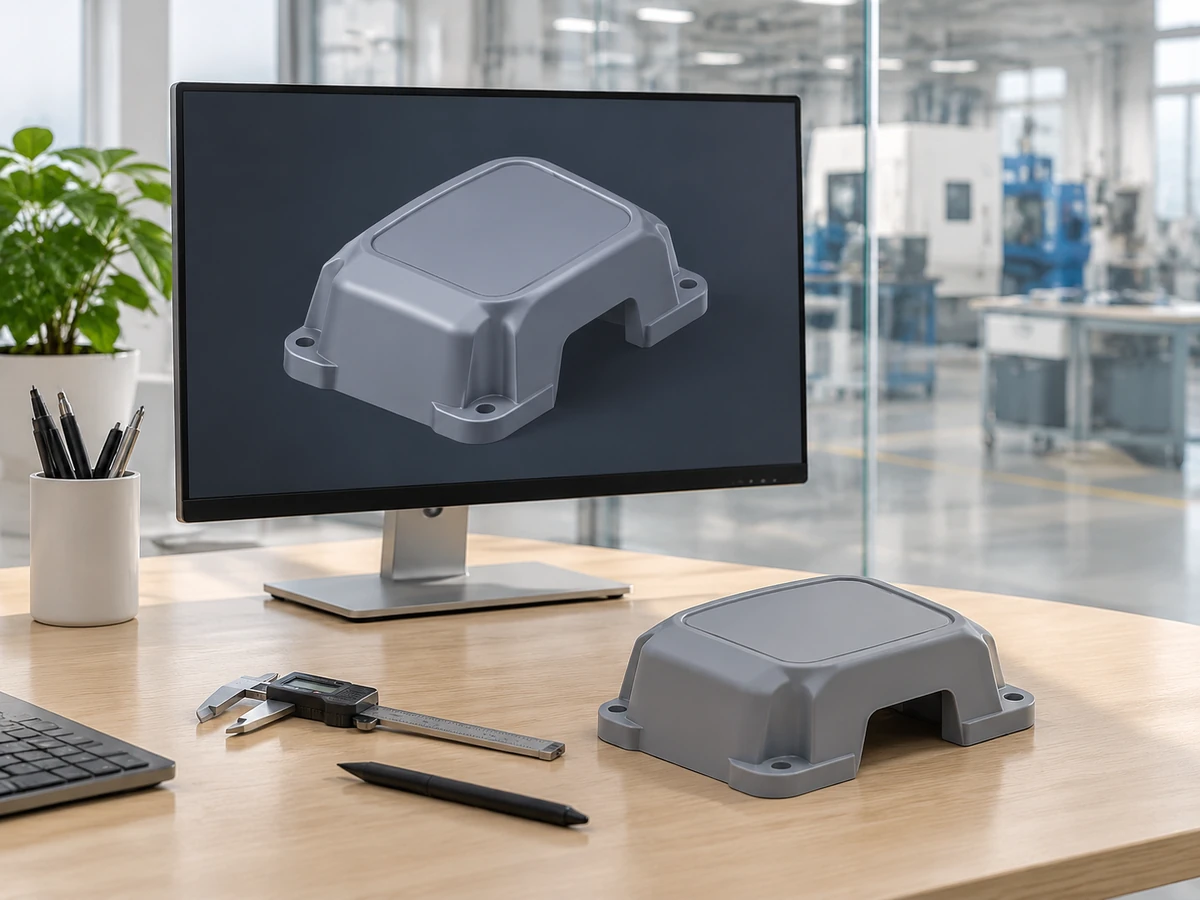
What is actually happening inside an instant injection molding quote?
A competent estimator reads the solid model and derives a defensible set of physical quantities. None of these are guesses, and this is why the numbers are often closer than skeptics claim:
| What the system can derive | How it derives it | Reliability from a clean CAD file |
|---|---|---|
| Part volume and mass | Solid volume x selected resin density | High |
| Projected core-cavity area | Boolean projection on the pull direction | High |
| Minimum clamp tonnage | Projected area x cavity count x cavity pressure | High, with a stated multiplier |
| Wall thickness distribution | Thickness analysis of the solid | High |
| Surface area for coating and printing | Facet area of the tessellated body | High |
| Draft availability | Face-angle test against the pull direction | Medium, unless a parting line is defined |
| Undercut count | Draft test plus negative-angle detection | Medium: lifters and side-actions are conflated |
| Shot count per hour | A modeled or averaged cycle time | Low to medium: this is the big one |
| Tool cost class | Cavity count and tonnage from your stated volume | Medium: driven by an input you typed, not your forecast |
| Secondary operations | Absent, unless you ticked boxes | None: the model cannot see a paint mask |
Read the bottom four rows again, because that is where quotes go wrong. Everything above them is geometry, and geometry is cheap to measure. Everything below them is a decision — how many cavities, which gate, what steel, what documentation, which trade performs the coating — and decisions are not encoded in a STEP file. An estimator has to guess them, and it guesses from the only signal it has: the quantity you typed into a box.
That is the structural limitation, and no amount of model training fixes it. The number you get back is a valid price for a plausible part. Whether it is your part is a different question, answerable only against your drawing, your forecast and your regulatory file.
Which cost drivers are invisible to a file upload?
Ten drivers account for most of the difference between a budget price and a firm one. Each is a fact about your program rather than about your geometry, which is precisely why an upload cannot see it.
| Driver | Why CAD cannot see it | Typical swing on a mid-size part |
|---|---|---|
| Tolerance class and datum scheme | A generic model carries no inspection intent | 3–12% of piece price plus inspection cost |
| Cosmetic standard and texture | A paint note lives on the print, not the solid | 2–8% of piece price, 5–10% of tool cost |
| Flame-retardant, medical or food-contact grade | Resin family is typed; grade and certification are not | 8–25% of material cost, which is 30–45% of the part |
| Color and changeover burden | Nothing in geometry implies purge cycles | 1–5% at low volumes, under 1% at high |
| Cavity count versus real forecast | Typed quantity is not an annual consumption curve | 5–20% of piece price through machine time and tooling |
| Documentation level: FAI, PPAP, Cpk, validation | Entirely contractual | 1–4% of piece price, or a fixed $2,000–$9,000 |
| Assembly, inserts, welding, packaging | Not modeled, or modeled without process intent | 5–25% of the delivered part cost |
| Regrind and regrind-fraction policy | A materials decision with a quality boundary | 1–6% of material cost |
| Incoming material lot variation and drying | A process control, invisible to geometry | Scrap allowance, 0.3–2 points |
| Tool steel and expected shot life | Driven by your volume and warranty terms | 5–15% of tool cost, which amortizes forever |
Three of these interact badly, which is where the real surprises live. A ±0.03 mm callout on a textured Class-A surface in a flame-retardant grade simultaneously raises the steel cost, the trial-out iterations, the inspection plan and the scrap allowance. Each is defensible alone; together they can move a price by a fifth, and every one of them is stated on a drawing that the algorithm never read. If you want the mechanics of how one of those drivers propagates, our DFM and hidden tooling cost guide walks the same part from print to price.

How large is the gap on a real part, and can you bound it?
Take a PC/ABS enclosure, 148 g net, two cosmetic faces, three features called out at ±0.03 mm, one custom color, 250,000 lifetime units, PPAP required. The estimator returns $1.8600 on a typed quantity of 250,000 and a generic PC/ABS selection. Here is the itemized distance to a firm price, with every row derived from a decision rather than an opinion.
| Driver | Instant assumption | Engineering finding | Delta per part |
|---|---|---|---|
| Machine time | 4 cavities at 22 s | 2 cavities at 24 s: the forecast does not amortize the extra steel | +$0.0400 |
| Tooling amortization | 4 cavities | 2-cavity tool, $9,200 less steel | −$0.0500 |
| Side actions | One lifter | Two internal undercuts need lifter cores | +$0.0600 |
| Mold texture | As-machined | Print note requires SPI-A2, adding EDM and etch | +$0.0096 |
| Tolerance and inspection | ±0.10 mm generic | ±0.03 mm on three features: gating, steel, CMM plan | +$0.0144 |
| Scrap allowance | 0.8% | 1.5% at that tolerance with that texture | +$0.0140 |
| Resin grade | Catalog PC/ABS | UL94 V-0 required, +$0.55/kg on 0.155 kg | +$0.0853 |
| Color changeover | Stock colors | One custom color, two purge cycles per year | +$0.0060 |
| Documentation | FAI only | PPAP level 3 with Cpk on critical features | +$0.0168 |
| DFM saving found | As modeled | Boss simplification removes one lifter, gate move trims 1.5 s | −$0.0420 |
| Sum of deltas | +$0.1541 | ||
| Firm price after review | $2.0141 |
The instant number was 8.3% low. Note what is not in that list: nobody padded anything. The largest single row is a resin grade that the drawing specified and the upload never saw. The second largest is a cavity decision that a typed quantity forced. The only row that moved the price down is the one that requires a human to have molded this geometry before: a boss detail that a lifter does not need, worth $6,000 of steel and 1.5 seconds of cycle.
That last row is the part of manual quoting that automated pricing genuinely cannot replicate, and it is worth more than the error it makes. An estimator prices the part you sent. An engineer prices the part you could have sent.
For planning purposes, assume these bands by part class. They are not measurements of one vendor's accuracy; they are the ranges a buyer should carry as risk when a firm price does not exist yet.
| Part class | What an estimator usually gets right | Band to assume on the budget number |
|---|---|---|
| Simple commodity, one resin family, no cosmetic class | Mass, tonnage, cycle within tolerance | ±3–6% |
| Moderately complex, one secondary operation | Geometry; not the operation | ±8–15% |
| Class-A cosmetic, tight tolerance, assembly | Nothing about finish or inspection | ±15–30%, skewed upward |
| Regulated, flame-retardant or color-critical | Almost nothing about documentation or grade | ±20–40%, skewed upward |
| Tooling-only or prototype quantity | Cavity logic from a typed quantity is guesswork | Treat as a placeholder, not a price |
Carry those bands into your should-cost model as risk, not as a haircut on the price. On a portfolio, that is the difference between a budget that survives the first tooling quote and one that does not: if you model a Class-A assembly at the instant number plus fifteen percent, the firm price becomes a variance to explain rather than an overrun to defend. Two disciplines make the band shrink on its own over time — insist every automated number arrives with its assumptions printed, and measure your own suppliers by the distance between their budget price and their firm price. After three programs per supplier you will know which vendors' fast numbers are worth quoting from, and that metric costs nothing to collect because both numbers already exist in your files.

Where does cycle time come from, and why does guessing it misprice everything?
Cycle time is the single largest pricing input that an automated estimate has to model rather than measure, and molding physics punishes approximations here. For a cooled part, cooling time scales approximately with the square of wall thickness: a part whose nominal wall goes from 2.0 mm to 3.0 mm does not take 50% longer to cool, it takes roughly double, before you account for a longer fill and higher holding time.
Run the arithmetic on a bracket. At 2.5 mm nominal wall, four cavities and a 24-second cycle, a 160-tonne press producing 600 parts per hour at $18 per hour lands $0.030 of machine time per part. Widen the wall to 4 mm, the cycle goes to roughly 34 seconds, output falls to 424 per hour and machine time rises to $0.042 — a 40% increase on one row of the quote, caused by a feature a thickness analysis can measure but no estimator can trade off against sink, warp and gate location.
Then the cavity question, which is where typed quantities do the most damage. An annual demand of 60,000 units needs about 200 press hours on a 2-cavity tool at 24 seconds, or about 92 hours on a 4-cavity tool at 22 seconds. Both fit inside a single press's available capacity many times over, so the extra $9,200 of steel buys flexibility rather than cost saving: amortized over the annual volume it is $0.153 per part, and even over a 250,000-unit life it is $0.037. An estimator that maximizes cavities because the typed quantity is high has therefore made the tool more expensive and the part no cheaper — and it will do this consistently, because the objective function it optimizes is the number you typed, not the consumption curve you did not supply.
The same logic explains why our shrinkage and dimensional control guide matters commercially rather than only technically: a directional shrinkage assumption that is wrong by two thousandths costs steel removal rounds, and each trial-out round is real money and seven to ten days. Cycle time, cavity count and shrinkage are where a price is genuinely engineered, and they are exactly where an automated estimate has to invent a value.
When is an instant quote the right instrument?
Instant pricing is not a compromise; on several jobs it is the correct tool, and a slow quote is the worse answer.
- Budgeting before the CAD is final. You need an order of magnitude to decide whether the program exists at all. A priced placeholder that moves ±15% beats a two-week study of a part that will change twice.
- Screening a supplier's price position. Five instant numbers on the same file tell you which vendors are structurally expensive on the geometry, before you spend anyone's engineering time.
- Commodity parts in a known family. A simple PP hinge with no cosmetic face and standard tolerances is close to fully determined by its geometry, which is why it sits in the ±3–6% band.
- Spend analytics and should-cost models. Automated pricing is consistent in a way that human quoting never is; that consistency is genuinely useful for a portfolio of hundreds of parts.
- Volume trade studies. The right output is not the price, it is the curve. An instant tool that shows you the piece price at 5,000, 50,000 and 500,000 units is doing useful work even when every point is wrong by ten percent.
What it cannot substitute for, in one sentence: a price you will attach to a purchase order for tooling you will not be able to un-buy.
When does a 48-hour engineering quote cost you money?
The honest counter-argument, because it is real. Speed is a feature of the buying process, not just of the supplier.
- You are in a competitive RFQ and the first compliant bid wins the shortlist. A faster budget price that is transparently a budget price beats a perfect price that arrives after the decision.
- The part is genuinely simple and the review adds a day to obtain a 2% correction you could have carried as risk.
- Your own definition is not frozen. A careful quote on a model that changes next week is wasted work twice over — once for the supplier, once for you.
- You are qualifying a second source under a deadline where the useful deliverable is capability evidence, not price precision.
The answer is not to choose. It is to insist the fast number arrives with its assumptions printed — cavity count, resin grade, documentation level, cycle time, what is excluded — so the difference between it and the firm price becomes a document rather than a surprise. That is the same discipline we apply to landed-cost comparisons in our China sourcing guide: a number without its basis is not comparable to anything.
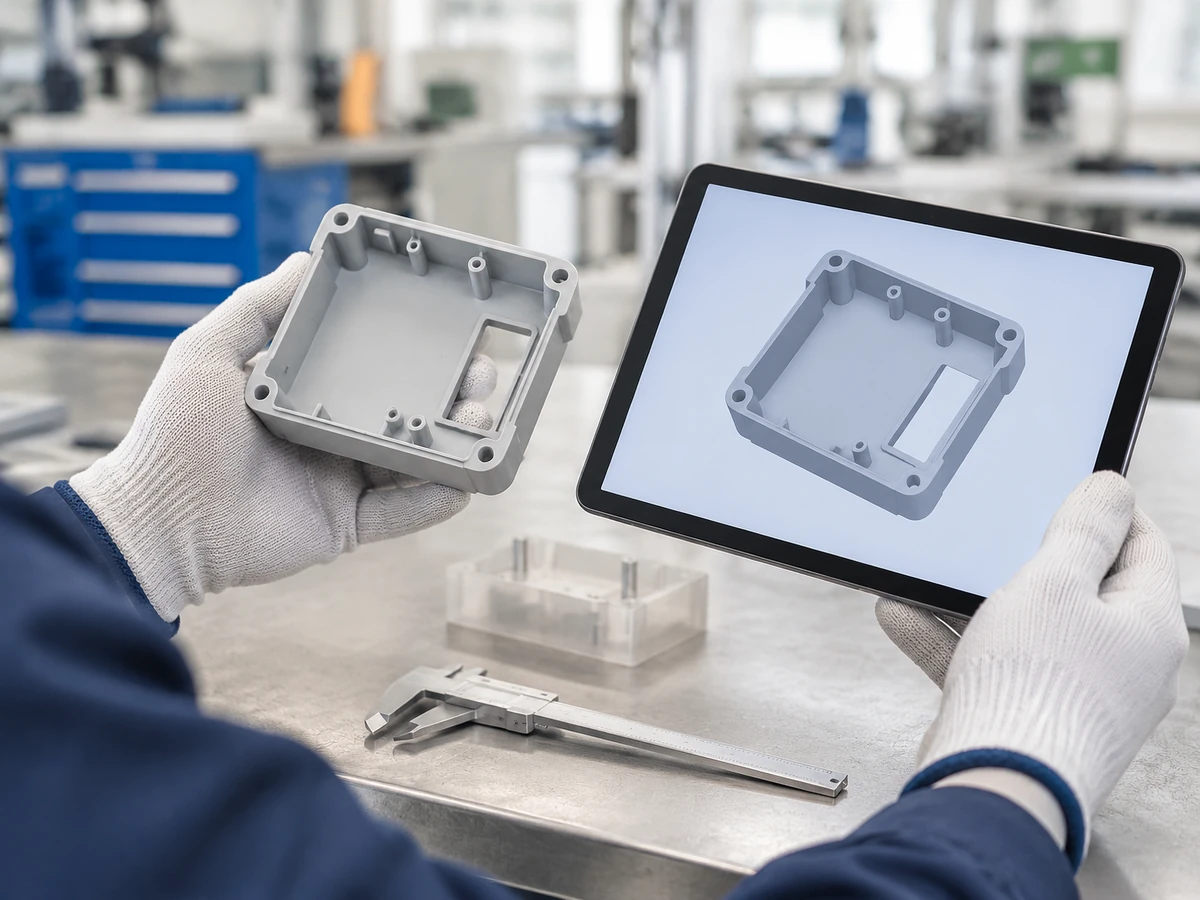
What should any trustworthy quote contain, whichever produced it?
Run every bid, automated or human, through these fourteen items. A quote that answers all fourteen can be compared line by line against another; a quote that answers eight cannot be compared at all, whatever its price.
| # | Check | Ask this | Red flag |
|---|---|---|---|
| 1 | Cavity count | How many cavities, and why that number? | No answer, or cavities derived only from your typed quantity |
| 2 | Cycle time | What is the cycle and what drives it? | A cycle stated with no cooling or fill basis |
| 3 | Clamp force | Which press and tonnage runs this? | A press class that does not fit your part's projected area |
| 4 | Gate | Gate type, location and size? | Silence; gate marks discovered at T1 |
| 5 | Steel | Cavity and core steel, hardness, expected shots? | P20 quoted for a 1M-shot abrasive glass-filled part |
| 6 | Material basis | Exact grade, supplier and certification? | A family name instead of a grade |
| 7 | Regrind | Is regrind allowed and at what fraction? | No policy, then a quality argument in month six |
| 8 | Tolerance | Which features are held how, and verified how? | Copying your tolerance onto the quote as if it were a plan |
| 9 | Inspection | FAI, CMM, fixtures, AQL and sampling? | Inspection priced as zero |
| 10 | Finish | As-machined, EDM or SPI texture? | A texture note absent from the tool price |
| 11 | Secondary operations | Which are in-house, which outside, and who owns rejects? | Three unnamed vendors, or nothing at all |
| 12 | Documentation | FAI only, or PPAP level and Cpk reports? | Level 3 promised with no hours behind it |
| 13 | Exclusions | What is not in this price? | No exclusions section, so assume everything is in |
| 14 | Change economics | Rate card and lead time for mold modification | No ECN price, so every change becomes a negotiation |
Items 13 and 14 are the ones that predict a bad year better than price does. Every supplier can produce a competitive first number; only a supplier who has already told you what the number excludes and what a change costs is quoting in a form you can actually plan against.
How do you get the speed and the accuracy in one process?
The two modes are not rivals; they belong at different points in a program, and a supplier who cannot separate them is selling you one number for both jobs. This is the sequence that works, with the deliverable you should demand at each step.
- Upload the geometry, get a priced band, not a priced point. The useful budget output states its own assumptions: cavity count, modeled cycle, resin family, tonnage class, and the exclusions list. If the output is a single number with no basis, it is marketing, not an estimate.
- Send the drawing with it. One PDF with tolerances, cosmetic notes, regulatory requirements and the annual consumption curve converts the band into a narrow range. This is the step that most buyers skip, and it is worth more than any negotiation that follows.
- Ask for a DFM review before you ask for a lower price. On the worked part above, the only price reduction available came from removing a lifter and moving a gate. A negotiation without engineering finds nothing; a review with engineering usually finds between 3% and 10% that nobody has to argue about.
- Convert the reviewed quote into a firm price in writing, with a validity window. Firm means the exclusions and assumptions are locked, not that the supplier promises not to change the price.
- Compare bids only after step 4. Until every bidder has been reviewed to the same specification, you are comparing assumptions, not prices — the same mistake that makes most country-to-country cost comparisons meaningless.
That is also exactly how our own path works, and you should hold us to it. The instant price on the quote page is a budget-grade number, returned in hours with the tooling and piece split; an engineer then reads the drawing and returns the itemized version, including mold-flow findings, before anything is committed. Our CAD-to-DFM decision guide is the checklist our reviewers work from, so you can see the questions before they are asked of you.
What does an itemized quote look like on a real part?
Concretely, so you can demand the same structure from anyone. For a 148 g PC/ABS enclosure at 250,000 lifetime units, a firm quote should read as a build-up you can audit row by row, not as a total with a lead time attached:
| Quote line | What a real quote states | What you can verify |
|---|---|---|
| Tool | Cavity count, parting scheme, gate type and position, cavity and core steel, expected shot life | Compare against the mold-flow report and the layout drawing |
| Amortization | Tool cost divided by an explicit lifetime volume you signed | Recompute the arithmetic yourself in ten seconds |
| Material | Named grade, supplier, certification, regrind policy, price basis and validity | Ask for the certificate of analysis format |
| Cycle and machine | Cycle time, its cooling basis, press tonnage and hourly basis | Check the tonnage against projected area |
| Molding margin | One stated percentage or fixed adder | Compare across bids on the same basis |
| Secondary operations | Each operation, its method, its in-house or outside status, its reject rule | Ask who owns a cosmetic reject |
| Inspection | FAI scope, CMM plan against your datum scheme, Cpk targets, AQL | Verify against your quality agreement |
| Documentation | FAI, PPAP level, validation reports and their hours | Ask what a level 3 package costs separately |
| Packaging and freight | Inner and outer spec, carton cube, Incoterm and freight basis | Recompute freight per part from carton volume |
| Exclusions | Everything not priced, in writing | Refuse to score a bid without this line |
| Change economics | Modification rate card and lead time | Predicts your year better than the first price does |
Where the numbers come from on our side: mold cavity tolerance held to ±0.02 mm, multi-cavity tools from 2 to 128 cavities, free mold-flow analysis before steel, and dimensional verification through CMM with CT scanning and colorimetric color control across more than twenty documented checkpoints, with APQP and PPAP paths including FAI and Cpk reporting. Standard production lead time is five to seven working days, with two to three days expedited for urgent prototypes, and low-volume programs from 100 to 10,000 parts run on the same tooling logic rather than a separate prototype process.
If you want the two numbers side by side on your own part — the budget price and the reviewed price, with the delta itemized the way the worked example was — upload your CAD and STEP file here and note that you want the itemized build-up. If the geometry is genuinely simple, we will tell you the review was not worth the wait. To discuss the part before pricing it, WhatsApp Fred at +86 156 0682 1288 or email [email protected].
FAQ
Are instant injection molding quotes accurate enough to order from?
Why does a manual quote take 24 to 48 hours?
Does a faster quote mean a more expensive part?
What is the single best question to ask about any quote?
About the Author

Alex Yu
Ideal Pro Manufacturing
Alex is the co-founder of Ideal Pro, but when he's not overseeing key projects or steering the technical team, you'll likely find him on a long bike ride, hunting for the best coffee in town, or planning his next travel adventure. With over 20 years of experience spanning international trade sales and project management, he's seen it all — tight deadlines, tricky engineering problems, and everything in between. He believes great work comes from a well-rested mind and a good cup of coffee, and he brings that same curiosity and attention to detail to every project he takes on. When he's not in the office, he's usually somewhere outdoors, exploring new places and collecting stories to share.


 English
 French
 Dutch
 German
 Japanese
 Korean