 English



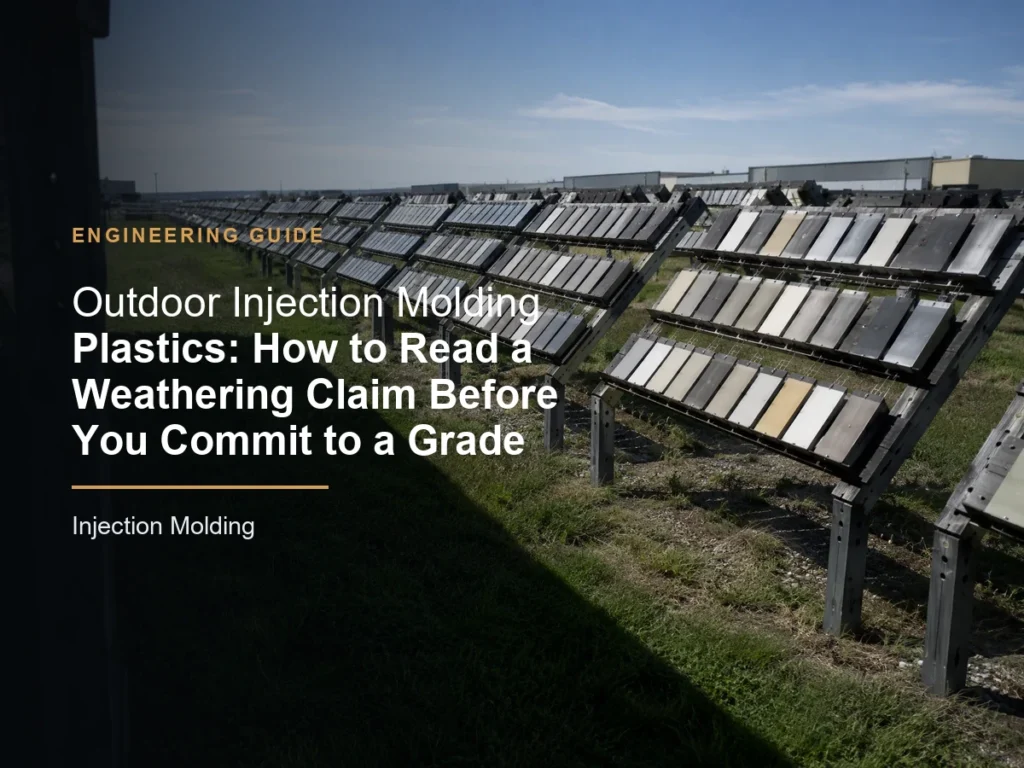
Ask which are the best outdoor injection molding plastics and you will get a ranked list: ASA first, UV-polycarbonate second, acrylic, black HDPE, and so on down to a PC/ASA blend. That list is not wrong. It is just unusable on its own, because it answers a question nobody can buy against. Every resin on every one of those lists has failed in the field, and every failure happened to someone who specified the right resin and never checked the claim.
The checkable version of the question is different. What is attacking your part, in what order, at what dose? What test would have predicted it, run to what cycle, judged against which property? And what sentence goes on the purchase order so that a supplier who substitutes a cheaper package tells you instead of discovering it in year three?
That is what this article builds: the arithmetic behind a weathering claim, the selection logic that follows from it, and the specification language that makes it enforceable. Where we quote a material property it is a typical catalogue value and your grade's datasheet outranks it. Where we quote an exposure number we say which site and which band it came from, because those numbers are always site and band specific.
What we are entitled to say: we mould ASA, PC, PMMA, PA66-GF, PBT-GF, POM, PP, TPE and blends for outdoor customers, we buy the resin, and we hold the lot traceability, so a stabilizer substitution is a thing that can happen and a thing we get paid to prevent. We gain when you specify a more expensive grade. That is why the cases where the expensive resin is unnecessary are in here too.
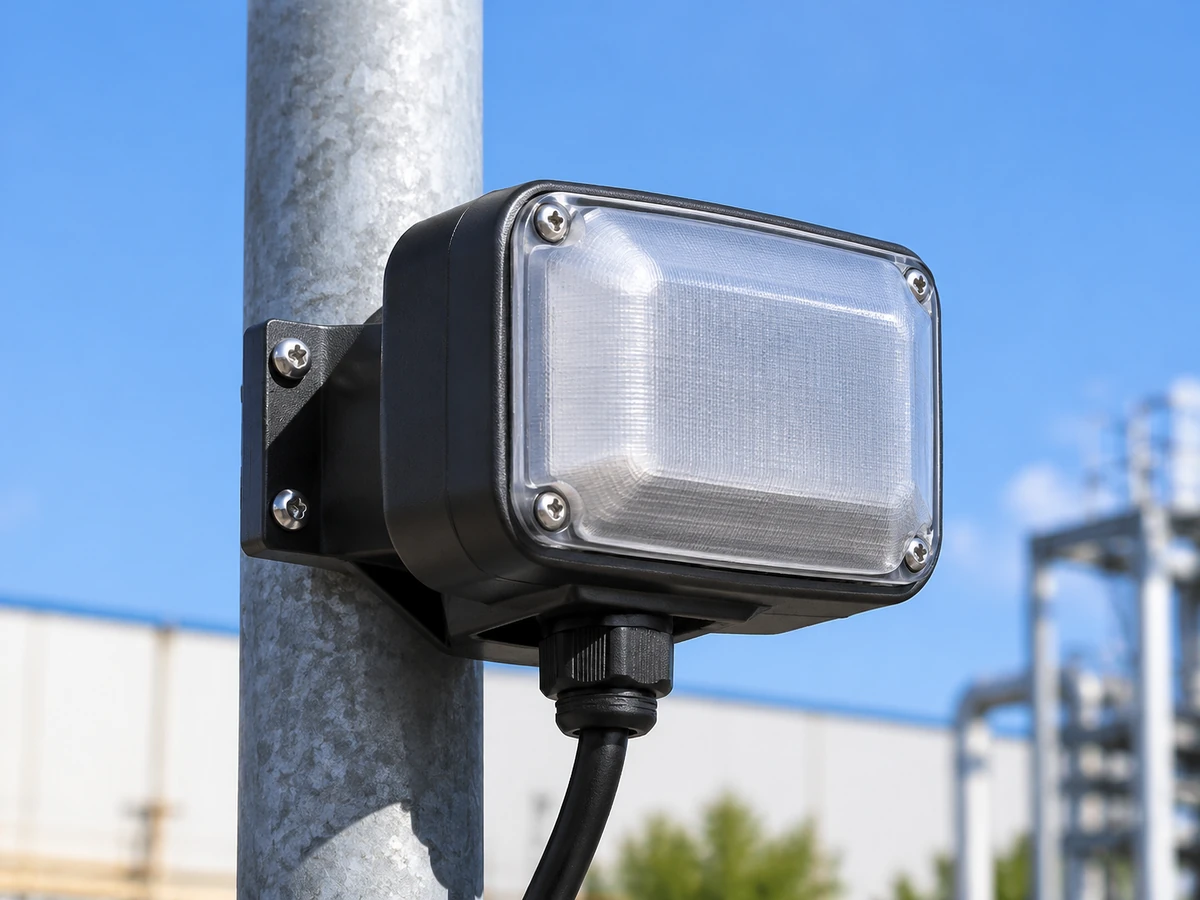
What is actually attacking an outdoor plastic part?
Not "the weather." Four separate clocks run on the same part at different speeds, and each one kills a different polymer in a different way. Getting this wrong is why a part that passes a UV test still fails.
| Clock | What it does | Where it bites | The number that predicts it |
|---|---|---|---|
| Photo-oxidation | UV above the bond energy of the weakest chromophore starts a radical chain; chains scission, crosslink, or form carbonyls | The surface layer first: gloss, colour, then micro-cracking and embrittlement | Cumulative radiant dose in the 295 to 400 nm band, plus whether the polymer absorbs there at all |
| Hydrolysis | Water splits susceptible backbone bonds; no light needed | Whole wall thickness on ester and amide polymers at heat and humidity | Service temperature and relative humidity, plus the bond type: PBT, PET, PC, PA are all exposed |
| Thermal and thermo-oxidative ageing | Antioxidants are consumed; polymer oxidises slowly in heat | Interior surfaces, ribs, thick sections, areas near a heat source | Continuous use temperature or RTI, and how much of the day is spent near it |
| Mechanical and thermal-cycling load | CTE cycling, screw stress, snap-fit strain, cold impact | Around inserts, bosses, gate areas, weld lines, and any notch | Stress level as a fraction of retained strength at the low temperature of the year |
Two consequences that a ranked list cannot tell you.
Photo-degradation is a surface phenomenon, hydrolysis is not. UV energy is absorbed in the top tens of micrometres, so a 3 mm wall can weather for years with a degraded skin over sound material, and a 0.8 mm wall on the same part can lose most of its section. Thin ribs, snap fits and threaded bosses are the parts of your housing that age first, which is why "the panel looks fine but the lid will not stay on" is a normal outdoor failure report. Hydrolysis in PC, PBT, PET and PA goes through the whole wall, driven by temperature and humidity, and it can pass a UV test with room to spare.
The colour is a formulation, not a cosmetic choice. Carbon black is the best UV shield per dollar that anyone has found, and it only works where light cannot get through: black is close to free protection, translucent is not. White is the opposite case, because titanium dioxide is not inert (more below). If your specification allows any colour but names no pigment chemistry, you have specified the resin and left the durability to the compounder's cheapest option.
Can a QUV test be converted into years of service?
Sometimes, but not with a factor, and the hours themselves are the wrong unit. Convert to dose first, then be careful.
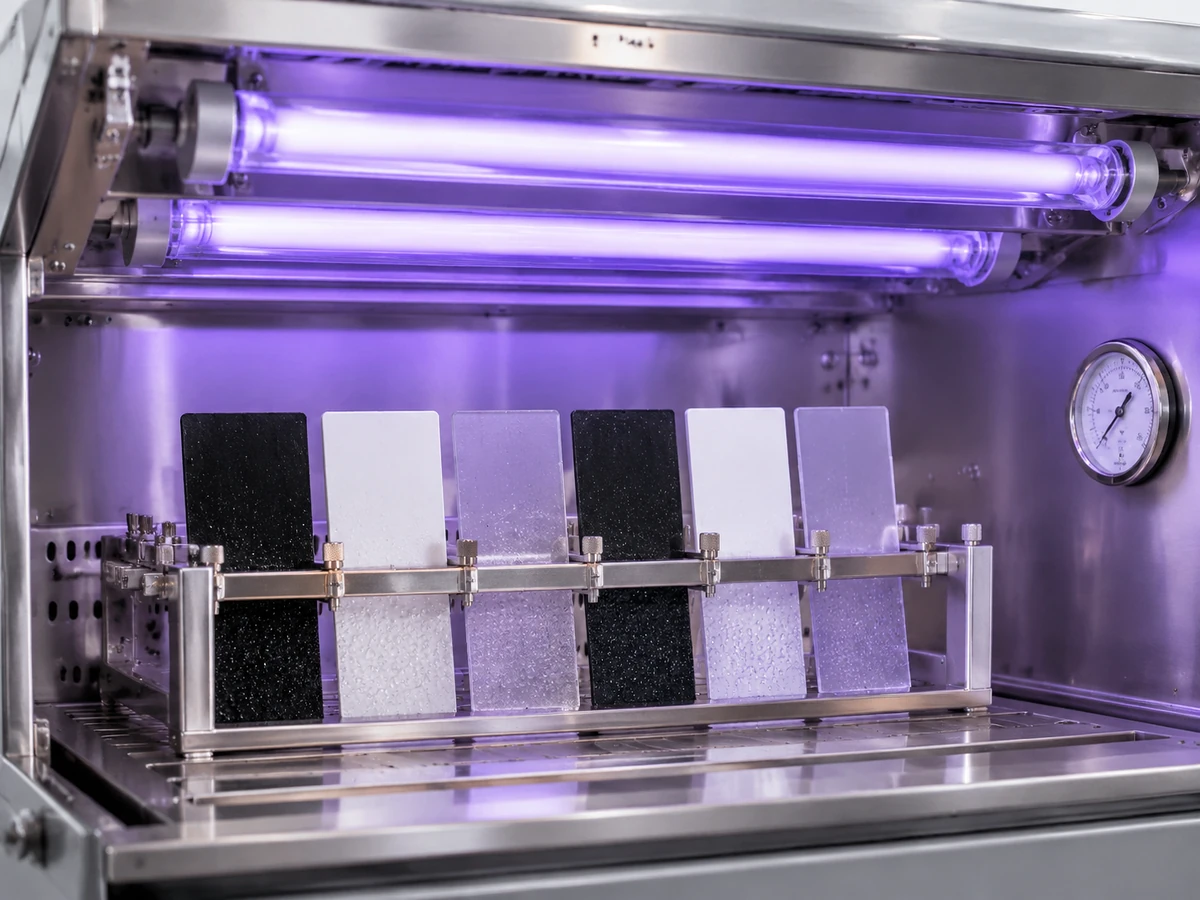
Published site data from an acrylic weathering program gives the annual ultraviolet load on a 25-degree south-facing panel as about 275 to 280 MJ per square metre in Miami and about 334 in Arizona, with Arizona also running hotter and far drier. The same source gives the corresponding chamber rates: a QUV with UVA-340 lamps at 0.76 W per square metre per nanometre delivers roughly 130.6 kJ per square metre per hour over the measured band, so 275 MJ accumulates in about 2,100 hours; xenon arc at 0.55 at 340 nm delivers roughly 169.4, reaching the same dose in about 1,620 hours.
Do the division and you get a useful sanity check on any claim:
| Report says | Rough dose | Equivalent Miami summers | Equivalent Arizona summers |
|---|---|---|---|
| 500 h QUV UVA-340 | 65 MJ per square metre | 0.24 year | 0.19 year |
| 1,000 h QUV UVA-340 | 131 MJ per square metre | 0.48 year | 0.39 year |
| 2,000 h QUV UVA-340 | 261 MJ per square metre | 0.95 year | 0.78 year |
| 1,620 h xenon arc at 0.55 | 275 MJ per square metre | about 1 year | about 0.82 year |
| 3,000 h QUV UVA-340 | 392 MJ per square metre | 1.4 years | 1.2 years |
Two things fall out of that table, and both are uncomfortable.
A 1,000-hour QUV result, which is the most common number in supplier weathering datasheets, is roughly half a Florida summer of UV. It is a fine comparative screening test. It is not a five-year warranty, and a supplier who implies it is has either misread their own test report or hoped you would.
And the conversion is dose, not life. The same radiant dose produces different damage in different materials, at different colours, at different wall thicknesses, at different sample temperatures, and chamber samples run much hotter than a ventilated part unless the cycle says otherwise. Q-Lab has made this point for two decades: there is no universal hours-to-years factor, accelerated data is comparative, and what you can legitimately expect from a chamber is a reliable ranking of candidates, not a service life. A correlation you are entitled to trust is one someone built empirically for their own material, their own cycle, and their own exposure site.
So specify the test in a way that ranks candidates against a control you chose, and buy the years from the field history of that control.
What should the weathering specification actually name?
Six fields, and a report that omits any one of them is not a weathering report. Most supplier documents we receive omit two or three.
| Field | Write this | Why it decides something |
|---|---|---|
| Standard and apparatus | ASTM G154 for fluorescent UV and condensation, or ASTM G155 / ISO 4892-2 for xenon arc | QUV cannot reach below about 295 nm and xenon reaches visible and infra-red, so they heat and wet the sample differently and disagree on some pigments |
| Lamp and wavelength | UVA-340, irradiance controlled at 0.76 W per square metre per nanometre at 340 nm | Without the irradiance, "hours" has no units of damage attached |
| Cycle | For example 8 h UV at 60 degrees black standard temperature, 4 h condensation at 50 degrees | Condensation is where hydrolysable polymers fail; a light-only cycle flatters PBT and PA |
| Dose or duration | 3,000 hours, and state the cumulative dose at the control wavelength | Makes two labs' results comparable |
| Acceptance criteria, per property | Delta E no greater than 3.0, gloss retention no less than 50 percent of initial, and unnotched or notched Izod retention no less than 50 percent | Colour and mechanical degradation are separated by hundreds of hours on most polyolefins |
| Sample geometry and history | As-moulded in the part's wall thickness and skin condition, with regrind percentage stated, plus the mould temperature and gate used | A 4 mm compression-moulded plaque is not your 1.2 mm skin-side weld line |
That last row is where the quiet lies are. Weathering data circulated with a resin grade is usually taken on a standard multi-purpose specimen. Weld-line strength can be a fraction of bulk strength, glass fibre gives anisotropy and a fibre-rich skin, and regrind has already spent part of the additive package before your part exists. If you want a defensible number, weather a part or a plaque moulded from the same tool path, and pull specimens from the same orientation.
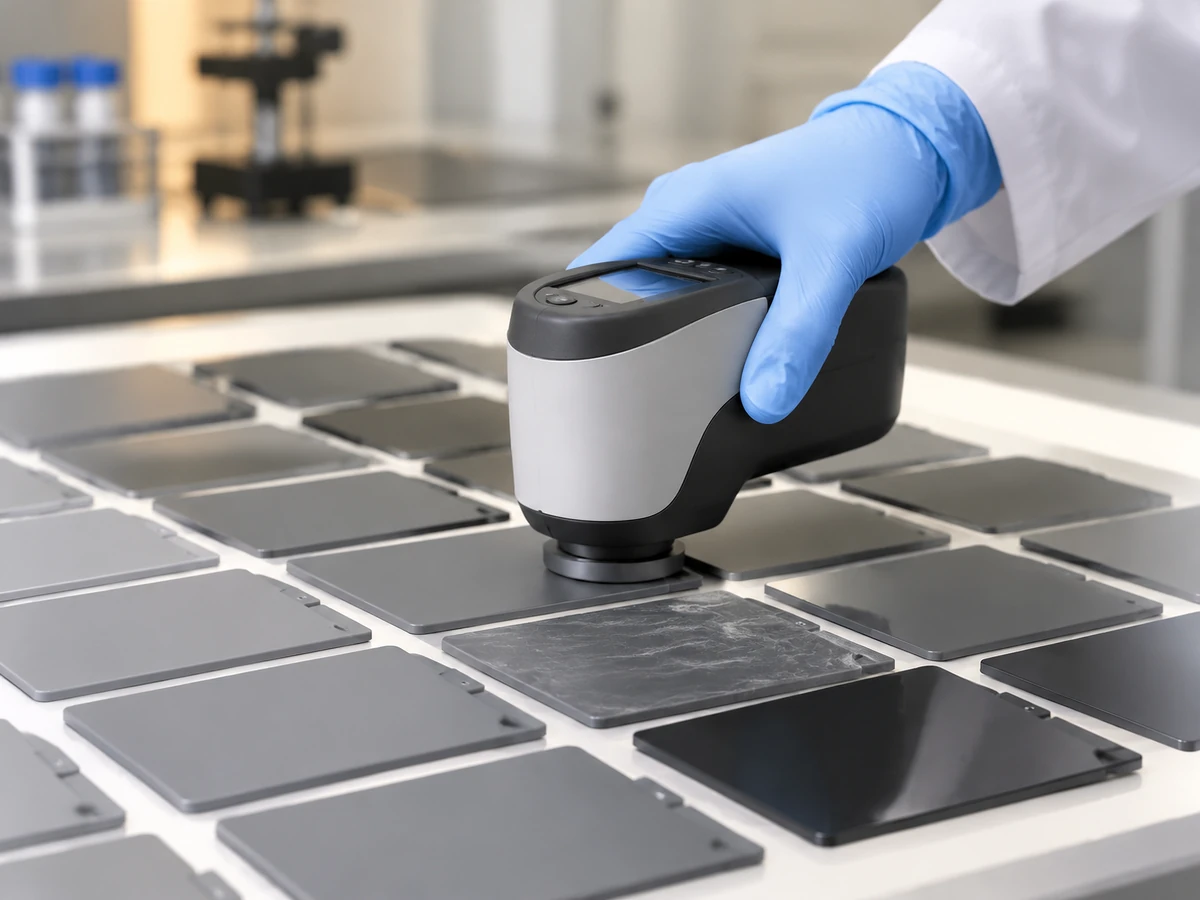
Then measure twice: at mid-point and end. A material at Delta E 2.0 after 3,000 hours is genuinely stable. A material at Delta E 2.0 after 3,000 hours that was already at 1.6 after 1,000 has a knee in the curve and the knee is where your warranty lives.
Does colour decide durability as much as resin?
Often, yes. Three specific mechanisms.
Carbon black. It absorbs across the solar spectrum and converts the energy to heat within the first micrometres, which is why the polyethylene pipe industry has for decades specified a minimum of 2 percent by weight with a primary particle size under about 25 nanometres, and why the benefit plateaus around 2 to 2.5 percent rather than improving indefinitely. It also makes the part hot, which feeds the thermal clock, and it is useless on anything that must be translucent or light.
Titanium dioxide. The white pigment that reflects the sun is also a photocatalyst: in its anatase crystal form it drives oxidation at the surface and shows up as chalk. Rutile is markedly less photoactive and is the form specified for outdoor coatings and plastics. The mitigation is a dense inorganic coating on the pigment particle (alumina and silica typically), and its quality differs between grades at the same stated TiO2 percentage. If your part must be white, ask for the crystal form and the treatment, not the loading.
HALS and everything that eats it. Hindered amine light stabilisers are the workhorse for polyolefins and styrenics, and they are catalytic rather than sacrificial: the regenerated nitroxide radical keeps scavenging, which is why a small loading protects for years. They also fail in specific, predictable company. Acidic species protonate the amine and switch it off, so some pigment dispersions, some flame retardants, and some mould releases knock HALS out locally. Sulfur from contacting rubber gaskets or straps does the same, and anatase TiO2 has been reported as antagonistic while rutile is not much. A white, flame-retardant, HALS-stabilised housing sitting in a neoprene gasket is a formulation trap that no resin datasheet will warn you about.
| Colour or finish | Real effect on outdoor life | Practical move |
|---|---|---|
| Black, carbon black pigmented | Longest life per dollar on PP, PE, PA; raises part temperature | Specify CB loading and particle size; check HDT against the hot-surface case |
| White, TiO2 pigmented | Good if rutile and properly encapsulated; chalks if anatase | Name the crystal form and the surface treatment in the colour masterbatch spec |
| Pastels and light greys | Least shielding; the organic pigments used are often the first thing to fade | Move to an inherently UV-stable resin (ASA, PMMA) rather than buying more stabiliser in a styrenic |
| Translucent | UV passes through the wall; surface effects throughout | Consider UV absorber plus HALS together, or accept a shorter life and design for replacement |
| Painted or coated | The coating carries the weathering, the substrate carries the mechanics | Test the system, not the resin; expect the paint to be the maintenance item |
| Metallic and flake | Flakes orient and can leave micro-paths; pigments vary widely | Weather the actual colour on the actual substrate |
One more consequence worth stating plainly: on a styrenic part, the mould texture shows the degradation before the flat surface does. A fine grain or leather texture concentrates gloss loss and whitening in the peaks, so a textured black handle can look chalky at a dose where a glossy panel of the same compound is unchanged. If appearance is contractual, weather a sample with the drawing's mould finish, not a polished plaque.
How hot does the surface get, and does HDT survive that?
This is the arithmetic that eliminates more resins than UV does.
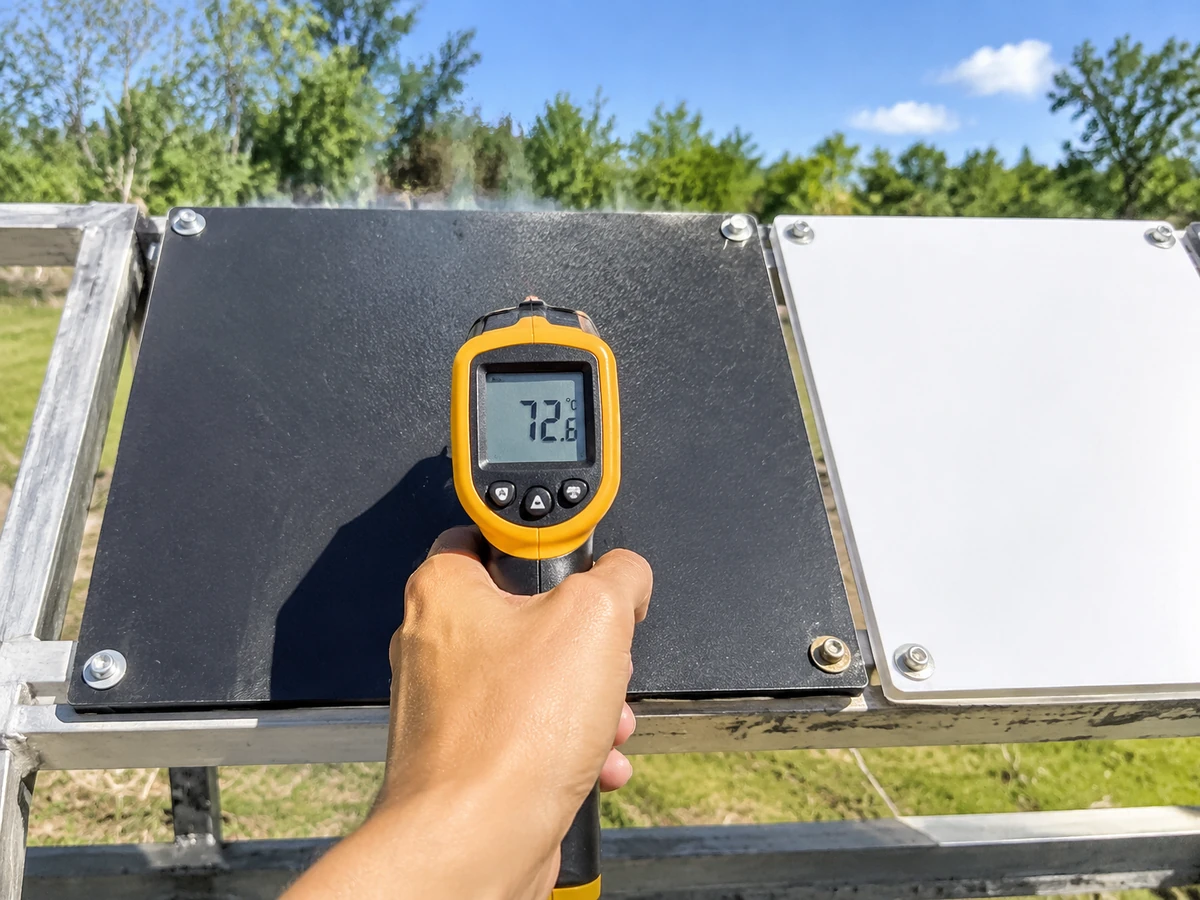
Published coating-industry measurements put a standard black surface about 50 degrees Celsius above ambient in full sun and a standard white about 8 degrees above. Take a 35 degree summer day in a southern US or Gulf market:
- Black ASA housing: surface near 80 to 85 degrees on a still day, less once ventilated.
- Natural or dark PP bracket in the same sun: same 80-plus, against an HDT at 1.8 MPa typically around 55 to 70 degrees for homopolymer PP.
- White PC/ASA blend: about 43 degrees surface, comfortably inside a blend whose heat deflection typically sits above 100 degrees.
surface temperature  =  ambient  +  colour rise
margin               =  HDT(load)  -  surface temperature
   check against:     sustained load, not just shape retention
Three caveats that matter more than the numbers. HDT is measured at a defined stress, and 1.8 MPa is not your boss's stress; a self-tapping screw into a boss can hold a plastic at real stress for years, which is a creep problem, so ask for the creep or modulus retention at temperature rather than defending an HDT. Semi-crystalline polyolefins have low HDT at 1.8 MPa yet serve outdoors for decades in unloading geometries, and a "passing" HDT on a loaded part can still creep a lid shut in two seasons. And dark internal surfaces facing a heat source are worse than the sun, which is the under-hood case entirely.
The practical rule: if the part is dark, load-bearing, and in a hot-sun market, the resin conversation is about creep modulus at 80 degrees and only secondarily about UV. Glass-filled PBT or PA66 black will usually beat a tougher unfilled styrenic there, whatever the impact numbers on the datasheet suggest.
Which outdoor injection molding plastics fit which job, and where does each one end?
A shortlist with a disqualifier on every line, because the useful column is the one that says when to stop.
| Requirement | First choice | Second | The failure that ends it |
|---|---|---|---|
| Opaque housing, impact, no coating budget | ASA | PC/ASA | Cheap "ASA-look" styrenic blends; and stress cracking at screw bosses from a mismatched self-tapping screw |
| Clear, must survive hail or a kick | UV-coated or co-extruded PC | PMMA where impact is not the risk | Coating pinholes and handling scratches; PC's hydrolysis if the coating is breached and the part runs hot and wet |
| Clear, longest optics, low load | PMMA (cast where possible) | UV-PC | Notch sensitivity and solvent crazing, not weathering |
| Cheapest non-structural outdoor part | Black HDPE | Black PP with HALS plus UV absorber | Creep and UV on light colours; and embrittlement when someone buys "PP, black" without the stabiliser package |
| Structural bracket in sun | PA66-GF30 or PA6-GF30, black | PBT-GF30 | PA's moisture uptake moving dimensions and its need for a copper salt or a HALS package; PBT's hydrolysis ceiling in hot, wet service |
| Outdoor electrical, dimensional, dielectric | PBT-GF | PET-based engineering blends | Hydrolysis at continuous high humidity and temperature; check the long-term wet HDT not the dry one |
| Hot, aggressive environment | PPS-GF | PEEK where PPS is too brittle | Cost, and impact weakness with notch sensitivity in a part that gets dropped in the field |
| Seals and gaskets in the same assembly | EPDM or a TPV | Silicone where temperature dominates | Hydrolysing TPU ester grades; and a moulded-in seal that swells in rain and releases the IP rating it was designed to hold |
The seal row deserves a sentence, because it is the commonest outdoor failure we get asked about: the housing survives and the interface does not, and the interface is a compression set problem under thermal cycling rather than a UV problem. Our own version of that failure, a CCTV housing that cracked in the cold rather than fading in the sun, is written up in why outdoor CCTV housings crack in cold weather, and the enclosure-side decisions are in waterproof enclosure design and what actually decides the IP rating.
What does the moisture half of the problem look like in a moulded part?
Two separate issues, routinely confused.
Processing moisture is a molder's problem and it is measurable at the machine. PC, PBT, PA and PET all need drying; polycarbonate wants low tenths of a percent, in practice around 0.02 percent or under at the barrel, with a dryer dew point logged rather than assumed. Miss it and you get hydrolysis in the barrel: chain scission before the part ever sees the sky, showing as silver streaks, loss of gloss and a part that fails a drop test while looking perfect. The full mechanism is in polycarbonate injection molding: moisture, stress and the clarity bill, and the practice behind it in resin drying in injection molding.
Service moisture is a designer's problem and it is not fixed by a dryer. Polyamide absorbs water to equilibrium with humidity, roughly 2 to 3 percent on an unfilled grade at room conditions and lower with 30 percent glass, and that water plasticises the matrix: toughness rises, stiffness and strength fall, and dimensions move by fractions of a percent, which is enough to close a clearance you designed at the lab bench in January. An outdoor nylon bracket swells in a monsoon season and shrinks in a dry winter, every year. PBT and PET do not absorb much water themselves, but their ester links hydrolyse at temperature in wet service, which is why a wet, hot specification deserves a datasheet line for properties after conditioning rather than dry-as-moulded.
If your part is dimensionally critical and outdoor, decide which of these two worlds you are in before you pick a resin. A sliding latch and a bolted bracket have opposite answers.
What does getting it right cost, and what does getting it wrong cost?
Resin prices move with feedstock and freight, so treat these as the multiples we typically see in a bill of materials rather than a quotation, and check your own:
| Material | Relative resin cost | Typical effect on a 60 g part's material line |
|---|---|---|
| PP, commodity | 1.0 | baseline, and unstabilised outdoors |
| HDPE | 1.0 to 1.2 | pennies, and the best outdoor value per dollar |
| ABS | 1.3 to 1.5 | the resin that must be painted to live outside |
| ASA | 1.7 to 2.1 | roughly the same as the paint you were going to buy, without the paint line |
| PMMA | 1.8 to 2.3 | clear, stable, brittle |
| PC | 2.2 to 2.7 | plus drying discipline and usually a coating for outdoor optics |
| PC/ASA blend | 2.2 to 2.8 | buys toughness and weatherability in one moulding step |
| PA66-GF30, PBT-GF30 | 2.2 to 3.0 | buys stiffness and heat, costs moisture management |
| PPS-GF | 6 to 10 | only when nothing else survives the chemistry |
Now put the small number next to the big one. On a housing where ASA costs 0.34 more in resin than ABS, painted ABS is not free: two-coat spray with masking, a handling operation, a defect population, an RMA if the paint lifts, and a coating that becomes the maintenance item. The crossover is the same arithmetic shape as any in-house-versus-outside coating decision, and the inputs are the same three lines: coating price per part, the yield loss on the coating operation, and the returns you will eat when it fails in the field instead of on the line.
A weathering test is not expensive against either number. A G154 run to 3,000 hours on three candidate colours plus a control is a few weeks of elapsed time in a commercial lab and, on the strength of published data, about a year and a half of Miami UV. If you sell outdoor parts in volume more than once, that is the cheapest information you will buy this year, and it is exactly the test to run on the two or three grades you are already arguing about.
How does this sit inside what Ideal Pro does?
We mould the whole shortlist above on one quality system, buy resin through named converters rather than a spot market, and keep lot traceability so that a stabilizer change is a documented event rather than a surprise eighteen months later. Material selection is a DFM conversation we have before quoting, not after, and the resin library our engineers select from is published at plastic materials for injection molding. If you are vetting a supplier rather than a grade, our China injection molding supplier audit checklist covers the questions worth asking in the plant.
Send the exposure profile, not just the word "outdoor": market, mounting orientation, whether it is ventilated, colour or no colour preference, load path, low temperature of the year, and required service life. You will get a shortlist of two grades with a test plan, the cost difference per part, and the sentence we would put in the specification.
Phone and WhatsApp: +86 156 0682 1288 · Email: [email protected]
FAQ
What is the best plastic for outdoor injection molding?
Is 1,000 hours of QUV testing the same as several years outdoors?
Why does my black nylon part measure fine but the assembly will not fit after a wet season?
Does ASA need a UV stabiliser added?
Can I rely on paint instead of choosing a weatherable resin?
About the Author

Alex Yu
Ideal Pro Manufacturing
Alex is the co-founder of Ideal Pro, but when he's not overseeing key projects or steering the technical team, you'll likely find him on a long bike ride, hunting for the best coffee in town, or planning his next travel adventure. With over 20 years of experience spanning international trade sales and project management, he's seen it all — tight deadlines, tricky engineering problems, and everything in between. He believes great work comes from a well-rested mind and a good cup of coffee, and he brings that same curiosity and attention to detail to every project he takes on. When he's not in the office, he's usually somewhere outdoors, exploring new places and collecting stories to share.


 English
 French
 Dutch
 German
 Japanese
 Korean