

A customer once sent us a drawing for a small pump impeller. The material call on the print read “PA66,” nothing more. The parts came out of the mold looking fine. Three weeks later they were failing in his test rig: one tooth in five, cracking right at the root. It was never a molding problem. The impeller ran in warm water, the nylon quietly absorbed moisture, its crystal structure relaxed, and a part that felt stiff on the bench turned soft in service.
Nylon does that. And it’s also why people keep coming back to it, once you understand what’s going on inside the material. This is the custom nylon injection molding guide we wish someone had handed us early in the shop: what nylon actually is, how the PA6 / PA66 / PA12 family splits, what glass fiber really buys you, and when the honest answer to “can we mold this in nylon?” is no.
Custom nylon injection molding means turning a drawing into production parts in polyamide (PA): picking between PA6, PA66, and PA12, reinforcing with glass fiber when the part needs stiffness, and running the process with the drying and conditioning discipline nylon demands. Nylon earns its place on the material rack because it is a semi-crystalline engineering thermoplastic that combines toughness, self-lubricating wear, and chemical resistance in one resin. Pure grades carry tensile strength of roughly 70-90 MPa; glass-filled versions push past 200 MPa with moduli in the 8-11 GPa range, which is how a 1.14 g/cm³ plastic ends up replacing aluminum or die-cast zinc in brackets, gears, and under-hood connectors. The grade you pick and the drying discipline behind it (under 0.2% moisture) matter more than almost anything else on the machine.
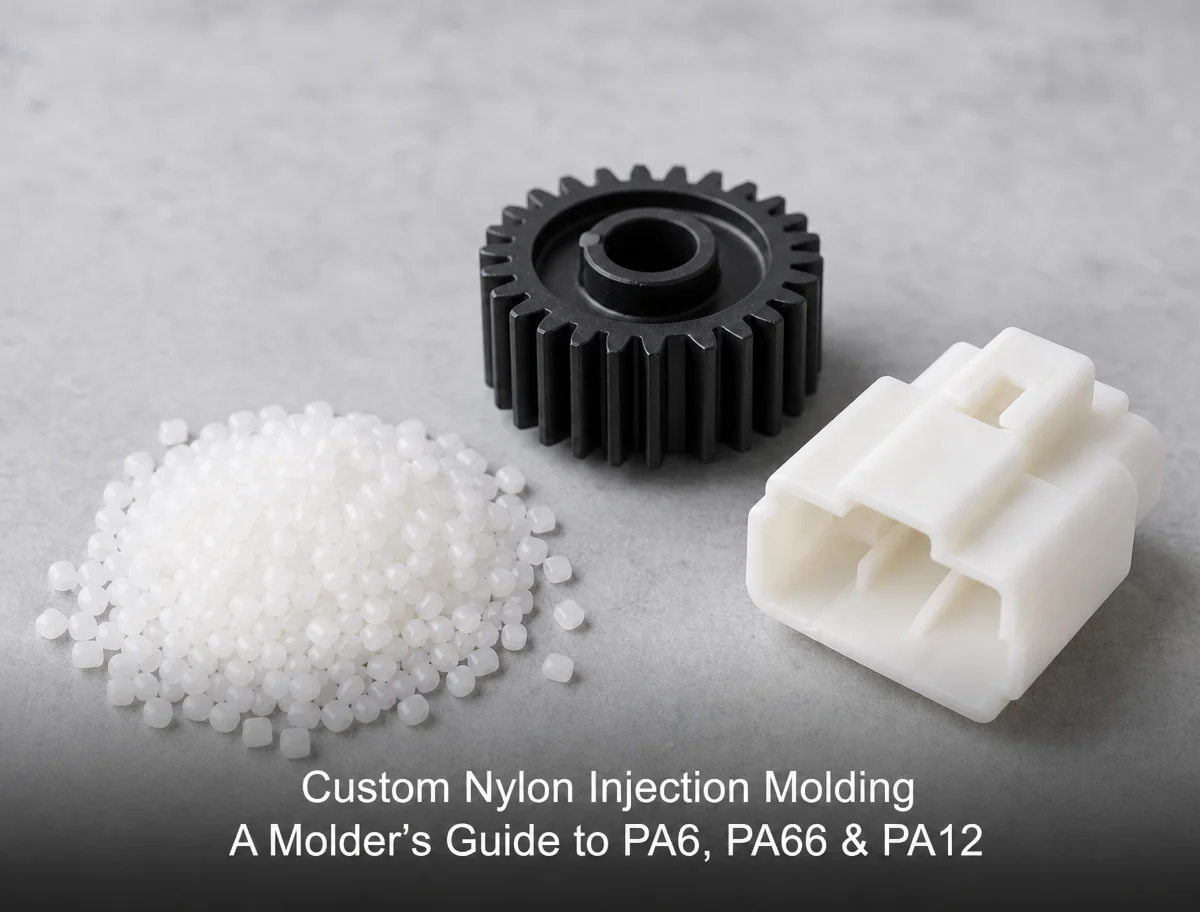
Key Takeaways
- Nylon is a family, not one resin. PA6, PA66, and PA12 differ in melting point, stiffness, moisture uptake, and price; “nylon 6” and “PA6” are the same material wearing different name tags.
- Water is the dial. Nylon equilibrates at 2-8% absorbed moisture depending on the grade, and its strength, stiffness, and dimensions all move with it. Design the wet state, not the dry one.
- GF30 buys stiffness, spends impact. Glass fiber roughly triples modulus and more than doubles tensile strength, but it makes the part direction-dependent, notch-sensitive, and hard on tool steel.
- Post-mold movement is normal. Nylon keeps crystallizing and absorbing water after it leaves the mold. Conditioning in the shop, not on your assembly line, is how dimensional stability gets locked in.
- Naming is a trap. “Nylon 6/6” and “PA66” are the same resin, and “nylon 66” on a drawing can quietly become PA6-GF30 on a purchase order. Match the codes before the tool is cut.
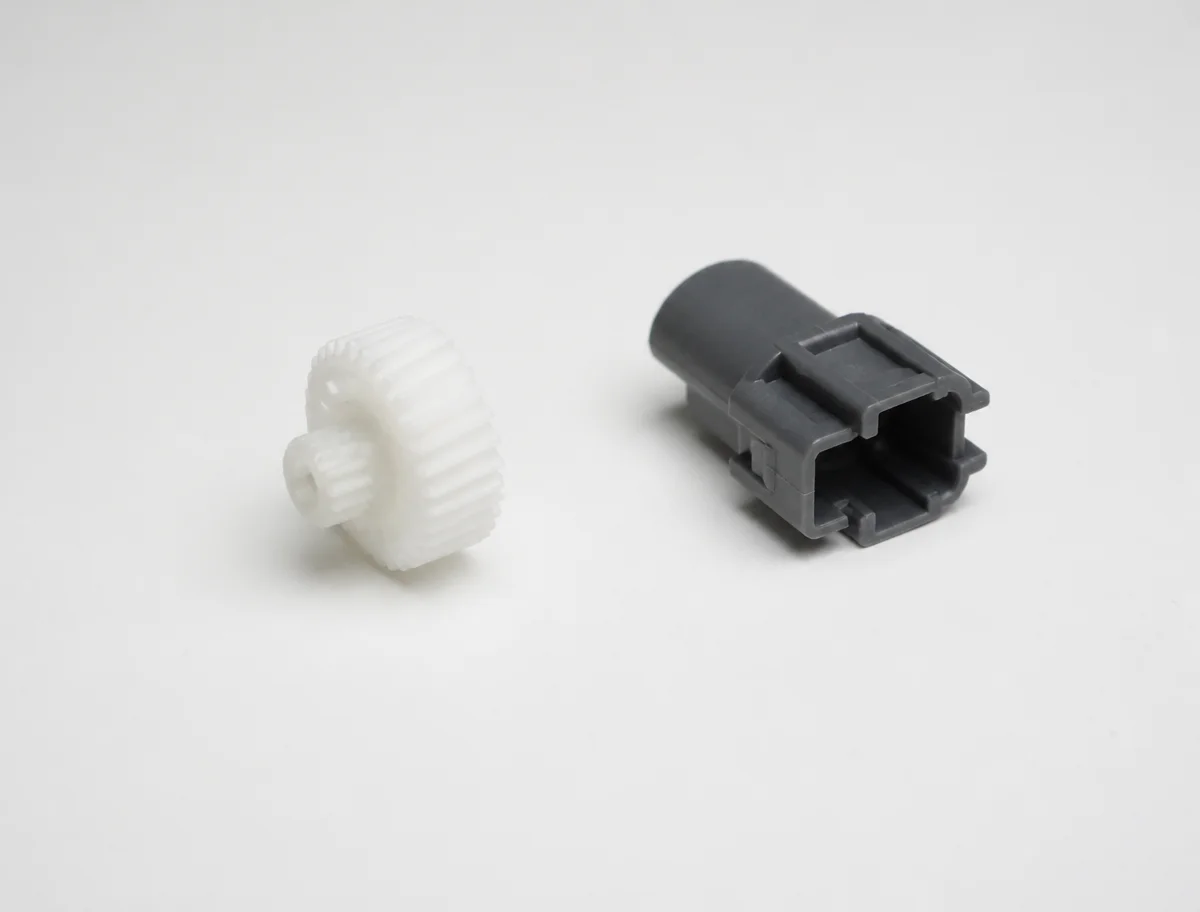
Why a Molder Wrote This Guide
Most nylon articles on the internet are written by material suppliers selling resin or by engineers who have never opened a mold. Both have a point of view, and neither is the one a part buyer needs.
We are Ideal Pro, a custom injection molding shop, and custom nylon injection molding runs on our floor every week: pump housings, drive gears, connector bodies, sensor brackets, and fluid-system parts for automotive, electronics, and medical customers. We run under IATF 16949 and ISO 9001, and the failures we see in nylon repeat the same three ways, season after season: parts designed on dry datasheet values, resins that never got properly dried, and tolerances that ignore what crystallinity does overnight. This guide is written from that bench experience, and where we give numbers, they are the numbers we actually run. We have watched good designs die in a datasheet column, and bad ones survive because the person at the machine caught what the print never said. This is the latter kind of knowledge.
What Exactly Is Nylon Plastic?
Strip away the brand name and nylon is a polyamide: a long-chain thermoplastic whose segments are linked by amide groups (-CO-NH-). Those amide bonds are the whole story. They form hydrogen bonds with neighboring chains, and those hydrogen bonds let the material crystallize in organized sheets. Crystallinity is where nylon gets its abrasion resistance, its chemical resistance, and most of its stiffness. Remove the water and heat long enough and those bonds break down; that is why nylon hates prolonged exposure above its limit temperature, and why drying the resin before molding is not optional.
There are two main ways to build the chains, and the route changes the material:
- PA6 (nylon 6) is made from a single monomer, caprolactam, opened up and polymerized. One building block, repeating forever.
- PA66 (nylon 6/6) is a condensation of two monomers, adipic acid and hexamethylenediamine. Two blocks, alternating. Because the repeat unit packs with slightly more amide bonding per mass, PA66 runs hotter and stiffer than PA6.
- PA12 (nylon 12) uses a much longer diamine chain. Fewer amide bonds per unit length means lower crystallinity, which means a tougher, more chemical-resistant, more expensive material.
The naming is a mess, and it confuses buyers. “Nylon” is a DuPont trademark from 1939 (the chemistry goes back to Wallace Carothers’s condensation work at DuPont in 1935); “polyamide” or “PA” is the chemical family. Nylon 6 = PA6. Nylon 6/6 = PA66. Nylon 12 = PA12. When a print says “nylon 66” and the buyer order says “PA6-GF30,” someone is about to get the wrong part.
One more thing worth knowing: the nylon in your stockings and the nylon in a fuel line are cousins, not twins. Textile nylon is a different (usually lower-strength) grade, drawn into fiber, while engineering nylon is extruded into pellets for molding. Same chemistry family, very different jobs.
The Family: PA6 vs PA66 vs PA12
Here is how the three workhorses compare, with the values we use in material selection (virgin, dry, as-molded reference states):
| Property | PA6 (nylon 6) | PA66 (nylon 6/6) | PA12 (nylon 12) |
|---|---|---|---|
| Melting point | ~220 °C | ~260 °C | ~240 °C |
| Typical melt processing | 240-270 °C | 260-290 °C | 250-280 °C |
| Equilibrium moisture (saturation) | ~6-8% | ~2.5-3% | ~4-5% |
| Tensile strength (dry) | 70-80 MPa | 80-90 MPa | 60-80 MPa |
| Modulus (dry / wet) | ~2.2 / ~1.5 GPa | ~2.8 / ~1.6 GPa | ~1.5 / ~1.2 GPa |
| HDT (unfilled) | 65-75 °C | 70-80 °C | ~75 °C |
| Crystallization speed | Fast | Fast | Slow |
| 비용 | Lowest | Mid | Highest |
| Where it wins | General structural, clips, housings | Gears, connectors, under-hood | Fuel lines, tubing, extreme abrasion |
Read down that table and the pattern is simple. More amide bonding per mass gives you a higher melting point and more stiffness, which is why PA66 outruns PA6. Longer carbon chains give you toughness and chemical resistance at the cost of price, which is why PA12 earns its keep in fuel and fluid systems where it sits for a decade without softening.
If your part is a general structural piece that needs to be cheap and mold fast, PA6 is the default. If it takes heat, load, or both, PA66 is the default. If it lives in fluid, PA12 is worth the premium. Everything else is a discussion we are happy to have about your part, not a guess.
Why Do Engineers Reach for Nylon?
Ask ten engineers why a part is nylon and you will get ten different one-word answers: tough, strong, wears well. All of them are right. Here is what is actually happening under the hood, in the order it usually matters:
1. It wears without greasing. Nylon’s coefficient of friction against steel is roughly 0.1-0.3, dry. That is why gears, bushings, and slideways are nylon while the mating surface stays steel. No lubricant to degrade, no seal to keep alive. A PA66 worm gear in a small appliance can run a million cycles and never see a drop of oil.
2. It takes a hit and keeps going. Nylon is tough in the materials-science sense: the area under the stress-strain curve, not just the peak. And unlike most polymers, getting wet makes it *more* ductile. Water plasticizes the amorphous regions, so a nylon part in a humid environment is less likely to shatter than the same part bone dry. Designers who spec on dry-lab values get surprise brittle failures; this is the first section of most failure reviews.
3. Filled, it is structurally honest. PA66-GF30 carries about 180-220 MPa tensile and 8-11 GPa modulus, with heat deflection around 160-180 °C. That is a material that holds 0.05 mm fits under heat while weighing a tenth of steel. Brackets, connectors, housings.
4. It shrugs off the stuff in a machine. Oils, greases, fuels, de-icing fluids. Nylon does not care about most of what it meets under the hood. Strong acids and sustained UV are the exceptions, and we will come back to both.
5. It replaces metal at a real weight saving. At 1.14 g/cm³, nylon takes roughly 40-50% weight out of a steel or zinc die-cast part, and at volume the molding cycle (20-30 seconds, multi-cavity) beats machining on cost. That math is why “plastic for metal” programs keep landing in PA66-GF30.
The moisture duality deserves its own paragraph, because it is the concept that separates people who design with nylon from people who design with it accidentally. Dry nylon is stiff and brittle; saturated nylon is softer and tougher; the part in between is wherever your assembly environment happens to be. So we design and dimension for the *wet* state, and if the spec says otherwise, we say so in the DFM report.
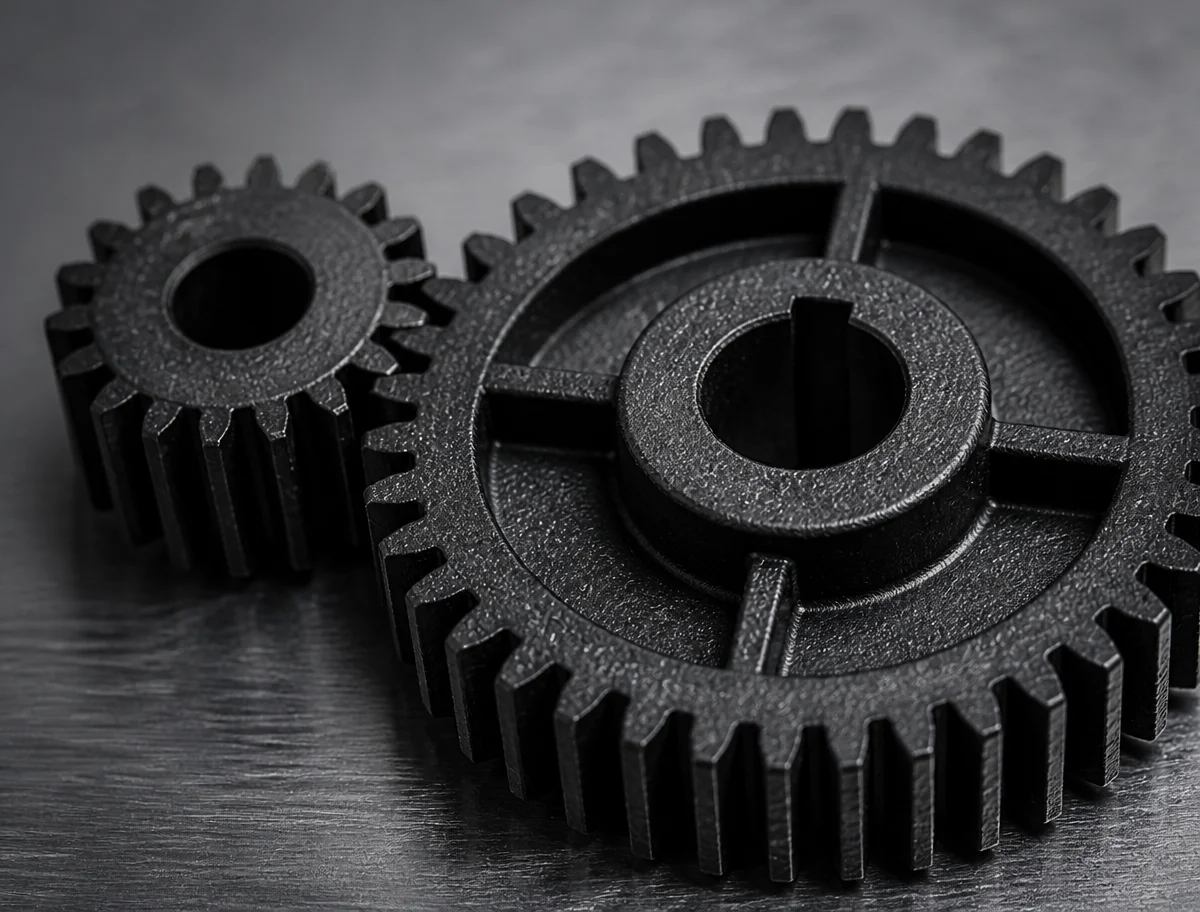
Reinforcement: What GF30, CF, and MF Actually Do
Pure nylon is tough, but it is not rigid, and it is not stable across a humidity range. That is what the fillers are for, and each one is a different trade:
Glass fiber (GF30, GF40, GF50) is the workhorse. Thirty percent by weight of glass fiber takes PA66 from ~2.8 GPa to ~10 GPa in modulus and from ~85 MPa to ~200 MPa in tensile. Heat deflection roughly doubles. The costs, and they are real:
- Anisotropy. Fibers align with the flow. A part that is stiff across the gate direction is measurably weaker along it. Where the fibers point is decided by gate location and runner design, which is why we simulate before tooling on anything loaded.
- Notch sensitivity. Impact strength drops sharply at sharp corners. That little 0.1 mm sharp interior radius in your CAD is where the part will break.
- Fiber float and frothing. At the surface, fiber-rich melt can flash out as haze or tiny protrusions. It is managed with mold temperature and gate size, not ignored.
- Tool wear. Glass is abrasive. We run bimetal barrels and hard-chrome or ceramic nozzles on GF grades, and tool life is tracked accordingly.
Long glass fiber (LGF) keeps fiber lengths above 2 mm instead of shearing them down, which buys back much of the impact strength and tames the anisotropy. It costs more and wants gentler screws.
Carbon fiber (CF) is for maximum stiffness and stiffness that conducts: dissipation for EMI-sensitive housings, conductivity for antistatic parts. It is the most expensive filler in the lineup and the hardest on tooling.
Mica (MF) is the quiet alternative: cheap, and it flattens shrinkage in the mold plane, which helps flat, dimensionally critical parts. It is more brittle than glass, and nobody pretends otherwise.
Whatever the fill, one rule from the floor: filled nylons want higher mold temperatures (commonly 80-120 °C for GF30) so the melt skins late and the surface stays clean. A “hot part, cold mold” setup is how you end up with frosted parts that fail a cosmetic check.
How Nylon Behaves in the Molding Process
In custom nylon injection molding, three things decide whether a part is good, and all three happen before the shot is even fired:
Drying is the whole ballgame. Nylon is hygroscopic, and moisture in the melt does three bad things at once: it causes splay and silver streaks on the surface, it hydrolyzes chains and quietly destroys impact strength, and it makes shrinkage unpredictable. We dry PA66 on a dehumidifying dryer at 80 °C for 4-8 hours to under 0.2% moisture, and the dryer stays on for the entire production run, not just the first hour. If a supplier quotes you nylon without mentioning drying, ask follow-up questions.
Crystallization keeps working after ejection. Nylon is semi-crystalline, and the crystal structure continues to grow for hours after the part cools below its melt. That is why a nylon part measured at 1 a.m. is a different part at 5 p.m., and why “the mold is fine, the part changed” is not an explanation, it is a symptom. We control it with mold temperature (which sets final crystallinity), holding pressure (which compensates for the shrink it causes), and, on anything dimensional, a conditioning step.
Conditioning moves the part to its final size in our shop. A water boil or a 100 °C water soak forces the moisture content to equilibrium while the part is constrained, so it arrives at your assembly cell at its final, larger dimensions instead of growing 0.3% and failing a fit check on line. For tight-tolerance parts this step is the difference between a Cpk of 0.8 and a Cpk of 1.6. The factors that actually affect precision in injection molding are covered in detail in our precision guide, but for nylon the two that dominate are moisture and crystallinity.
On the machine itself, nylon is well-behaved: PA66 runs at 260-290 °C melt, moderate pressures, 20-30 second cycles. Filling thin walls is the usual challenge, and the standard playbook for fixing short shots in injection molding applies. Appearance has its own quirks with filled grades, and if color is part of the spec, the performance requirements for colorants in nylon parts are worth a read before the first shot, because a pigment that is fine in ABS can discolor in a 280 °C PA66 barrel.
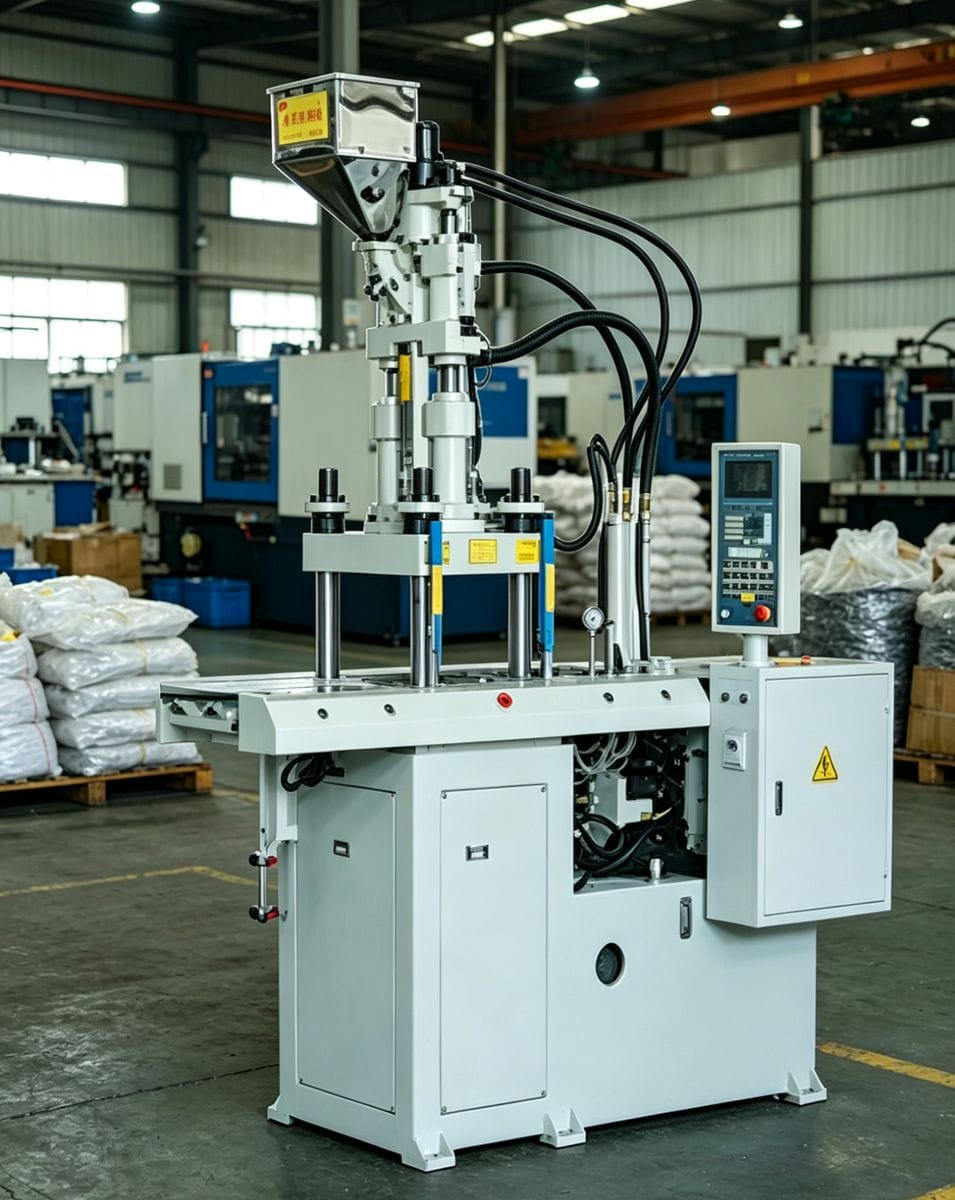
When NOT to Use Nylon
We would rather lose the job than ship a part that degrades, so here is the honest list. If your application sits in any of these rows, we will usually talk you off nylon:
- Dimensions that cannot move ±0.3-0.5% across humidity. If a fit must hold from a desert to a marine environment without conditioning and design tolerance, look at PBT or PC, which are far less moisture-sensitive.
- Sustained heat above ~150-180 °C. Even GF30 nylon creeps at automotive under-hood peaks. Above that, PEEK or PPS is the conversation.
- Unprotected outdoor UV. Nylon amide bonds photodegrade; parts turn amber and embrittle. UV-stabilized or carbon-black grades exist and cost extra, but “white nylon in the sun for five years” is a failure waiting for a date.
- Constant immersion with load. Creep gets worse wet. PA12 handles it best, but if the part is submerged 24/7 under load, check the creep curves before committing.
- High volume, low load, tight budget. If the part is a cosmetic clip that never sees stress, PP or ABS will do the job at a third of the resin price. The cheapest part is often the one that never needed an engineering resin in the first place, and the first line of our DFM report is frequently “you do not need nylon here.”
Case Study: A Warped PA66-GF30 Bracket, Fixed
Last year a sensor maker sent us a bracket for custom nylon injection molding: 140 mm across, 2.5 mm wall, PA66-GF30, with a 0.4 mm flatness call on the mounting face. Their previous vendor’s parts were bowing up to 1.1 mm across the diagonal, and it was not consistent from cavity to cavity.
The root cause took one afternoon to find and is worth knowing, because it is the most common warpage story in filled nylon: the mold was temperature-asymmetric (one half running ~40 °C, the other ~90 °C), holding pressure was cut short to chase cycle time, and nothing was conditioned. Asymmetric cooling plus crystallization anisotropy plus fiber orientation at the weld line is a recipe for a bow that changes every time you look at it.
The fix was unglamorous. Multi-zone mold temperature control holding both halves within ±1.5 °C at 95-110 °C. A two-stage packing profile that holds pressure while the gate freezes. And a 100 °C water conditioning step for two hours before any part got measured. The bracket then held 0.15 mm of bow across the diagonal, the flatness feature ran Cpk 1.5 over the full audit, and the 16-cavity tool settled into a 24-second cycle with a 99.2% first-pass yield. The customer stopped sorting parts by feel.
No exotic material. No new machine. Just the three boring things done properly.
자주 묻는 질문
What is custom nylon injection molding?
It is what we do: you send a drawing with a nylon material call (or no call at all, which is half the job), and we deliver production parts with the grade, reinforcement, drying, and conditioning matched to where the part will actually live. The service spans DFM, tooling, molding, and inspection, and the first 24 hours of it are free. The questions below are the ones our engineers answer most often.
Is nylon a plastic? What is it made from?
Yes, nylon is a plastic: an engineering thermoplastic in the polyamide (PA) family. It is made by polymerizing diamines with dicarboxylic acids (PA66) or by ring-opening a single monomer (PA6). The amide linkages between the chains are what give nylon its strength and wear resistance.
What is the difference between PA6 and PA66?
PA6 comes from one monomer (caprolactam); PA66 comes from two (adipic acid and hexamethylenediamine). PA66 melts higher (~260 °C vs ~220 °C), runs stiffer and more heat-resistant, and is the default for loaded parts. PA6 is cheaper, crystallizes fast, absorbs more water, and suits general structural work. When in doubt between the two for a loaded part, we default to PA66.
How much water does nylon absorb, and does it matter?
A lot, by polymer standards: PA66 equilibrates around 2.5-3% moisture, PA6 around 6-8%. It matters because stiffness, impact, and dimensions all shift with it. A part molded dry and shipped dry will grow and soften in your warehouse. We design and dimension for the wet state and condition parts before shipping.
Can nylon be used outdoors?
Yes, with caveats. UV breaks down amide bonds, so outdoor parts need UV-stabilized grades or a carbon-black masterbatch, and the service life should be checked against the stabilizer package. White nylon left in direct sun will yellow and embrittle.
What tolerance can you hold on a nylon part?
For small-to-medium parts, ±0.05-0.1 mm is routine on GF30 grades once conditioning and mold temperature are locked. Beyond that, the honest answer is “it depends on the geometry and the humidity range,” which is exactly the question a DFM review settles.
How much more does PA66-GF30 cost versus pure PA66?
Roughly 30-60% on the resin, plus faster tool wear on the shop side. The premium buys stiffness, heat deflection, and dimensional stability, which is why it is the default for anything loaded. If the part is not loaded, that premium is just cost, and we will say so.
Do you offer a free DFM for nylon parts?
Yes. Send the drawing to our engineering team and you will get a written DFM review within 24 hours: material call, fiber orientation plan, drying and conditioning route, and a realistic tolerance assessment. It is the fastest way to find out whether your part is a nylon part at all. Request it here.
Summary: Nylon, Honestly
Nylon has sat on material racks for about ninety years, and it is still there for the same reason it is on your bench: it works, it is not expensive, and it is honest with you if you respect it. It is a family of tough, self-lubricating, chemically resistant polyamides that turn into excellent structural plastic the moment you follow two rules: pick the right grade for the environment, and manage the water. PA6 for the general, PA66 for the loaded, PA12 for the fluid. Glass fiber when you need stiffness, with your eyes open about anisotropy and impact. Dry the resin, control the mold temperature, condition the part, and the dimensions stop being a surprise.
If you have a drawing with “PA66” on it and a tolerance you are nervous about, that is a conversation worth having before the tool is cut. Send your part to the Ideal Pro engineering team and get the custom nylon injection molding plan, material call, DFM, and process route, in writing within 24 hours.

 English
 French
 Dutch
 German
 Japanese
 Korean