 한국어



Every buyer eventually learns the same lesson from the same direction: the company that quoted them is not the company that will mold their part. The question trading company vs direct injection molding factory is usually asked as a morality tale — honest factory, greedy middleman — and that framing is useless. Intermediaries exist because manufacturing across a language barrier is genuinely hard, and some of them add more value than they charge for. The useful question is narrower: what does the extra layer cost on my specific program, what does it actually buy me, and can I verify with documents which one I am dealing with before I cut steel?
We are a direct manufacturer — our own mold shop, our own presses, our own finishing lines — so read the arithmetic below with that bias in mind. Our own plain-language overview of the factory-versus-trader decision covers the basics; this article is the decision layer: the margin math, the containment economics, twelve document tests with their failure modes, and the contract language that makes the difference matter even when you deliberately choose a middle.
What is the actual difference between a trading company and a direct injection molding factory?
The difference is not size, branding, English quality, or whether the website shows a factory photograph. It is where three specific things physically sit: the machine that runs your part, the steel that shapes it, and the person who can change a parameter today.
| 속성 | Direct injection molding factory | Trading company or broker |
|---|---|---|
| Owns or leases the presses | Yes, on the audited site | No, contracted with one or more plants |
| Owns the tool room | Often yes, or a captive affiliated shop | Almost never |
| Business license scope | Manufacturing of plastic products | Wholesale, trade, import-export services |
| VAT invoice line items | Named parts, molds, tooling services | Generic goods, services, or the same part names bought upstream |
| Who answers a DFM comment | The engineer who will run the part | A relay, then the engineer |
| Who absorbs a process error | Owns the scrap and the re-run | Claims it upstream, passes your schedule risk back |
| Price structure | Cost of process plus one margin | Cost of process plus plant margin plus their margin |
| Typical service breadth | Deep in one process family | Wide across categories and suppliers |
Both structures can deliver good parts. Only one of them can change a molding parameter while the material is still hot, and that single capability is what most of the money in this decision is actually about.
What does the middle layer cost on a real program, line by line?
Take an ordinary program and price the layer. Tooling $34,000, 320,000 parts per year, direct-factory piece price $1.28. Typical intermediary marks we see quoted on tooling run 10–15% and on piece price 8–12%; we will use 12% and 9%.
| Line | Direct factory | Through an intermediary | 프리미엄 |
|---|---|---|---|
| 공구 | $34,000 | $38,080 | $4,080 |
| Piece price | $1.2800 | $1.3952 | $0.1152 per part |
| Annual part spend at 320,000 units | $409,600 | $446,464 | $36,864 |
| Three-year part spend | $1,228,800 | $1,339,392 | $110,592 |
| Three-year program total | $1,262,800 | $1,377,472 | $114,672 |
| Premium as share of direct cost | — | — | 9.1% |
| Premium as share of what you pay | — | — | 8.3% |
State the premium both ways, because the two numbers get used in different arguments: 9.1% of your true cost, or 8.3% of every invoice you will ever receive.
Three second-order costs rarely appear in the same spreadsheet. The first is payment float: if the intermediary pays the plant at net 30 and bills you at net 60, you are financing thirty days of their working capital. At a 12% cost of capital that is 30/365 × 12% = 0.99% of annual spend, or $4,055 per year on this program — a real cost to you, a real income line for them.
The second is minimum order quantity inflation. An intermediary who carries no inventory risk of their own protects their margin by setting MOQs that suit the plant's production batching rather than your consumption, and the difference between 5,000-piece pulls and 20,000-piece pulls is warehouse space, obsolescence and cash. Our own low-volume program page exists precisely because 100-to-10,000-part orders are an engineering problem, not a favor.
세 번째는 change latency, which is where the biggest hidden number lives. A DFM comment that goes through a relay costs the round trip — typically three to six working days for a written answer that would have taken an hour on the floor — and the ECN count on a first-year program is routinely six to ten. Multiply the loop by the schedule consequence rather than the labor cost, and the relay is often dearer than the margin.
Where does that margin actually go, and when is it earned?
Be fair to the middle layer, because two thirds of the price difference is not profit. An honest breakdown of what a competent intermediary is paying for:
| What the margin funds | Typical value to you | When it is genuinely earned |
|---|---|---|
| Sourcing across categories | One PO, one inspection, one freight booking | Multi-category programs, small volumes per SKU |
| Language and negotiation | Faster commercial resolution | When staffed by people who have run a mold, not translators |
| Export compliance and freight | Fewer customs errors | When they hold the AEO or C-TPAT equivalent and file themselves |
| Consolidation and packaging | Lower freight per unit | When they have real volume on the lane |
| Own QC headcount | An extra inspection layer | Only when they show inspection records in their own name |
| Payment terms | Cash-flow smoothing | Only if you would otherwise be asked to prepay |
| Financial float for you | None, unless they fund it themselves | Rarely; check who carries the receivable |
The line to scrutinize is the fifth. An intermediary with its own inspectors, its own AQL plan, and its own report format signed by a named quality engineer is adding a control point. An intermediary whose QC report is the factory's report with the header replaced is adding a markup. Ask for the inspection records of a previous shipment and see whose letterhead and whose inspector's name appear — and ask whether you may phone that inspector.
Why can process control not be bought second-hand?
Injection molding is a state, not a spec. Melt temperature, injection profile, holding pressure and time, cooling balance, and back pressure all sit inside a window, and the window drifts with humidity, regrind fraction, screw wear, ambient temperature and material lot. Holding ±0.02 mm across a million shots means someone is watching the process record, not just the part.
When the information path is long, two things degrade. Detail decays: a nine-point DFM report that passes through a relay typically returns as three points, because the intermediary forwards conclusions rather than physics, and the six dropped points were where the risk lived. Authority decays: the person who can stop the machine is not the person you are talking to, so a containment decision waits for a translation, a quote, and a commercial argument about who pays.
Model the consequence rather than arguing about intent. Use your own probabilities; the structure is what matters:
| 이벤트 | Per year, direct | Per year, through a middle | Cost per event | Expected cost, direct | Expected cost, middle |
|---|---|---|---|---|---|
| Cosmetic lot rejection | 0.10 | 0.25 | $8,500 | $850 | $2,125 |
| Dimensional drift beyond Cpk target | 0.05 | 0.15 | $14,000 | $700 | $2,100 |
| Undeclared material or colorant substitution | 0.02 | 0.08 | $22,000 | $440 | $1,760 |
| Documentation gap discovered at audit | 0.08 | 0.20 | $6,000 | $480 | $1,200 |
| Total expected containment cost | $2,470 | $7,185 |
On this model, the information path costs $4,715 a year in expected containment before you count a single air shipment. Change the probabilities to your own experience and re-run it; the point survives a wide range of inputs because the middle column is a ratio, not a guess. If you want to see what good looks like on paper before you compare, our 품질 계약 가이드 sets out inspection plans, Cpk targets and containment duties in the form you should expect back.
Which twelve tests separate the two in 48 hours?
Every one of these is a document request or a twenty-minute call. None requires travel. Each row also states what the test cannot prove, because a single passing test has never convicted or acquitted anybody.
| 시험 | 이것이 증명하는 것 | 이것이 증명하지 못하는 것 |
|---|---|---|
| Business license scope lists manufacturing of plastic products, not wholesale or trade only | Legal capacity to produce at that address | That they actually produce there today |
| Registered address equals the plant address on the license and the certificate | The entity, site and paperwork align | That your part will run on that site |
| Social insurance participant count against claimed headcount | Workforce of plausible size for the claimed floor | Shift structure, or contract labor |
| VAT invoice line items name parts and molds | The entity sells what it claims to make | Who physically made them |
| Export declaration shows the plant as manufacturer | Direct export relationship | That the exporter does not own the plant |
| ISO 9001 certificate checked at the accreditation body, holder name and site address match | A managed system at that address | Scope creep — read the certificate scope line |
| Mold clamping plate carries a serial, and design drawings use the shop's own part numbering | The tool exists where they say it does | Tool ownership; that is a contract term |
| Resin certificate of analysis traceable to a lot and a converter whose address matches | A real material chain | That the lot was actually used |
| Live video at the press during your T1 shot, mold serial and today's date on paper | The machine, the tool and the shift are real | Long-run capability |
| Electricity account at the plant address in the entity's name | Industrial load, not a desk | Which entity pays it, if a landlord does |
| Contractual right to an unannounced third-party audit at the plant | They are not hiding the site | Anything about the process, until you use the right |
| Named texture, paint and plating trades, with their invoices addressed to the factory | One accountable chain | That they will not quietly switch trades |
Run the pattern, not the individual test. Five of these cost nothing and can be requested in one email; a supplier who is a real factory will usually answer them within two working days because the documents already exist. A relay has to ask somebody, and the delay is itself informative. Our 공급업체 감사 체크리스트 turns these into a scored audit you can hand a third party.
Can a genuine factory fail one of these tests?
Constantly. Assuming a failed test proves a trader is how buyers reject good suppliers, so treat the following as the mirror image of the previous table.
| Why a real factory can fail a test | How to tell it is benign |
|---|---|
| Tooling is cut by a captive or affiliated mold shop, so the molder's license does not list mold making | The tool room is on the same site or a named sister address, and both appear in one audit |
| The group uses a separate export entity, so customs records name a trading company | The export entity's address is the plant's, and you are given a tripartite manufacturing agreement |
| Certificate scope reads sales only, while the manufacturing site holds a second certificate | You can see both certificates and the site audit report |
| Headcount on social insurance looks low because night shift and assembly are contracted | Press logs, maintenance tags and shift rosters are consistent with the volume claimed |
| Production moved to a second site without updating the certificate | A real risk: insist the certificate names the site that will run your part |
| One process, such as plating, is genuinely outsourced | They name the trade, distance and their own incoming inspection — which is normal |
The last two rows are the ones that bite. A certificate that names a site you never audit is a documentation problem, not a fraud problem, and it is worth a contract clause. And when a supplier's explanation for a failed test is specific, checkable and slightly embarrassing, that is usually worth more than a clean answer.
Who owns the mold, and why does that decide everything later?
Tooling is the asset that outlives the relationship, and title to it is decided by one clause you will not read twice in the standard purchase-order terms. Ask the concrete question: who paid the tool room, and whose name is on the tool?
| Situation at month 18 | With documented title and records | Without them |
|---|---|---|
| Program ends, you want the tool | Release or transfer per contract | Release fee reported between $2,000 and $8,000 |
| You must move to a second supplier | Transfer, re-key, harden, spares, alignment: $6,000–$9,000 and 4–6 weeks | New mold: $34,000 and 10–12 weeks |
| Quality collapses and you need leverage | You hold the steel and the drawings | You hold an invoice |
| You need a duplicate tool for capacity | Drawings and gate geometry already exist, duplication is a quote | Reverse engineering from a part, plus risk of mismatched parts |
On this program the difference between the two columns is roughly $25,000 in cash and six weeks of schedule. That entire exposure is closed by three sentences: the tool is your property from the moment it is paid for; it carries your part number and a serial stamped on the clamping plate and photographed into the record; and the design drawings, gate details, steel specification and maintenance log are yours, delivered in a named format, before the first production shipment is invoiced.
The same logic applies to the smaller thing that nobody contracts for: process records. A shot-profile export, the trial-out report, gate freeze and holding curves from your T1 attempt are what make a second source possible at all. If they are not in your hands, your second source starts from zero every time.
When is a trading company genuinely the right choice?
There are sourcing profiles where going direct is the more expensive decision, and a Chinese intermediary is often the better instrument:
- Many categories, low volume each. Five SKUs across molding, stamping, extrusion and casting at 3,000 pieces each is a consolidation problem, not a molding problem. One trading house with one inspection plan beats five supplier qualifications.
- No trade compliance function. Classification, customs entry, freight booking and documentation are real work; if nobody in your company does them, buying them is rational.
- You need the payment terms and cannot get credit insurance another way.
- Subcontractor breadth you genuinely cannot reach: a specialist plater or an IMD supplier who will not take a foreign direct customer.
- Your own engineering capacity is thin and the intermediary demonstrably staffs engineers rather than coordinators — which is testable by asking a gate-locating question and reading who signs the reply.
If you choose the middle, choose it on paper. Direct the tooling invoice to your own entity wherever the tool room will accept it; insist the manufacturing agreement names the actual plant and is signed by three parties; require the mold serial and photographs in the delivery documents; keep a direct technical channel to the plant for DFM and containment, even if commercial traffic stays with the intermediary; and reserve the right to audit the plant by name. If an intermediary refuses any one of those five, they have told you which of their margins is the part you are not buying.
How does a first-year program actually run on each path?
The cost tables above understate the difference because they price documents, not weeks. Here is the same twelve months counted in calendar events, using the loop times we work to in-house against the relay pattern we are most often asked to recover.
| Milestone or event | Direct factory | Through a relay | What the gap costs |
|---|---|---|---|
| RFQ to firm quote with DFM comments | 24–48 hours | 5~10일 | Design freeze slips to the next review meeting |
| Mold design review, gate and parting agreed | 1–2 iterations, same week | 2–4 iterations over 3–4 weeks | Steel is cut later, T1 later |
| Mold-flow analysis read together | Same call as the fix | Forwarded, then answered in generalities | The finding nobody acted on |
| T1 samples and dimensional report | 3–5 days after first shot | 1–2 weeks after, plus the round trip | Your validation plan waits |
| One engineering change after T1 | 3–7 days, $800–$2,500 | 2–4 weeks, quoted per relay | Two to four weeks of launch schedule |
| A cosmetic reject in month three | Rework loop the same shift | Containment meeting, then a commercial discussion | Air freight to hold the line |
| A material lot change or substitution | Told to you before it runs | Told to you when it matters | Your regulatory file, quietly wrong |
Count the second column's ECN line at six changes in year one and the third column's at the same six: that is eight to twenty weeks of schedule difference, which is what actually turns a launch into an air-freight program. If your product has a retail window, a certification deadline or a customer PPAP submission date, the relay latency is not an inconvenience — it is the dominant cost of the layer.
Which documents should land in your inbox, and when?
One of the cleanest ways to tell the two structures apart is to ask for the deliverable list before you order. A plant sells a process, and a process generates records. A middle sells an outcome, and an outcome generates an invoice. Ask for these by name and in a stated format, in the quality agreement, with the trigger event attached.
| Document | Should arrive when | Why it is worth asking for |
|---|---|---|
| Mold design layout, gate and cooling drawing | Before steel | Proves someone engineered the fill, and gives you duplication rights |
| Mold-flow report with warpage and weld-line prediction | Before steel | The only pre-production evidence of dimensional risk |
| Tool steel certificate and hardness report | At mold trial | Protects the shot-life warranty you negotiated |
| Trial-out sheet with shot parameters at T1 | With the first samples | This is the recipe a second source needs |
| Dimensional or FAI report against your datum scheme | Before first shipment | Turns a visual approval into a measured one |
| Cpk study on your critical characteristics | At production approval | Separates capable from lucky |
| Resin certificate of analysis per lot | Per lot | Your traceability chain, and the substitution alarm |
| Inspection plan with AQL and limit samples | Before production | The standard your rejects are judged against |
| Maintenance and mold-repair log | Quarterly | Predicts the cavity that will fail in month nine |
What changes when you buy direct, in concrete terms?
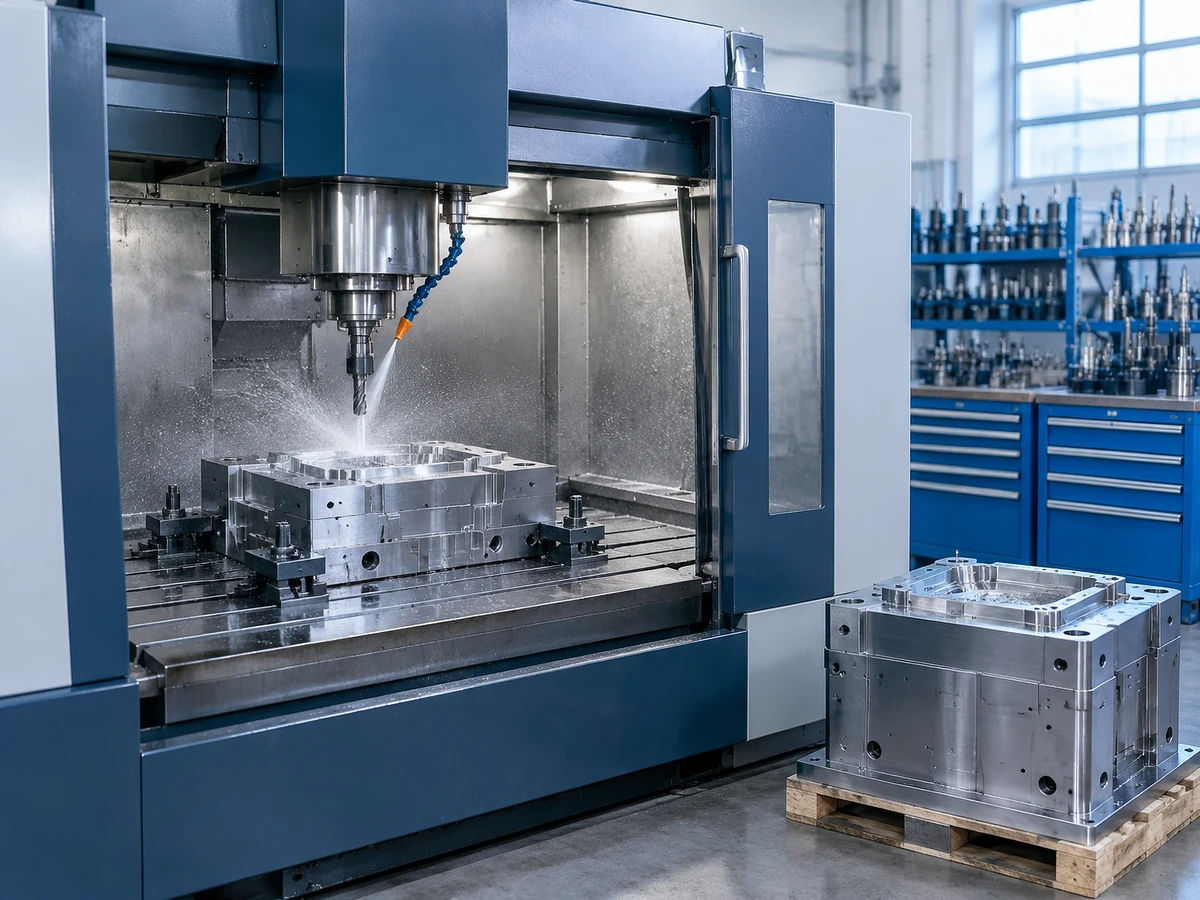
Here is the specific version of the claim, stated so you can check it. When the person answering your DFM comment is the person who will cut the steel, three of the costs above do not appear on your invoice: there is no payment float, because you transact with the plant; there is no relay latency, because our engineers sit in the same building as the presses; and there is no reseller margin on material, because we buy resin and mold steel from producers and compound suppliers rather than through a trading desk. That last point matters most on programs with high material content, which is why our quote for a glass-filled or flame-retardant grade usually moves differently from ours on a commodity polyolefin.
The verification you should demand of any supplier, including us: the ISO 9001 certificate holder and site address checked at the accreditation body; a named texture, coating and plating trade for every secondary operation; CMM dimensional records with your datum scheme, plus CT scanning and colorimetric color control across more than twenty documented checkpoints; APQP and PPAP documentation paths with FAI and Cpk targets written before steel; free mold-flow analysis before we cut; and mold cavity tolerance held to ±0.02 mm on tools from 2 to 128 cavities. Standard production lead time is five to seven working days, expedited two to three for urgent prototypes, which is the number that makes an in-house claim testable rather than decorative.
If you want to test us on the twelve documents, send your CAD through the quote page and paste the test list into the notes — you will get the pack back or you will not, and either answer is useful. To talk to the person who will own the program rather than a mailbox, WhatsApp Fred at +86 156 0682 1288 or write to [email protected]. We will also tell you, on a program that is really a consolidation job, that a trading house suits you better; that conversation costs nothing and has saved more than one buyer the 9%.
자주 묻는 질문
How do I know if my Chinese supplier is a factory or a trading company?
Is buying direct from a factory always cheaper?
Who should own the mold if I buy through an intermediary?
Do trading companies add any real value?
저자 소개

Alex Yu
아이디얼 프로 매뉴팩처링
알렉스는 Ideal Pro의 공동 창립자이지만, 주요 프로젝트를 총괄하거나 기술 팀을 이끌지 않을 때는 장거리 자전거 타기를 즐기거나, 동네에서 가장 맛있는 커피를 찾아다니거나, 다음 여행 계획을 세우는 모습을 볼 수 있습니다. 국제 무역 영업과 프로젝트 관리 분야에서 20년 이상의 경력을 쌓아온 그는 촉박한 마감 기한부터 까다로운 엔지니어링 문제까지, 그 사이의 모든 상황을 다 겪어보았습니다. 그는 훌륭한 성과는 충분한 휴식을 취한 마음과 맛있는 커피에서 나온다고 믿으며, 맡은 모든 프로젝트에 그와 같은 호기심과 세심한 주의를 기울입니다. 사무실에 있지 않을 때는 대개 야외 어딘가에서 새로운 장소를 탐험하며, 나중에 나눌 이야기를 수집하곤 합니다.
 English
 French
 Dutch
 German
 Japanese
 Korean