 日本語




Why Cooling System Design Is Critical in Injection Molding
In 射出成形[^1] , an optimally designed mold cooling system is non-negotiable. Plastic parts must solidify to sufficient rigidity before ejection—otherwise, residual stress or external forces cause warpage, sink marks, or dimensional inaccuracies.
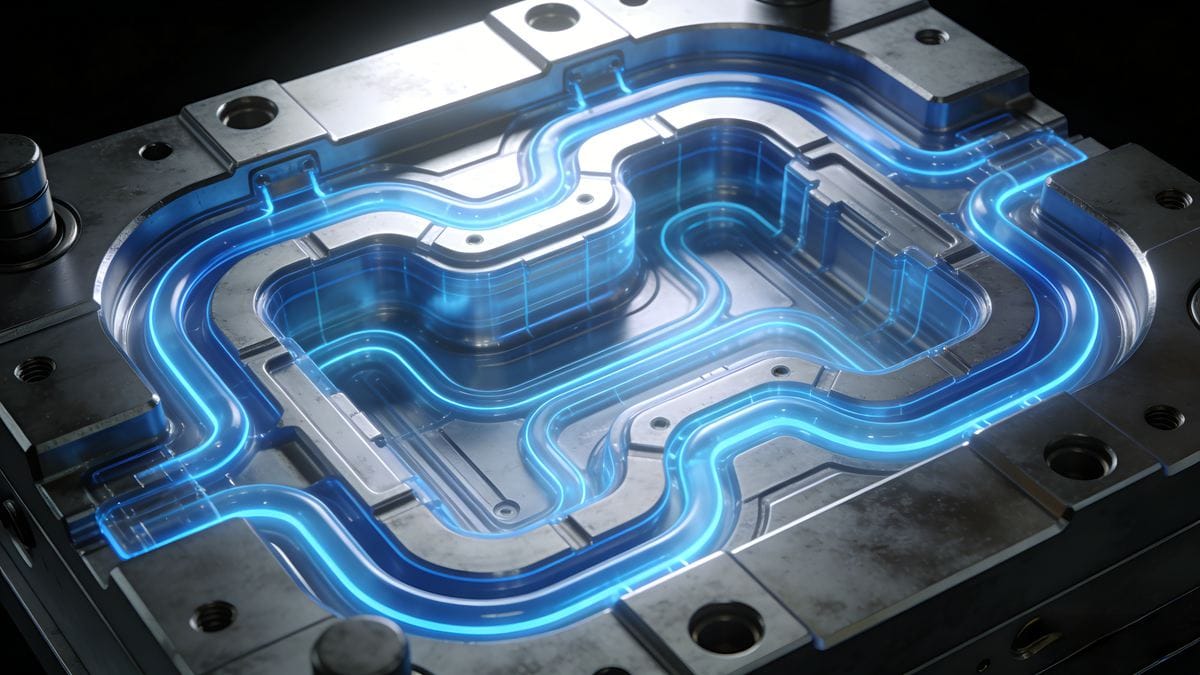
極めて重要なことだ、, cooling time consumes 70–80% of the total molding cycle. A precision-engineered cooling system slashes cycle times, boosts throughput, reduces energy costs, and enhances part quality. Conversely, poor cooling design leads to:
- Extended production cycles
- Higher operational costs
- Non-uniform shrinkage and part deformation
Heat Dissipation Mechanics: Data-Driven Insight
Experimental studies confirm:
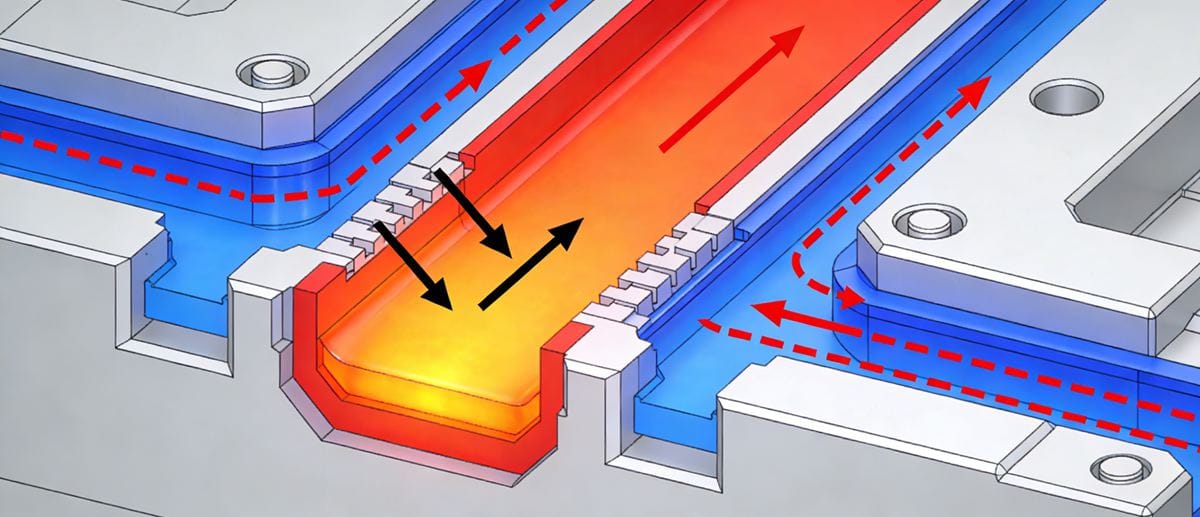
- ? 95% of heat transfers from molten plastic → mold steel → cooling channels (via conduction & convection)
- ? 5% dissipates into ambient air through radiation/convection
Coolant (typically water or glycol mix) absorbs heat via turbulent flow[^2]. Residual heat gradually dissipates through the mold structure post-cycle.
Cooling Time’s Role in the Molding Cycle
The full injection molding cycle comprises:
- Mold closing
- Injection/filling
- Packing/holding
- Cooling (70–80% of total time)
- 排出
Parts must cool below their Heat Deflection Temperature (HDT)[^3] before ejection to prevent:
- Warpage from residual stress relaxation
- Deformation from ejector pin pressure
7 Key Factors Influencing Cooling Rate
| Factor | Impact on Cooling Efficiency |
|---|---|
| Part Wall Thickness | Cooling time ∝ (thickness)². Doubling thickness = 4× longer cooling |
| Mold Material Conductivity | High-conductivity steels (e.g., beryllium copper inserts) accelerate heat extraction |
| Cooling Channel Layout | Channels closer to cavity, larger diameter, higher density = superior thermal control |
| Coolant Flow Rate | Turbulent flow (Re > 4,000) maximizes convective heat transfer |
| Coolant Properties | Low viscosity + high thermal conductivity + lower temp = optimal performance |
| Plastic Material | High thermal conductivity (e.g., filled nylons) or low specific heat = faster cooling |
| Processing Parameters | Higher melt/mold temps or lower ejection temp = extended cooling requirement |
[Image: Comparison graphic – uniform vs. non-uniform cooling channel layout[^4]s with thermal simulation overlay. Alt text: "Cooling channel design impact: uniform layout prevents warpage in thick-walled plastic components"]
Essential Cooling System Design Rules (SEO-Optimized Checklist)
✅ Uniformity First: Position channels symmetrically relative to cavity surfaces to prevent thermal gradients.
✅ Proximity Matters: Maintain 1–1.5× channel diameter distance from cavity surface (e.g., 12mm channel → 12–18mm spacing).
✅ Standardize Components: Use ISO-standard channel diameters (e.g., 8mm, 10mm, 12mm) for machining ease and maintenance.
✅ Flow Optimization: Design for turbulent flow; avoid dead zones with proper inlet/outlet placement.
✅ Material-Specific Tuning: Adjust channel density for thick sections or high-heat plastics (e.g., PEEK, PSU).
✅ Thermal Simulation: Validate layout with Moldflow® or similar CAE tools pre-manufacturing.
✅ Maintenance Access: Include quick-connect fittings and corrosion-resistant materials (e.g., stainless steel lines).
Final Takeaway
Mastering cooling system design transforms molding efficiency. By aligning channel geometry, coolant dynamics, material science, and thermal simulation, manufacturers achieve:
✨ Shorter cycles
✨ Higher part consistency
✨ Reduced scrap rates
✨ Sustainable cost savings
Optimize your mold cooling strategy today—because every second saved in cooling multiplies across thousands of production cycles.
[^1]: Explore this resource to discover essential techniques and innovations that enhance injection molding efficiency and part quality. [^2]: Understand how turbulent flow maximizes heat transfer and improves cooling efficiency. [^3]: Learn how HDT affects part quality and performance during the injection molding process. [^4]: Explore the critical role of channel design in achieving uniform cooling and preventing defects.
著者について

アレックス・ユー
アイデアル・プロ・マニュファクチャリング
アレックスはIdeal Proの共同創業者ですが、重要なプロジェクトの監督や技術チームの指揮をとっていないときは、長距離サイクリングを楽しんだり、街で一番おいしいコーヒーを探し回ったり、次の旅の計画を立てたりしている姿を見かけるでしょう。 国際貿易の営業やプロジェクト管理に20年以上の経験を持つ彼は、厳しい納期や厄介な技術的課題など、ありとあらゆる状況を経験してきました。彼は、素晴らしい仕事は十分な休息と一杯の美味しいコーヒーから生まれると信じており、その好奇心と細部へのこだわりを、手掛けるすべてのプロジェクトに注ぎ込んでいます。 オフィスにいないときは、たいてい屋外で、新しい場所を探索したり、皆と共有できるエピソードを集めたりしています。.




 English
 French
 Dutch
 German
 Japanese
 Korean