

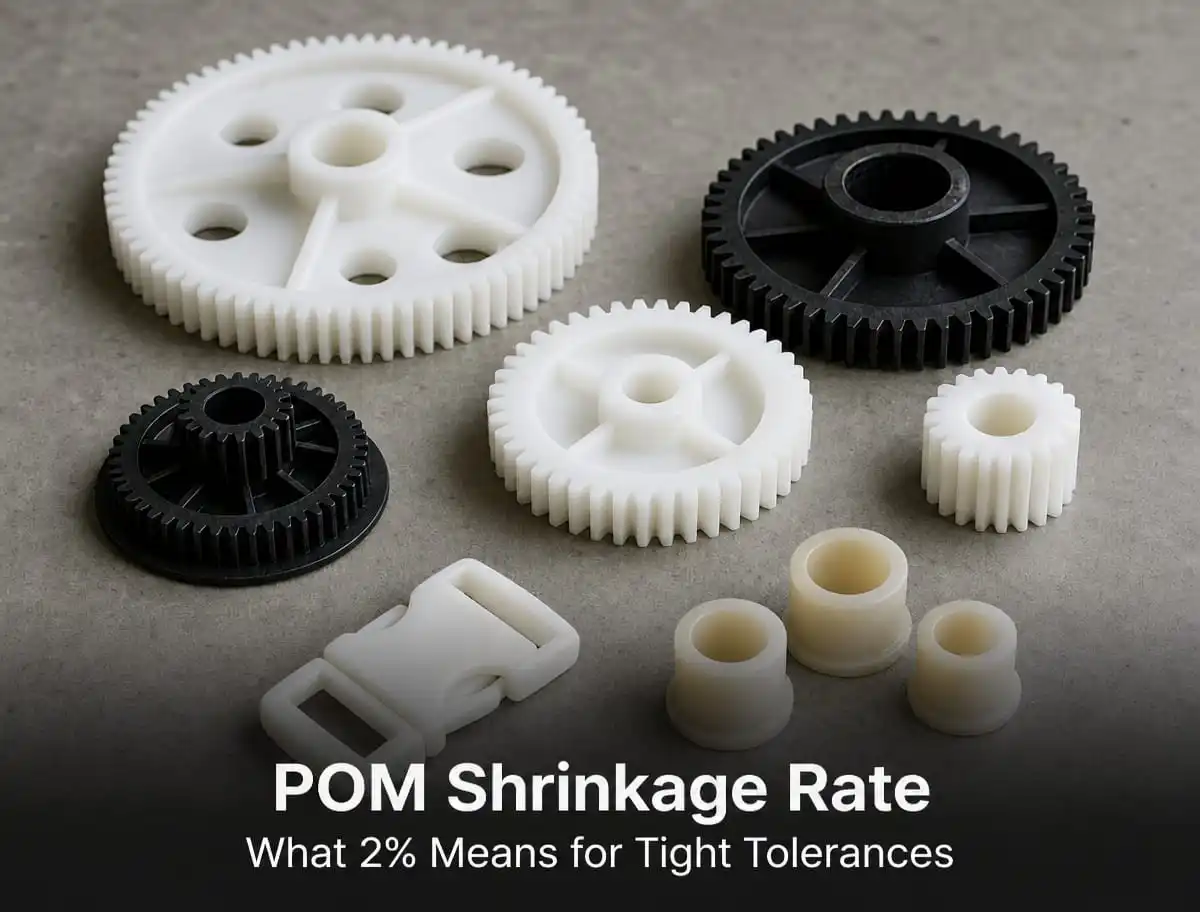
POM shrinks about 2%. Every quoting sheet knows the number, and the number is where dimensional arguments start. A Delrin-grade unfilled copolymer runs roughly 1.7–2.2% mold shrinkage, but the same supplier’s test data shows a glass-reinforced grade shrinking 0.4% along flow and 1.2% across it, and a toughened grade at 0.8/1.1. Those aren’t decimals on a spreadsheet; on a 100 mm bearing boss, the difference between 1.2% and 2.0% is 0.8 mm of steel. This article is about the parts of POM shrinkage that actually decide whether your gear bore lands at ±0.02 mm: the three separate shrinkage events, the measurement-time trap, the hot-mold paradox, and what to fix in the mold instead of the process.
| Number to carry | Value (typical published windows) |
|---|---|
| Unfilled POM mold shrinkage | ~1.7–2.2% |
| GF-reinforced, along vs across flow | ~0.4–1.0% vs ~1.2–1.4% |
| Suggested first measurement clock | 24 h post-mold, 23 °C / 50% RH |
| Usable steel correction on 100 mm | 0.2% assumption error = 0.2 mm |
Is It One Shrinkage Number or Three?
Three, and they happen in sequence.
Mold shrinkage is the drop between cavity steel and the free part once it cools, the figure on the datasheet, measured per ASTM D955 or ISO 294. Post-mold shrinkage is the drift in the following days: POM crystallizes fast but not instantly, and the remaining crystallization plus relaxation of frozen-in stress keeps pulling dimensions after ejection. Only after that does the part settle. (Moisture-driven size change is tracked separately by ISO 294-4; for POM it’s small: the material barely drinks water, which is one reason designers pick it over nylon.)
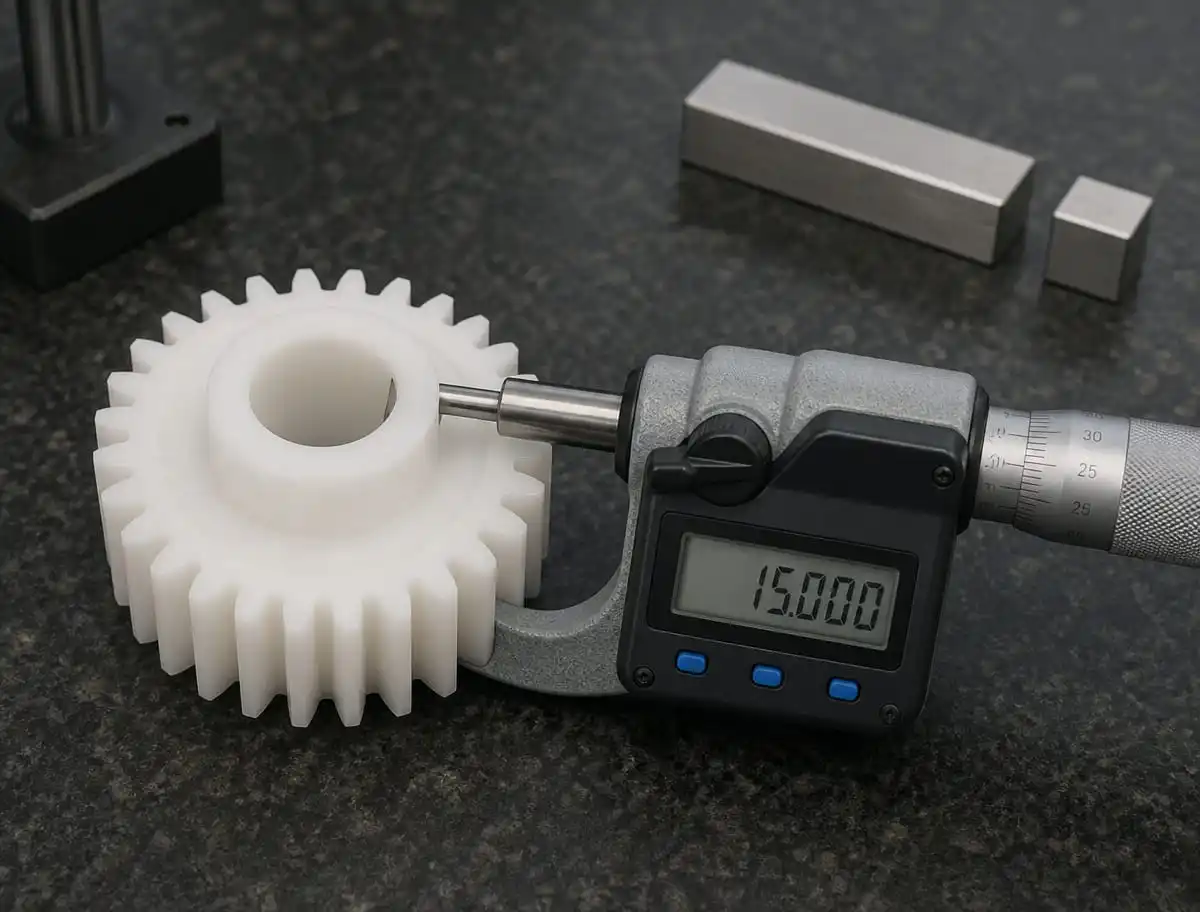
Practically, it means a POM part can pass CMM on the bench at hour two and fail at week one, with nothing wrong in either measurement. The fix isn’t tighter processing. It’s agreeing, before steel is cut, on which hour the dimension is true: our default for dimensional POM work is a 24-hour clock at 23 °C and 50% RH, measured in the free state unless the drawing says assembled, with the report stating the clock out loud. ASTM D955 gives 24 and 48 h checkpoints precisely because “after molding” isn’t a time.
Figure 1: Bore measurement on a granite plate at the agreed 24-hour clock, not at the machine.
Why Does a Hotter Mold Shrink More Now and Less Later?
This is the decision that separates stable POM programs from nagging ones, and it feels backwards at first.
Crystallization needs time at temperature. Run the mold cool (say 60-70 °C) and the part freezes early: less crystal finished forming at ejection, so the immediate dimension sits closer to your model, which flatters everyone at first articles. But that unfinished crystallization continues at room temperature for days, and the trapped stress leaves too, meaning later drift and the occasional surprise of a stack of “passed” parts arriving out of tolerance at the customer’s incoming inspection.
Run the mold hot (80-100 °C, and some precision setups push toward 120 °C where the supplier window allows) and the part completes most of its crystallization before it ever leaves the cavity. The first measurement shows more shrink (you design the steel for it), but the part you measure today is nearly the part you’ll ship next month.
For dimensionally critical POM we choose the hot-mold route and hold it within ±1 °C through validation and production, because the variable you want to keep is total dimensional behavior, not first-shot flattery. If a processor offers to “fix” an oversize POM dimension by dropping mold temperature, that’s a false win and you should ask what the 7-day dimensions will be.
How Much Does Grade Choice Move the Number?
More than any process knob. The published ISO 294 test values from Delrin’s own references show the spread inside one supplier’s family alone:
| Grade type (example) | Shrink along flow | Shrink across flow |
|---|---|---|
| Unfilled homopolymer standard (500P class) | ~2.0% | ~1.9% |
| GF-reinforced, lower fill | ~1.0% | ~1.4% |
| GF-reinforced, higher fill (525GR class) | ~0.4% | ~1.2% |
| Toughened (100ST class) | ~0.8% | ~1.1% |
Read the columns, not just the rows. Reinforcement cuts along-flow shrinkage dramatically, but it does not cut across-flow shrinkage proportionally: the anisotropy grows. That’s the origin story behind two classic POM failure modes: oval-out-of-round bores (a gear hub wants a circle, fiber orientation gives it an ellipse) and corners that curl after conditioning, because opposing walls shrank in different directions around the gate. Copolymer vs homopolymer matters less for shrinkage than people expect; filler load and flow path decide the shape of the number.
Two process levers still matter after grade choice:
- Packing to gate seal. Hold pressure that lets the gate freeze before the pack ends is free shrinkage you’ll chase forever. Establish the seal time once (pressure trace, or weight-vs-hold curve), then build the hold window around it. Under-packing raises both shrinkage and its scatter.
- Wall thickness. A 3 mm boss next to a 1.6 mm web shrinks differently in those two zones, a local difference big enough to walk a snap-fit past its gauge. Balance walls before arguing shrink percentages.
Where Should the Gate Go If Dimensions Have to Behave?
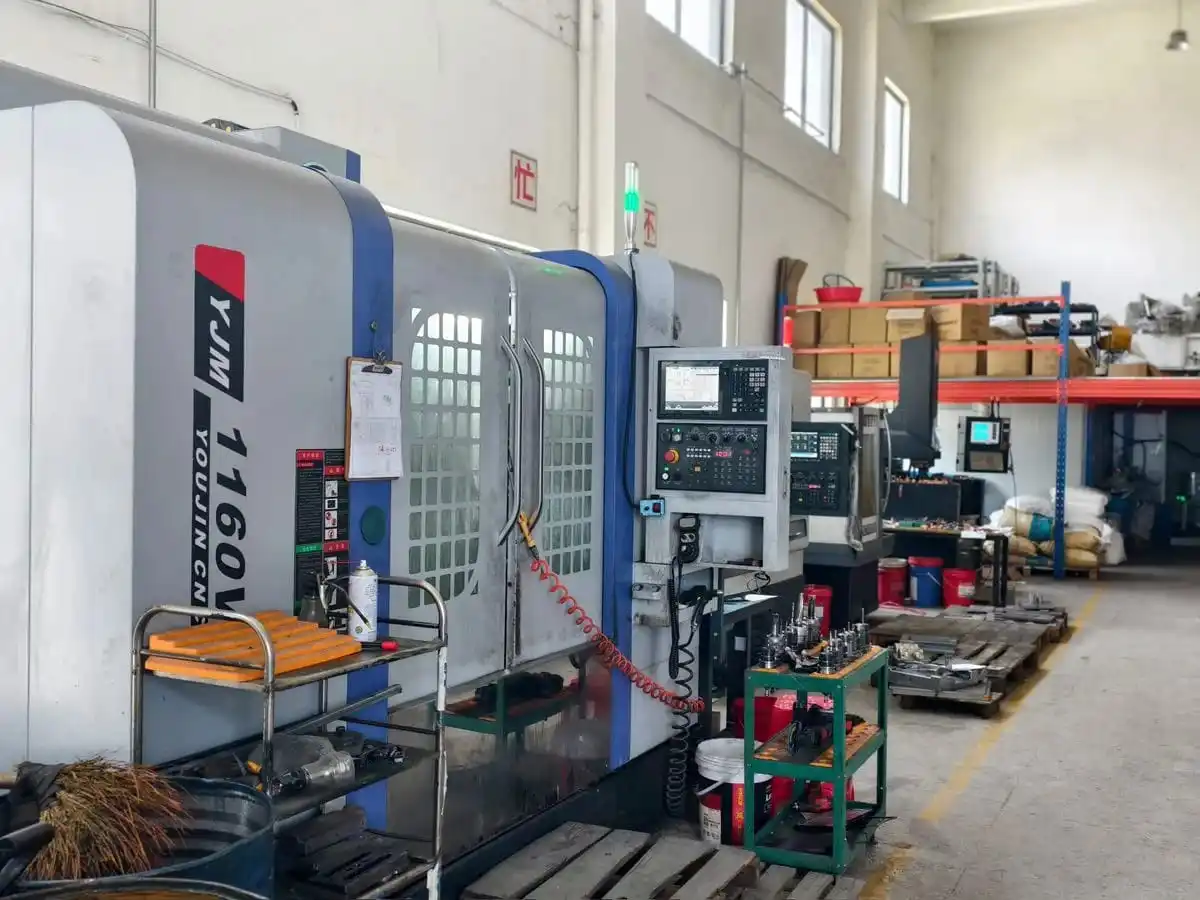
Figure 2: Our mold-shop machining center. The shrink allowance decided at RFQ becomes cavity steel here, which is why the correction direction has to be planned per feature before the first cut.
Because POM’s shrinkage is directional, the gate is a dimensional tool, not just a filling convenience. Fibers (when present) align with flow and restrain along-flow shrink; the face of a boss that happens to sit upstream versus downstream of the gate will land differently. Move the gate and you move: the pressure path (packing effectiveness at the far corner), the weld-line map, and which critical dimension experiences the along-flow number versus the cross-flow number.
Before tooling a tolerance-sensitive POM part, we put the critical-dimension map on the same screen as the predicted flow field and ask one question per dimension: does the number governing this feature come from the good column or the bad column of the grade table above? If a ±0.02 mm bore is governed by the cross-fiber number on a 30% GF grade, sometimes the answer is a gate move, sometimes it’s a core pin you plan to shave at T1, and sometimes it’s the honest conversation that the tolerance should ride on a machined insert instead.
Which brings us to steel. On POM, plan every critical dimension correction-safe from the first cut: an outside dimension formed by cavity gets left conservatively small with room to add by adding… correction stock logic in the other direction for cores: feature by feature, never a blanket offset of the whole model. A blanket 2% offset on a fiber-filled part overcorrects one axis and undercorrects the other. And keep enough steel on the table that T1 can move 0.1–0.2 mm without a weld-up: at POM’s shrink magnitudes, a two-trial correction budget is not paranoia, it’s arithmetic (0.2% on 100 mm, said it twice on purpose).
Should You Anneal POM to Lock Dimensions?
Annealing accelerates the crystallization and stress-relaxation that post-mold shrinkage is made of, via a controlled hot-air or bath soak per the grade’s procedure. Used deliberately, it’s a legitimate production state: some tight-tolerance bearing cages and elevator components ship from us in an annealed, measured-after-anneal condition, so the customer’s incoming inspection matches our final inspection.
Used as a repair, it’s a trap. Annealing adds a thermal cycle that can introduce distortion as it relieves stress, and it doesn’t make an unstable molding process stable. If the press, the mold temperature, and the pack profile are wandering, an anneal soak will simply average out your problems in the sample set and hide them until a full pallet disagrees. The two honest uses are: (1) the delivered condition is defined as annealed and validated in that state, or (2) you run a hot-mold process that does most of the job inside the cycle and skip secondary operations entirely. Annealing a few samples just to make a dimensional report behave is how shops lose audits, and we’ve turned that request down twice.
Does POM Need Drying Before Molding?
Mostly no, and it’s worth saying plainly since half the internet treats every resin like nylon. Standard unfilled copolymer grades don’t require predrying under normal storage per the major supplier molding guides: the material doesn’t carry significant bound moisture, and its degradation pathway is thermal (excess melt temperature or residence time), not hydrolytic. Toughened and some specialty grades are the exception and carry their own moisture limits, so the ticket still rules.
What POM does demand instead of a dryer: clean thermal discipline. Overheated POM evolves formaldehyde, visible as a sharp smell, gas streaks, or corrosion pitting on corroded vents, and it cross-contaminates violently with acidic residues like PVC in the barrel. A dedicated barrel for black/white POM is a luxury; a disciplined purge sequence is not optional. Copper-alloy warnings in the guides refer to prolonged molten contact (stagnant heater-band pockets, long dwell), not the fact that your ejector sleeve is brass and releases every cycle.
If you’re chasing silver-streak-type defects in a material you’re sure is dry, that’s your signal the problem is thermal or contamination, not moisture. The same diagnostic loop applies, pointed the other way.
How Do You Tell When POM Is the Wrong Material?
POM is brilliant for low-friction, dimensionally stable, fatigue-resistant snapping and sliding parts: gears, buckles, zip components, valve internals under 100 °C continuous. It is the wrong answer for: parts near 0.2 mm wall or thin living hinges (it’s not flexible at those scales the way TPU is), outdoor visible parts (unmodified POM UV-degrades; you’d pay for stabilized grades that exist anyway), any assembly near open flame or post-consumer burn streams (halogen-free but formaldehyde-releasing when it does burn), and high-precision parts in direct water-immersion where a nylon’s toughness matters more than POM’s dimensional virtue. A customer once asked us to replace a brass latch spring in POM; it worked at room temperature, and the field failures started at -30 °C. Match the material to the worst day, not the datasheet day.
And if your drawing calls for “POM, ±0.005 mm on four bores,” send it to a molder anyway, because some of those can be cored-and-shaved to print, and the honest ones will mark the rest for a machining operation in the DFM instead of pretending in the quote.
What Should the DFM Package Nail Down Before Steel?
For dimensional POM parts, get these seven answers in writing at RFQ stage; each one is a fight you otherwise have at T1:
1. Exact producer and grade (colorant included: black and natural can differ measurably).
2. The measurement clock: 24 h or 48 h, temperature and RH of the room, free or assembled.
3. Critical dimensions labeled per cavity with their flow direction at that feature.
4. Shrinkage assumption stated per direction, not one number for the part.
5. Mold temperature set for total stability, with a control alarm band.
6. Steel-safe correction direction for every critical feature.
7. Whether annealing is part of the delivered state.
That list is also exactly what we run on our own DFM review for POM programs; it takes an experienced planner one afternoon and saves a second set of trial shots. Upload the drawing at our contact page and the answer comes back within 24 hours with those seven points annotated, including which dimensions we want to shave at T1 and which we’d argue are over-tight for molding.
Questions fréquemment posées
What is the POM shrinkage rate?
Unfilled grades ~1.7–2.2% typically; glass-filled ranges from ~0.4% along flow to ~1.2–1.4% across it; toughened grades sit in between. The grade sheet’s directional ISO 294 values, not the family average, go into your steel.
When should POM parts be measured for tolerance?
At the agreed clock: commonly 24 h post-mold, 23 °C / 50% RH, free state, and always with the clock stated on the report. A “pass” measured at hour one and a “fail” at day three are often both correct.
Does higher mold temperature reduce POM shrinkage?
It usually increases the immediate number while reducing later drift. Decide on total dimensional behavior; a hot mold plus correction-safe steel is the most repeatable combination we run.
Is acetal the same as POM?
Same material family; Delrin is DuPont/Franklin’s brand for the homopolymer, and most acetal you buy is copolymer (Hostaform, Ultraform families). Copolymer resists thermal bleed-out and smell a bit better; don’t mix the brand folklore across the shrink table.
Why did my POM bore go oval after a week?
Classic anisotropic shrink signature on a fiber-filled grade around a hub: along-flow and cross-flow numbers differ, so the core cools into a very slight ellipse that post-crystallization finishes drawing. Fixes in order: gate reposition, increase pack-to-seal, unfilled grade for that feature, or a coring strategy that lets you shave the long axis at T1.
Can POM hit ±0.01 mm?
Someday yes, generally no. Count on stable ±0.02–0.05 mm class on well-managed dimensions with hot molding and 24 h protocol, and machine the features that truly need better. Anyone quoting ±0.005 mm on molded acetal without asking which dimensions, which grade, and which hour is selling hope.
Do I dry POM before molding?
Standard grades: usually no. Toughened/specialty: check the sheet. What POM actually requires is thermal hygiene: melt window, residence limits, and a serious purge after acidic resins.
Does moisture make POM grow like nylon?
Barely. POM’s water uptake is low single-digit-hundredths territory; its dimensional story is crystallization timing, not humidity. That’s exactly why POM wins sliding-fit parts where nylon’s post-mold swelling would close clearances.
Bottom Line
The “2%” number is a conversation starter, not a design input. POM dimensional control works when you replace that one number with a grade-specific, direction-specific assumption, run hot enough to finish crystallization inside the cycle, measure on an agreed clock, and leave correction-safe steel on every critical feature. Do those five things and acetal becomes the most predictable semi-crystalline material on your floor, good enough for gear bores and latch clearances that nylon simply cannot hold. Skip any one of them and the 2% conversation comes back later as a chargeback, usually at the customer’s incoming inspection rather than at yours, with none of the context that made the number defensible.
Go deeper on our site: the full POM processing, defects, and mold-design guide, root causes of uneven shrinkage and warpage, et why dimensions drift after molding passes inspection.




 English
 French
 Dutch
 German
 Japanese
 Korean