

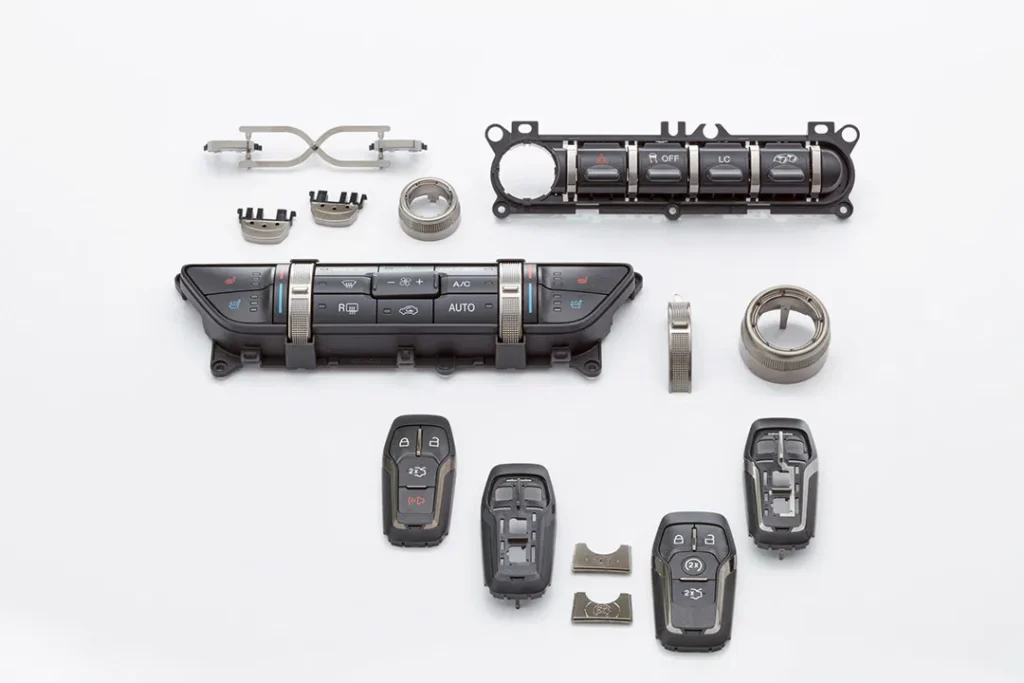
Verbundwerkstoffe für den Spritzguss kombinieren verschiedene Materialien, um bestimmte Eigenschaften wie Festigkeit, thermische Stabilität und chemische Beständigkeit zu verbessern. Diese fortschrittlichen Verbundwerkstoffe werden häufig in Hochleistungsanwendungen eingesetzt, sind jedoch mit höheren Kosten und einer komplexeren Produktion verbunden. Beispiele hierfür sind:

PC-ABS (Polycarbonat-ABS-Mischung)
- Mechanische Festigkeit: Hohe Schlagfestigkeit und Zähigkeit.
- Wetterbeständigkeit: Mäßig, besser als ABS allein.
- Chemische Beständigkeit: Gut, resistent gegen verschiedene Chemikalien.
- Anwendungen: Automobilteile, Elektronikgehäuse, medizinische Geräte.
- Verarbeitung: 230°C - 290°C.
GFPP (glasfaserverstärktes Polypropylen)
- Mechanische Festigkeit: Erhöhte Festigkeit und Steifigkeit im Vergleich zu normalem Polypropylen.
- Wetterbeständigkeit: Gut, mit verbesserter Leistung bei Außenbedingungen.
- Chemische Beständigkeit: Gut, resistent gegen viele Chemikalien.
- Anwendungen: Autoteile, Industrieteile und Baumaterialien.
- Verarbeitung: Wird in der Regel bei 200°C - 250°C verarbeitet.
GFPE (glasfaserverstärktes Polyester)
- Mechanische Festigkeit: Hoch, mit ausgezeichneter Steifigkeit und Haltbarkeit.
- Wetterbeständigkeit: Ausgezeichnet, geeignet für raue Umgebungen im Freien.
- Chemische Beständigkeit: Gut, resistent gegen verschiedene Chemikalien.
- Anwendungen: Elektrische Komponenten, Autoteile und Baumaterialien.
- Verarbeitung: Wird in der Regel bei 240°C - 280°C verarbeitet.
GFN (glasfaserverstärktes Nylon)
- Mechanische Festigkeit: Sehr hoch, mit verbesserter Steifigkeit und Festigkeit.
- Wetterbeständigkeit: Gut, geeignet für viele Umgebungsbedingungen.
- Chemische Beständigkeit: Gut, resistent gegen viele Chemikalien.
- Anwendungen: Autoteile, Industriemaschinen und Konsumgüter.
- Verarbeitung: Wird in der Regel bei 260°C - 300°C verarbeitet.
CFRP (kohlenstofffaserverstärktes Polymer)
- Mechanische Festigkeit: Sehr hohes Verhältnis von Stärke zu Gewicht.
- Wetterbeständigkeit: Ausgezeichnet, geeignet für extreme Bedingungen.
- Chemische Beständigkeit: Gut, resistent gegen viele Chemikalien.
- Anwendungen: Komponenten für die Luft- und Raumfahrt, Hochleistungssportgeräte und Automobilteile.
- Verarbeitung: Wird in der Regel bei 350°C - 400°C verarbeitet.
CFRN (Kohlenstofffaserverstärktes Nylon)
- Mechanische Festigkeit: Sehr hoch, mit überlegener Steifigkeit und Stärke.
- Wetterbeständigkeit: Gut, geeignet für verschiedene Umgebungsbedingungen.
- Chemische Beständigkeit: Gut, resistent gegen viele Chemikalien.
- Anwendungen: Hochwertige Autoteile, Industriemaschinen und Sportgeräte.
- Verarbeitung: Wird in der Regel bei 260°C - 300°C verarbeitet.
CFRPC (kohlenstofffaserverstärktes Polycarbonat)
- Mechanische Festigkeit: Hoch, kombiniert die Vorteile von Kohlefaser und Polycarbonat.
- Wetterbeständigkeit: Gut, geeignet für verschiedene Bedingungen.
- Chemische Beständigkeit: Gut, resistent gegen viele Chemikalien.
- Anwendungen: Elektronikgehäuse, Automobilteile und Hochleistungskomponenten.
- Verarbeitung: Wird in der Regel bei 270°C - 320°C verarbeitet.


 English
 French
 Dutch
Dutch German
 Japanese
 Korean