

2K Injection Molding vs. Overmolding: A Comprehensive Guide to Multi-Material Processes
In the rapidly evolving world of injection molding, choosing the right multi-material process is critical for product success. While 2K Injection Molding (Double Injection) and Overmolding (Secondary Injection) both achieve composite structures, their technical approaches, cost implications, and ideal applications differ significantly.
With intelligent manufacturing upgrades in 2024 and 2026, the boundaries of these technologies are expanding. This guide breaks down the principles, processes, and latest industry trends to help you make the best selection.
Quick Definition:
- 2K Injection Molding: A single-cycle process using a specialized machine to inject two materials sequentially into one mold.
- Overmolding: A two-step process where a pre-molded part (substrate) is placed into a second mold for a secondary injection.
Core Principles: Integrated vs. Step-by-Step
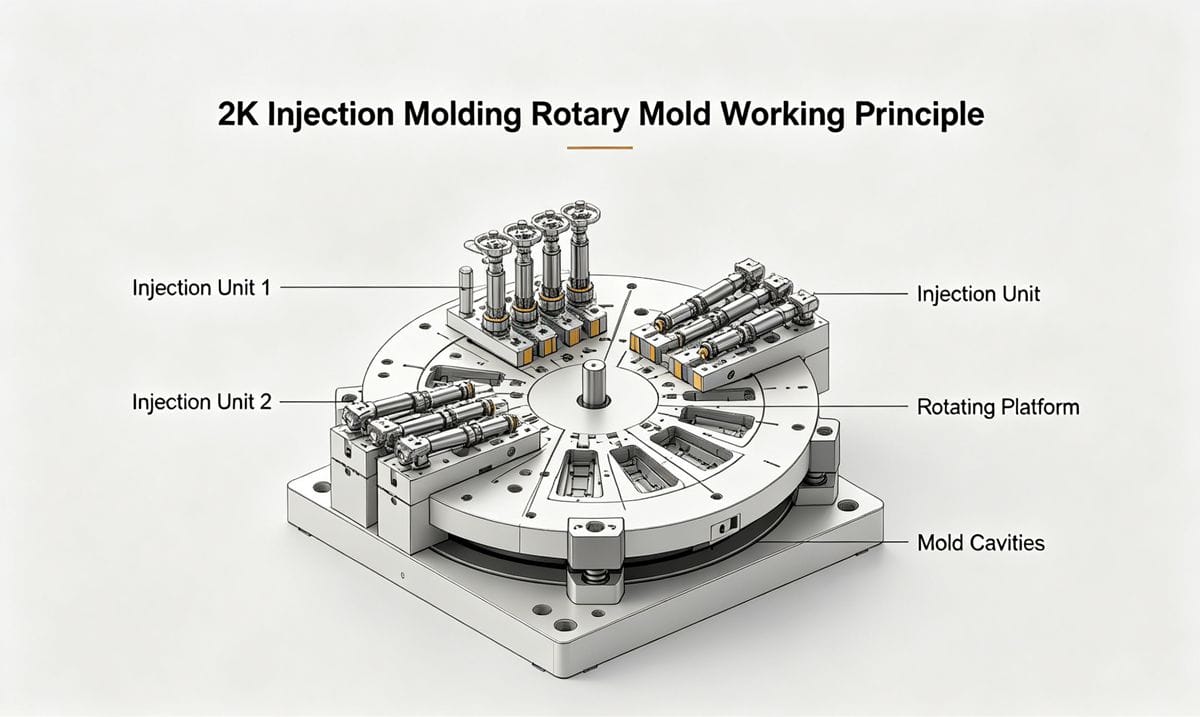
1. 2K
Injection Molding (Molten State Integration) The Technology: This process relies on a specialized 2K injection molding machine equipped with dual injection units. The mold rotates or shifts to allow two different materials to be injected sequentially within a single production cycle. Because the first shot is often still semi-molten when the second is injected, the materials bond at a molecular level, creating a seamless interface.
Typical Applications:
- Smart Watch Casings: PC outer layer + PMMA inner layer molded together, eliminating the need for painting (RoHS 3.0 compliant).
- Automotive Dashboards: Multi-color components achieving integrated color and texture through layered cavities.
2. Overmolding (Solid State Encapsulation)
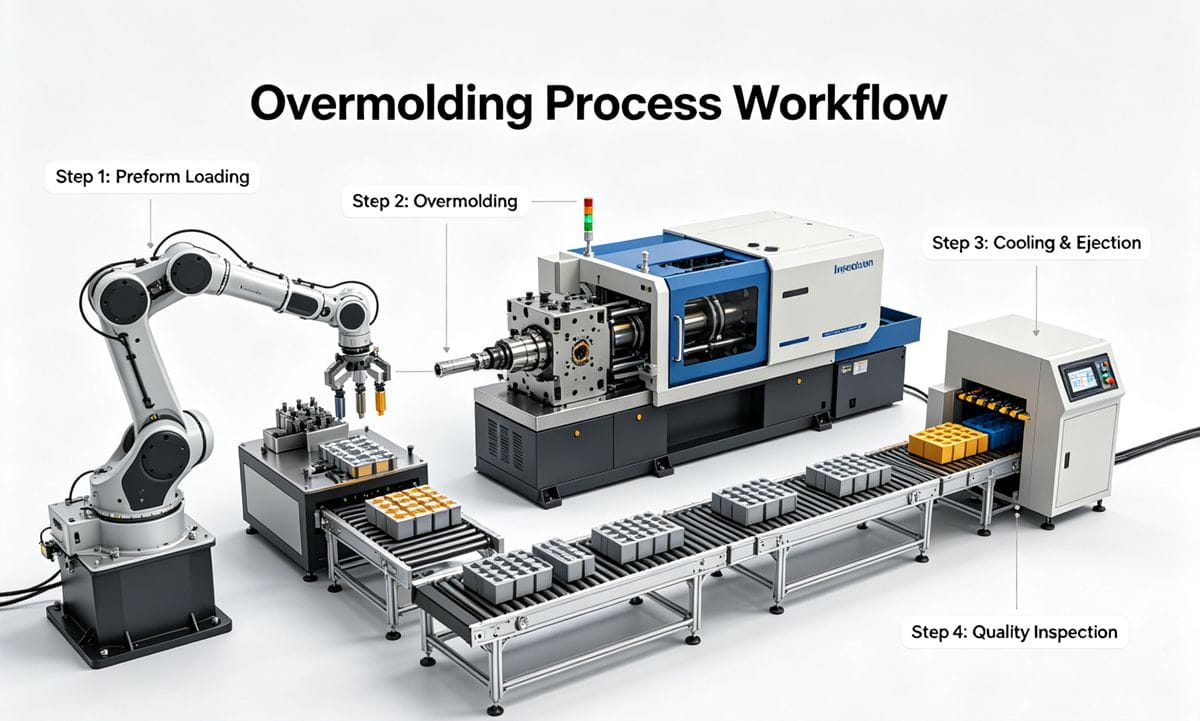
The Technology: Also known as "Insert Molding" or "Secondary Injection," this is a discrete process. First, a rigid substrate (e.g., PA66 gear) is molded. After cooling, it is transferred—manually or via robot—to a second mold where a softer material (e.g., TPU) is injected over it.
Recent Breakthroughs:
- Medical Sector: Nano-coating pretreatment has increased the bonding strength between PE and silicone by 40%.
- Industrial Parts: Direct encapsulation of high-temperature PPS over metal substrates (like aluminum alloy) for extreme heat resistance.
Process Upgrade: Equipment & Mold Technology (2026 Update)
The following table highlights the technological advancements driving efficiency in 2026.
| Technical Dimension | 2K Injection Molding (Latest Trends) | Overmolding (Latest Trends) |
|---|---|---|
| Mold Innovation | Multi-station Rotary Molds: Supporting 3+ colors.In-Mold Hot Cutting: Achieving 98% material utilization. | Smart Positioning: Integrated vision recognition systems.Embedded Sensors: Real-time monitoring of coating thickness. |
| Equipment Intelligence | AI Temperature Control: Paired with servo-hydraulic hybrid drives (Response speed ↑50%). | Automation: Fully automated loading and unloading systems. |
| Green Tech | Energy-saving injection units. | Heat recovery from mold temperature controllers (Energy consumption ↓25%). |
Materials & Bonding: Compatibility vs. Functionality
Material Selection Differences
- 2K Injection Molding: Requires strict chemical compatibility. The shrinkage rates must be similar (difference < 5%) to prevent warping.
- Classic Combo: ABS + PC, PC + PMMA (Consumer Electronics).
- New Trend: OBC compatibilizers enabling PP and PC bonding for lightweight automotive parts.
- Overmolding: Focuses on structural adaptability. It can bond almost any material if designed correctly.
- Classic Combo: Hard Plastic + TPU/TPE (Tool Handles).
- New Trend: Biodegradable PLA + PBS (Medical Staplers), Conductive TPE (Robot Joints).
Bonding Mechanism Evolution
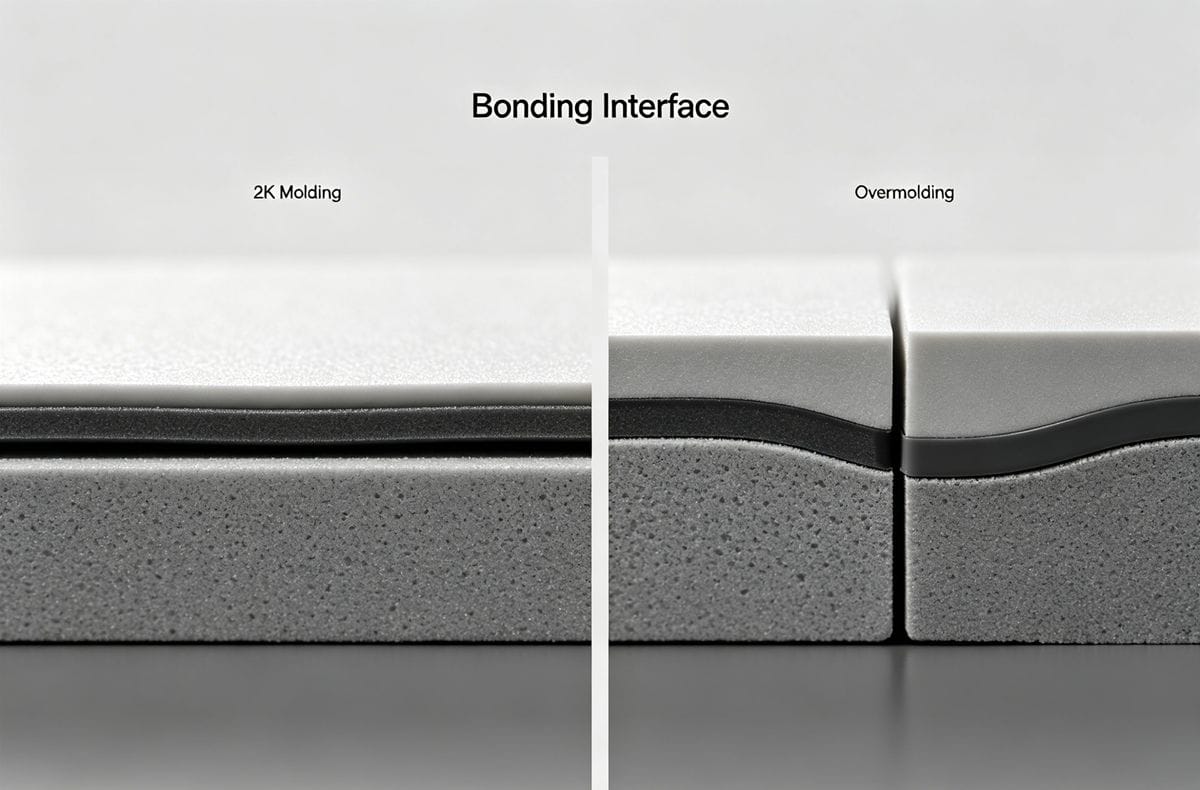
- 2K Injection Molding: Traditionally relies on molecular diffusion. The upgrade involves Ultrasonic-Assisted Welding, using local heating to boost fusion strength by 25%.
- Overmolding: Traditionally relies on mechanical interlocking (undercuts/grooves). The upgrade uses Laser Micro-Nano Structuring, increasing surface roughness (Ra 3.2) and boosting peel force by 30% (ISO 8510 compliant).
Application Scenarios: Aesthetics vs. Function
2K Injection Molding: Driven by Aesthetics
This process excels in precision appearance parts where seamlessness is key.
- Consumer Electronics: Gradient colored phone cases, lightweight TR90+TPU eyewear frames.
- Automotive Interiors: Dashboard components combining matte and high-gloss finishes in one shot.
- Advantage: Eliminates painting/post-processing, meeting strict environmental directives like the 2024 RoHS 3.0.

Overmolding : Driven by Functionality Ideal for complex functional requirements involving dissimilar materials.
- Tools: Screwdrivers with soft-grip handles (Hard core + TPU coating).
- Medical Devices: Biodegradable PLA staplers with PBS elastic layers (FDA approved in 2024).
- Industrial Components: 5G base station copper substrates coated with high-thermal-conductivity silicone (Thermal resistance reduced by 15%).
- Advantage: Supports arbitrary combinations of metal-plastic or hard-soft materials for conductivity, insulation, or biocompatibility.
Future Trends: Where is the Industry Heading?
As we move through 2026, the competition focuses on finding the dynamic balance between efficiency, function, and cost.
- Hybrid Processes: Combining 2K Injection Molding with IMD (In-Mold Decoration) to achieve "Three-Color Injection + In-Mold Film" integration, popular in high-end home appliance panels.
- Green Manufacturing: Water-assisted cooling technology (saving 70% water) is becoming standard. Both processes are pushing towards closed-loop recycling of waste materials.
- Digitalization: With the widespread adoption of AI process optimization and Digital Twin molds, the selection process is becoming more data-driven.
Final Verdict: If your priority is high-volume efficiency and aesthetic precision, 2K Injection Molding is the superior choice. If you need flexibility, functional complexity, or metal-plastic bonding, Overmolding remains the industry standard.


 English
 French
 Dutch
Dutch German
 Japanese
 Korean