

Regrind is not scrap. It is resin with a history, and that history gets paid for in mechanical properties. We once traced three months of mystery field failures on a PA66-GF30 clip back to a single change at the press: the shop had started grinding rejected parts into the same bin as sprue and runner. The contract said 20% regrind, and the meter said 20%, but the melt now contained flakes that had already been through a barrel up to four times. Grade name unchanged. MFI still inside the datasheet band. Notched impact at -10 °C was down by about a third. That is the whole problem with regrind in injection molding in one story: the percentage is the easy part to control, and the part nobody controls is the heat-and-shear history riding inside the percentage.
| Resin family | Common spec ceiling | What fails first |
|---|---|---|
| PP / HDPE (homopolymer scrap only) | 25 to 50% | Color, then impact |
| ABS | 20 to 30% | Surface gloss, impact |
| PA6 / PA66, unfilled and GF | 20 to 30% | Moisture pickup behavior, toughness |
| PC and PC blends | 10 to 15%, often zero | Notched Izod, hydrolysis |
| POM | 10 to 20%, tight thermal control | Dimensions, then decomposition |
| Glass or carbon filled | 15 to 25% | Fiber length, strength, shrink balance |
The ceilings above are common industry practice, not promises. The controlling document is always your part spec and the compounder’s written position on the exact grade.
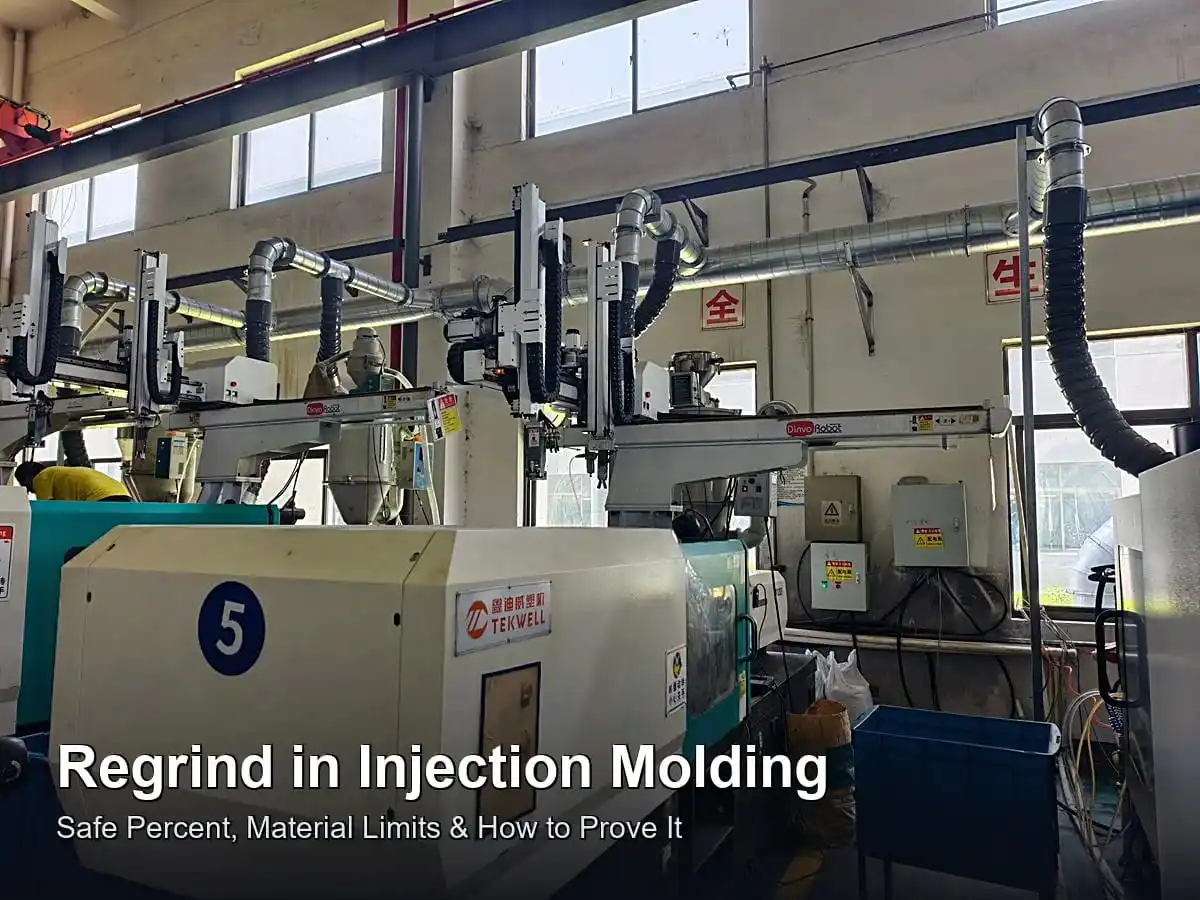
Why Trust This Regrind Guide?
We are a custom injection molder in Shenzhen, not a recycling broker, and regrind is one of those topics where the person writing the guide is the person who eats the consequences. Every lot of regrind that goes wrong becomes our scrap pile, our overtime, and our customer’s audit finding, so the controls in this article are the controls we run: separate grinders per material family, flake size and dust extraction checked at shift start, blend ratios recorded on the lot card next to dryer settings, and melt-flow verification against the retained virgin standard whenever a regrind stream changes. ISO 9001 with documented change control sits over all of it. We have also sat on both sides of the contract: as the molder defending a regrind policy, and as the one auditing a partner’s. The failure case later in this article is our own tooling and inspection records, anonymized. Where the numbers are ranges rather than single points, they are because grade, color, and filler package move them, which is the honest answer in materials work.
What Counts as Regrind, and What Definitely Does Not?
Three streams get called regrind, and they are not interchangeable. In-house sprue regrind is your own runners and gates, ground, one melt cycle in its life, from a known single grade. This is the stream specs usually allow, because its history is a single page, not a novel. Good-part regrind is flighted shots, color drift pulls, and rejected parts ground up. It already carries at least one full molding cycle, sometimes sat on a shelf absorbing moisture, sometimes picked off the floor. Bought-in regrind or regranulate is somebody else’s stream: unknown grade lineage, unknown heat history, and for dyed parts a quiet cocktail of colorants that reads fine on a scale and fails on a ΔE gauge.
Recycled post-consumer pellet is a different decision entirely (recyclate with its own contamination and wash history), and calling it regrind in a PO is how arguments start later. At the grinder itself, two habits decide most of the quality: one material family per machine (purge-and-switch between colors or grades does not remove the previous resin, it dilutes it), and sharp blades at a consistent screen size, usually 6 to 10 mm. Worn blades smear and shred instead of shearing, which raises fines, and fines bridge blender ports and carry every contaminant three times faster than clean flake does.
What Does One More Trip Through the Barrel Do to a Pellet?
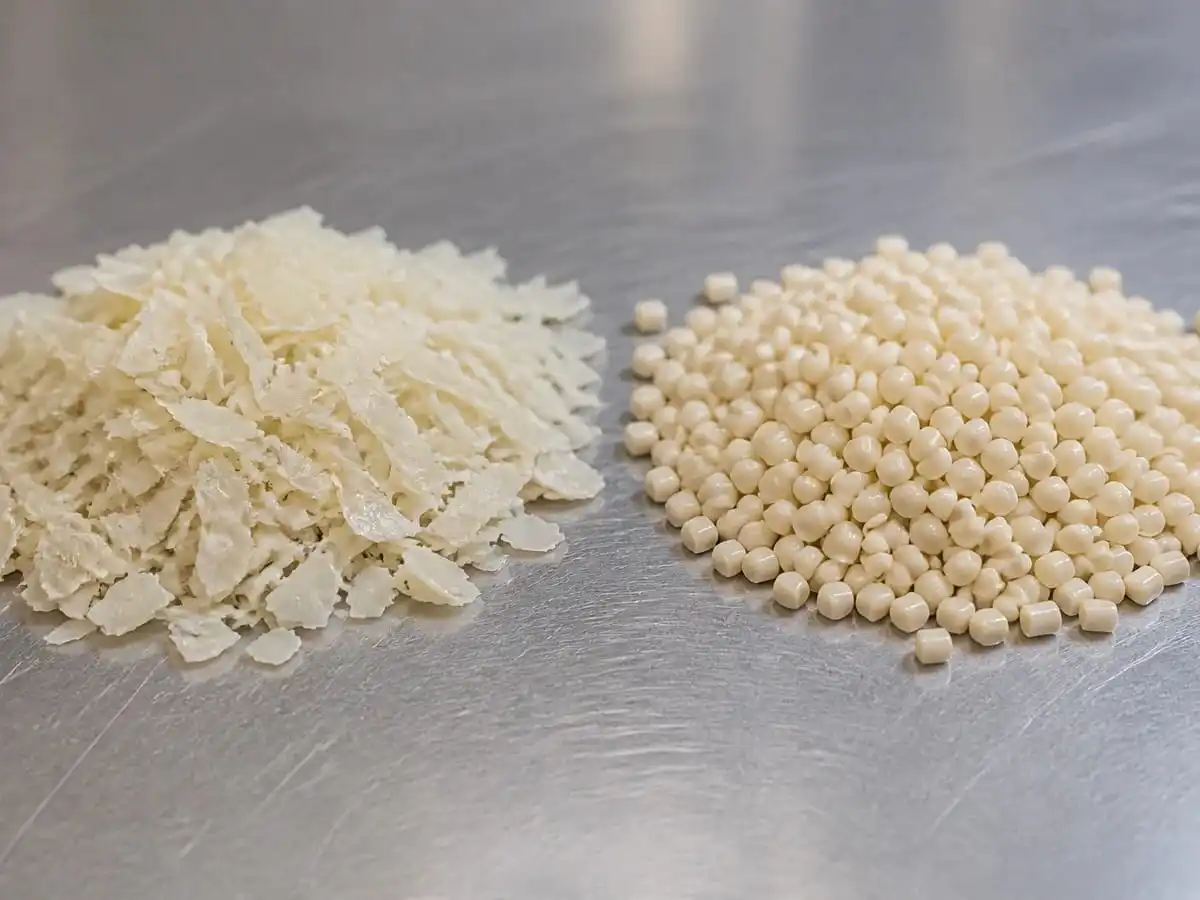
Sprue flake from a clean purged runner beside pelletized regrind, same PA66-GF30 grade, different thermal history.
Every pass adds heat and shear, and shear in a reciprocating screw does something specific: it breaks polymer chains. Molecular weight drops, melt flow index climbs, viscosity falls, and the material that used to pack like your PPAP now fills like a thinner grade. The property ranking under regrind is consistent across families: notched impact toughness dies first (the longest chains are the ones carrying crack-arrest duty, and they are the ones scission attacks hardest), tensile and flex hold within a few percent until blend fractions pass roughly 30%, and color shifts on PC and ABS two cycles before anything measures on a load frame.
Then there is the surface-area tax, the rule that makes regrind in injection molding as much a drying problem as a grinding problem. A pellet ground into flake multiplies its exposed area maybe a hundredfold, so it re-absorbs moisture in hours instead of days, and a hydrolysis-sensitive resin like PC molded wet does permanent molecular damage that no dryer cycle can undo. Drying rules for regrind are stricter than for virgin, not the same, which is covered in our resin drying in injection molding guide. Shrinkage also drifts with MFI, so a part that qualified at virgin viscosity can walk out of tolerance at cycle-three viscosity. Dimensional change in that direction usually shows up first as bores tightening and bosses sinking; our dimensional variations troubleshooting guide covers how to tell process drift from material drift.
Which Resins Take Regrind Well and Which Hold a Grudge?
PP and HDPE are the forgiving end: semicrystalline homopolymers running 25 to 50% same-scrap regrind with small property movement, which is why automotive interior PP recipes treat regrind as a normal input with records, not a scandal. ABS takes 20 to 30% but shows it on appearance first: gloss drops and the part yellows before impact moves much, so cosmetic grilles get tighter caps than hidden brackets. Nylon handles the mechanics of regrind, and punishes you on logistics: flake drinks water fast, so store sealed and dry on the flake schedule, not the pellet schedule. GF nylon adds a second tax: every pass shortens fiber length, and shortened fibers mean lower strength plus a different flow-versus-cross shrink split, which is a warpage story you will pay for at assembly.
PC is the diva. 10 to 15% of clean, dried sprue flake is typical at best; many specs say zero, because PC’s notched impact is fragile at the best of times and hydrolysis makes it permanent. POM deserves special caution: it degrades fast and exothermically when overheated, releasing formaldehyde and leaving acid that catalyzes the next pass. Keep POM regrind under about 20%, never from a burnt barrel, and never sit the melt in a hot barrel at soak. TPU hydrolyzes like PC. TPE has its phase morphology shredded by regrinding, so blends get requalified at the actual ratio or not at all. PEEK inverts everything: at resin prices above \$80 per kilo, aerospace molders routinely run 25 to 30% tightly documented regrind because the sprue is worth more than the grinding. Our PEEK machining vs injection molding guide covers that economy.
Why Does 20 Percent Regrind Quietly Become 35 Percent on the Floor?
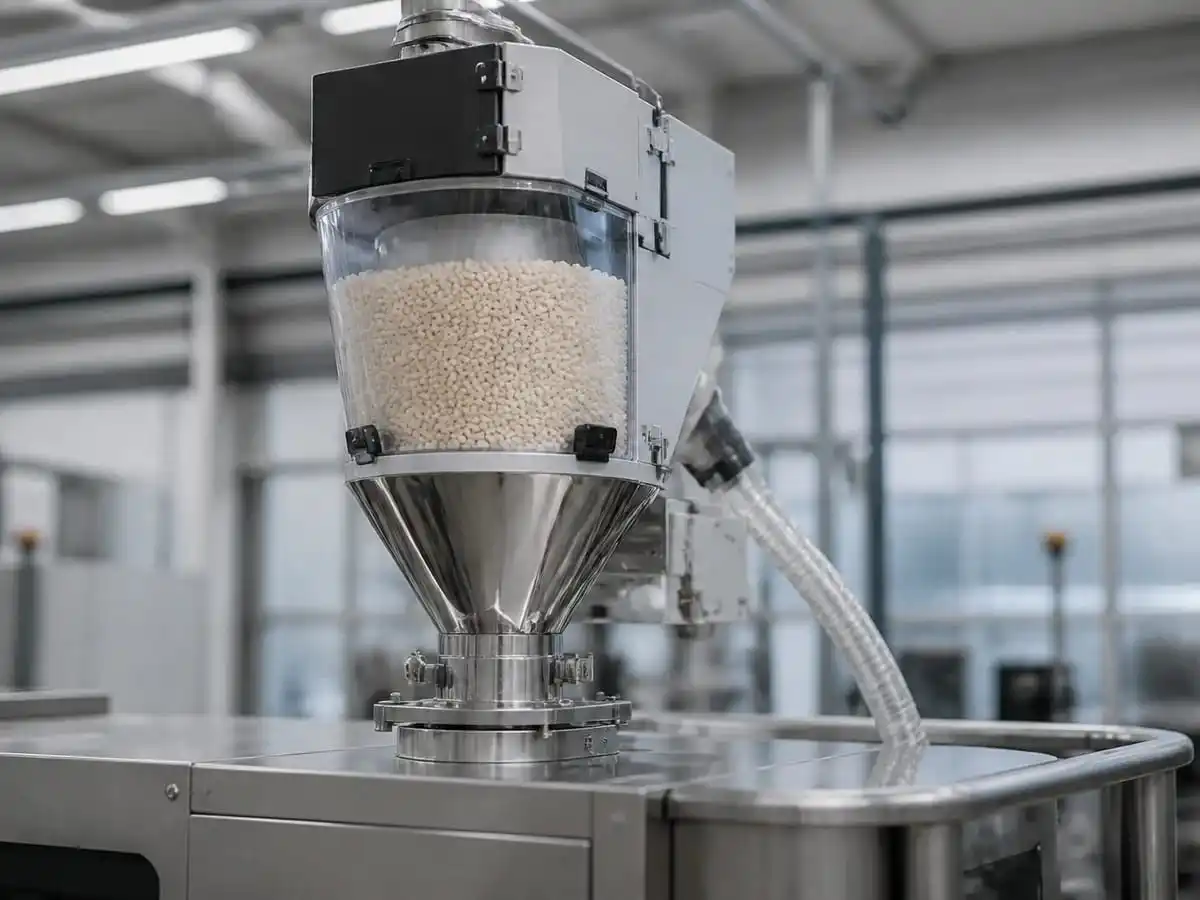
Loss-in-weight blender mounted over a hopper, metering flake and pellet by mass instead of by volume.
Because most shops meter it wrong. A volumetric blender is calibrated in volume, and flake bulk density is roughly half of pellet bulk density and varies with screen size, dust load, and how the bin bridged this morning. Set a volumetric unit to 20% with clean pellet-calibrated flake and you can be feeding 30%-plus by mass without one dial moving. Gravimetric loss-in-weight blenders meter by mass continuously and are the only honest way to hold a ratio on a machine without a checkweigh habit. Manual scooping into the hopper is a lottery with a story attached: the ratio becomes whatever the operator can lift.
Three floor controls close most of the gap. First, dedusting: suction at the grinder and a screen under the flake bin, because dust is where contamination and moisture concentrate. Second, bin discipline: one grade per bin, labeled with the melt-cycle count, which means a lot card field for cycle count actually exists and gets filled. Third, the shift-check weigh: a marked fill line is good; a scale reading of flake mass and pellet mass at shift start, logged beside dryer settings, is better and takes ninety seconds. Then the spec number and the actual number match, which is the entire point of writing a percentage into a contract.
Is Regrind Allowed in Food, Medical, and Aerospace Parts?
Read this section as a list of who gets to say no, not as legal advice. The first authority is always the part spec and the regulator’s file for the article in question, and the second is the compounder’s written position on the exact grade. In the United States, FDA has historically treated in-house, closed-loop regrind (the same grade, the same intended use, your own uncontaminated scrap going straight back) differently from post-consumer recyclate; that distinction is exactly why documentation of segregation and source matters more than the word “regrind” itself. Medical moldings carry the biocompatibility problem: a grade’s ISO 10993 dossier belongs to the grade as compounded, and re-melting changes extractables profiles enough that requalification, not assumption, is the defensible path. Many aerospace and gas-pressure programs cap regrind or forbid it outright at the OEM spec level, regardless of how well behaved the material is in trial.
Practical translation: if the drawing or program spec is silent, the molder’s regrind policy is a negotiation item at RFQ, never a surprise after PPAP. Ask the compounder for a position in writing before anyone says “our regrind is food safe” out loud, because that sentence has ended more supplier relationships than it has saved.
How Do You Actually Verify Regrind Level and Quality?
The blend ratio is verified by the equipment record (loss-in-weight log or weigh tickets); the material state needs its own evidence trail. The workhorse is melt flow index to ISO 1133 or ASTM D1238, run per resin lot with the virgin standard retained from the qualification lot as the reference. A common control window we accept on un-filled engineering resins is ±15% of the retained baseline at the datasheet load; outside that, the blend either comes down or the lot gets quarantined. Notched Izod (ASTM D256) is the early-warning property that the MFI window misses: on PA66-GF30 it can drift 15 to 35% while MFI barely moves, because fiber-matrix bonding degrades before viscosity does. Periodic cadence, not every lot: impact every 40 to 80 hours of production time on a live regrind stream, plus after any grinder service, screen change, or material switch. Color ΔE against the golden board for anything cosmetic, because regrind fails the eye before it fails the load frame. Moisture by Karl Fischer or halogen balance on the flake before blending, per our drying guide.
What you cannot do is detect regrind percentage from the finished part and call that a control. FTIR catches foreign polymer contamination, DSC hints at thermal history through crystallinity shifts, and nobody runs any of them at 2 a.m. on a bin. Ratio is proven upstream by records and by melt-flow behavior; the downstream tests only catch what already got away.
The 25 Percent Regrind That Passed Every Check and Still Cost \$118,000
The part: a PA66-GF30 battery-tray clip, snap-fit, loaded in the field at -10 °C, contract ceiling 25% in-house regrind. For six months the clip had zero complaints. Then field returns started: ears snapping during assembly in northern winters. Everything measured clean. The blend was 23% by weigh tickets. MFI sat 6% above the retained baseline, inside the window. CMM on critical dimensions: green. The failure was impact: a retest on retained samples showed notched Izod down about a third from qualification. Root cause was not the percentage. It was the stream. The shop had quietly folded ground rejects into the sprue bin two quarters earlier, so parts in the melt had been through the barrel up to four times, and the MFI of GF-reinforced nylon barely moves with chain scission because the glass carries the flow signature. Fiber length and interface quality carried the damage instead, and neither shows up on an MFI spec sheet. Containment, air freight, sorting, and re-tooling the affected lot: \$118,000. The regrind that cycle had saved \$2,100 a month. The fix cost less than one recall: separate bins with cycle-count labels, a melt-cycle limit of two on the lot card, impact testing added every 40 machine-hours, and the same numbers written into the PO the next quarter.
When Is Regrind the Wrong Answer?
Honesty section, from the side that sells regrind-friendly molding. On a \$1.20/kg PP part, the full cost stack of grinding, dedusting, segregation, blender depreciation, verification testing, and the paperwork of records frequently eats most of the resin savings, and some months beats it. For cheap, non-critical, invisible parts, honest virgin running with sprue destined for a baled waste stream is often the cheaper engineering answer, whatever it does to the ESG slide. If a molder quotes you a “virgin material only” premium on hidden PP brackets, ask what the premium buys, because the answer is sometimes nothing.
And regrind has real no-go zones regardless of price: optically clear parts where haze is the product; cosmetic A-surfaces beyond tight ΔE; pressure-rated and safety-critical parts where the property that degrades is the property that qualifies the part; primary-barrier medical moldings; and PC on anything that carries a person. Then there is the opposite extreme: with PEEK at \$80-plus per kilo, or a \$4,000 mold trial’s worth of carbon-filled PPS, “zero regrind” is not prudence, it is just burning margin, and the mature answer is a documented loop. The right policy is per part, priced out loud, and written down. If you want the per-part math on your geometry, our engineers run it during the free 24-hour DFM: send the drawing and the regrind answer comes back in the same PDF as the gate plan.
What Should the Purchase Order Actually Say?
Most regrind failures we audit trace back to a contract that said “maximum 20% regrind” and stopped there. Six clauses make regrind in injection molding contracts say what they mean:
| Clause | What it should specify |
|---|---|
| Ceiling and stream definition | Percentage by mass; sprue/runner only, or good-part flake explicitly allowed |
| Melt-cycle limit | No material beyond N passes, tracked by lot-card cycle count |
| Verification and cadence | Per-lot MFI vs retained baseline ± window; impact test every N hours; ΔE on cosmetics |
| Drying of regrind | Flake drying schedule, sealed storage, moisture check before blend |
| Segregation | One grade per grinder, labeling, no co-mingled returns |
| Change control | Written approval before any change of grinder, screen, source, or ratio |
A molder who signs all six without arguing has a system. One who signs the first and waves the rest is describing an intention. Paste this table into an RFQ annex verbatim if you like; it is written to survive a supplier review meeting, and every line maps to something an auditor can request and a good shop already keeps. The percentage is the one number your contract already has. The stream, the cycles, the tests, and the change control are the numbers that will decide whether your first article and your ten-thousandth part are the same part.
Veelgestelde vragen
Is 30 percent regrind too much for an injection molding part?
For PP and PE hidden parts with same-scrap flake and records, 30% is routine. For PC, POM, cosmetic ABS, or glass-filled load parts, 30% is past the usual engineering ceiling of 10 to 25% and needs qualified testing per grade, not per category average.
What is the difference between regrind and recycled resin?
Regrind is this part’s own scrap, ground and re-melted, with heat history you can count. Recyclate is post-consumer or post-industrial material re-pelletized through an unknown chain of sources. Both can be documented, but only one has a traceable melt-count, which is why specs cap them differently.
Why does regrind hurt impact strength more than tensile strength?
Chain scission from shear disproportionately shortens the longest molecules, and the longest chains are what blunt a crack tip. Tensile and flex are mostly carried by the bulk of the distribution, which shifts more slowly.
Is pelletized regrind better than raw flake?
It flows consistently, so blend ratios stay honest, and it debubbles. The cost is one extra melt pass, which buys you better control at the price of one more dose of heat history. For PC and nylon we prefer pelletized; for PP it is usually overkill.
Can regrind be used in parts that contact food?
US FDA has historically distinguished in-house closed-loop regrind of the same resin and use from post-consumer recyclate. The answer for your part lives in the compounder’s written statement and the applicable food-contact notification, not in a blog, including this one.
How do I know my molder is not running more regrind than agreed?
Ask for the loss-in-weight logs or shift weigh tickets for the flake stream, the grinder cleaning records, and the per-lot MFI trend against the retained baseline. Shops running honest ratios hand these over because they already keep them; shops that are not will offer you trust instead.
Does regrind change shrinkage and dimensions?
Yes, through viscosity. Scission-thinned melt packs differently and the crystallization balance shifts, so gate-adjacent dimensions and post-mold drift move together. Qualify shrink on the regrind recipe, not on the virgin datasheet.
Do you use regrind at Ideal Pro?
Only where your spec says it is right, with segregated grinders, lot-card melt-cycle tracking, per-lot melt-flow verification, and the blend ratio printed on the certificate of conformance. The 24-hour DFM review includes a recommended regrind policy and its per-part cost effect, free, before any tool is cut.
Summary
Regrind in injection molding is a legitimate engineering input when three things are true: the stream is defined, the melt-cycle count has a ceiling that someone actually tracks, and verification watches the property that fails first (usually impact and color, not tensile). The 20% in your contract is a mass percentage, a stream definition, and a history, all at once. Write all three into the PO, or the number is decoration. Match the ceiling to the resin family, hold the blend ratio by mass at the hopper rather than by a calibrated assumption, and verify with melt flow against a retained baseline plus periodic impact on anything load-bearing. Then decide per part where regrind belongs in the cost stack, because the answer genuinely runs both directions: sometimes it is the $2,100-a-month saving that quietly turns into an $118,000 recall, and sometimes it is the reason a $90-per-kilo resin is affordable at all.
If you want a second opinion on where regrind belongs in your part’s cost and quality stack, send us the drawing. The DFM comes back in 24 hours with the material recipe, the drying plan, and the verification cadence written into the same document as the quote.


 English
 French
 Dutch
 German
 Japanese
 Korean