 Français



The trading-company question is not really about ethics, it is about physics: someone owns the machines, and you need to know who, because when the process drifts at 2 a.m. on your production Sunday, only the machine owner can fix it, and that is the whole reason the factory or trading company question has to be settled before a PO. One of our prospective customers once sent us three competing quotes for a two-cavity connector tool. The cheapest, from a vendor whose website said “manufacturer since 2008,” got eliminated in ninety minutes: the business license showed a registered trading company in an office tower, the live video tour landed in a showroom with one locked door to the “production area,” and when our engineer asked which EDM machine had sunk the last connector cavity, the answer was a pause, then an email “to confirm with the factory.” The tool never touched steel at that address. If you are evaluating an injection molding supplier and want to know whether you are talking to the people who own the presses, here are seven verification tests for your injection molding supplier, in the order that catches fakes fastest, all of them runnable from your office in under an hour.
| Test | Time needed | What it proves |
|---|---|---|
| License and certificate name chain | 10 min | Legal entity actually does manufacturing |
| Mold shop interrogation | 15 min in one call | Owns tooling capability, not brokerage |
| Surprise video tour | 30 min | Machines, people, and records exist today |
| Nameplate vs equipment list | Inside the tour | The machine list is not fiction |
| Records forensics (Cpk, FAI, calibration) | 20 min | Quality system runs on the floor, not in a PDF folder |
| Freight and payment trails | 10 min | Goods and money move under the right name |
| DFM response clock | 3 days of silence | Engineers are on staff, not on retainer |
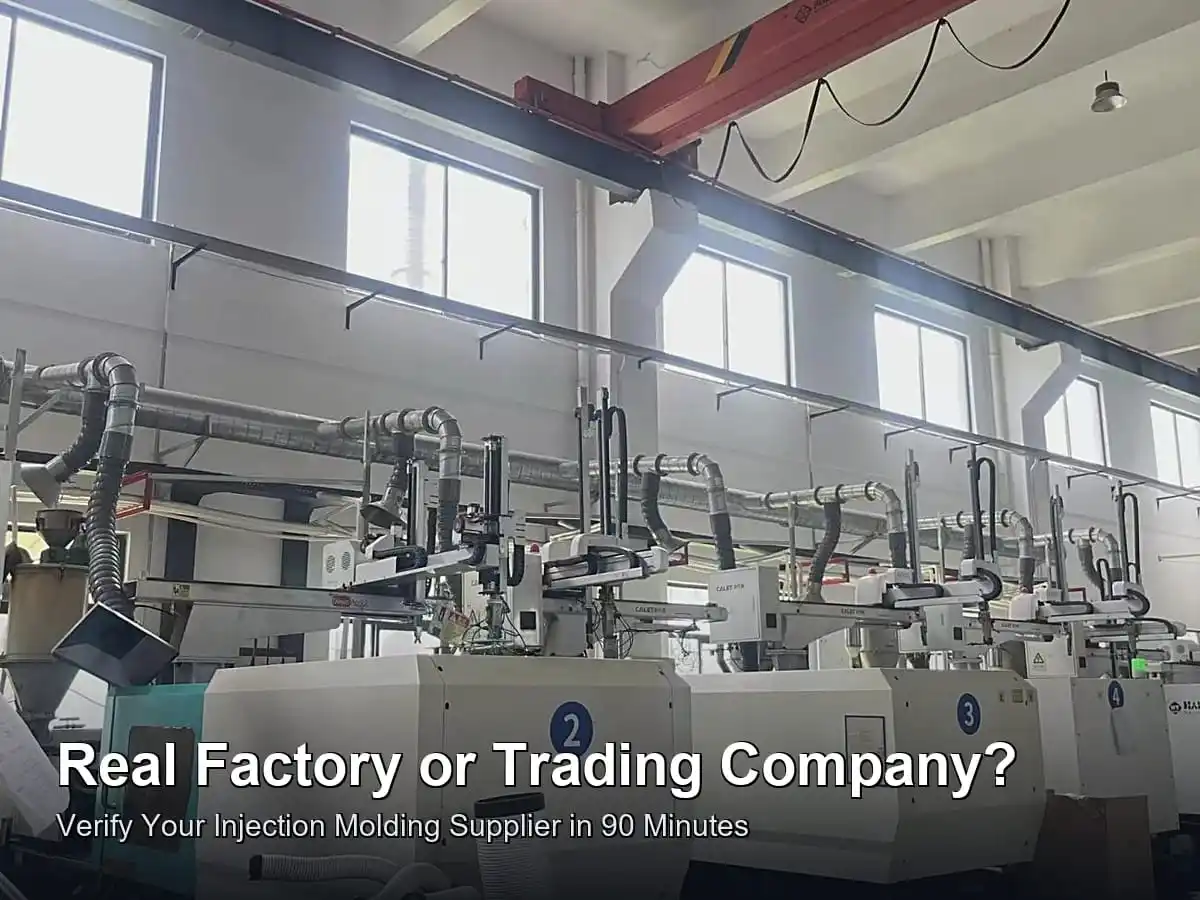
Why Trust a Verification Guide From a Factory?
We are Ideal Pro, a custom injection molder in Shenzhen with our own mold shop, and we are the side of this transaction that gets accused. The honest reason a real factory publishes verification guides is that these tests filter in customers and filter out time-wasters: a buyer who asks for the certificate number is a buyer who eventually asks for the cavity-level Cpk, and that is exactly the conversation we want at RFQ stage. Our ISO 9001 certificate carries a number you can pull up in the registrar’s public register, our business license names manufacturing as the registered scope, and the machines that will run your parts carry nameplates a video call can reach in ninety seconds. Over the years we have also audited the other direction, sitting with customers’ third-party auditors through our own records, so this checklist is written knowing exactly what a good paper trail looks like from the inside, and where a fabricated one snags. Where we quote a rule of thumb below, such as how long engineering should take to answer a DFM question, it comes from our own logs and the complaints we hear on the buyer side of the market, not from a textbook.
What Does the Business License Actually Tell You?
Start with the boring documents, because fakes fail at paperwork before they fail anywhere else. Every registered Chinese company has a business license with a field called the business scope, and that field is the fastest factory-versus-trading filter in existence: a real molding operation registers manufacturing of plastic products and molds, while a trader’s scope reads like a catalog of verbs for moving other people’s goods. Pull the license (your supplier has it; a supplier who cannot send it in five minutes has answered your question already), then run the name chain: the entity on the license, the entity on the ISO certificate, the entity on the bank account you are being asked to wire, and the entity at the factory address must all be one name, or a disclosed parent-subsidiary relationship you can verify in the national enterprise credit system. Trading companies love borrowing a partner factory’s ISO certificate, which is technically the partner’s document, not theirs. The address check catches the second most common setup: a registered office in a downtown tower while the “factory tour” happens forty minutes away at a plant nobody mentioned until you asked to see it on camera.
Why Is the Mold Shop the Dead Giveaway in This Industry?
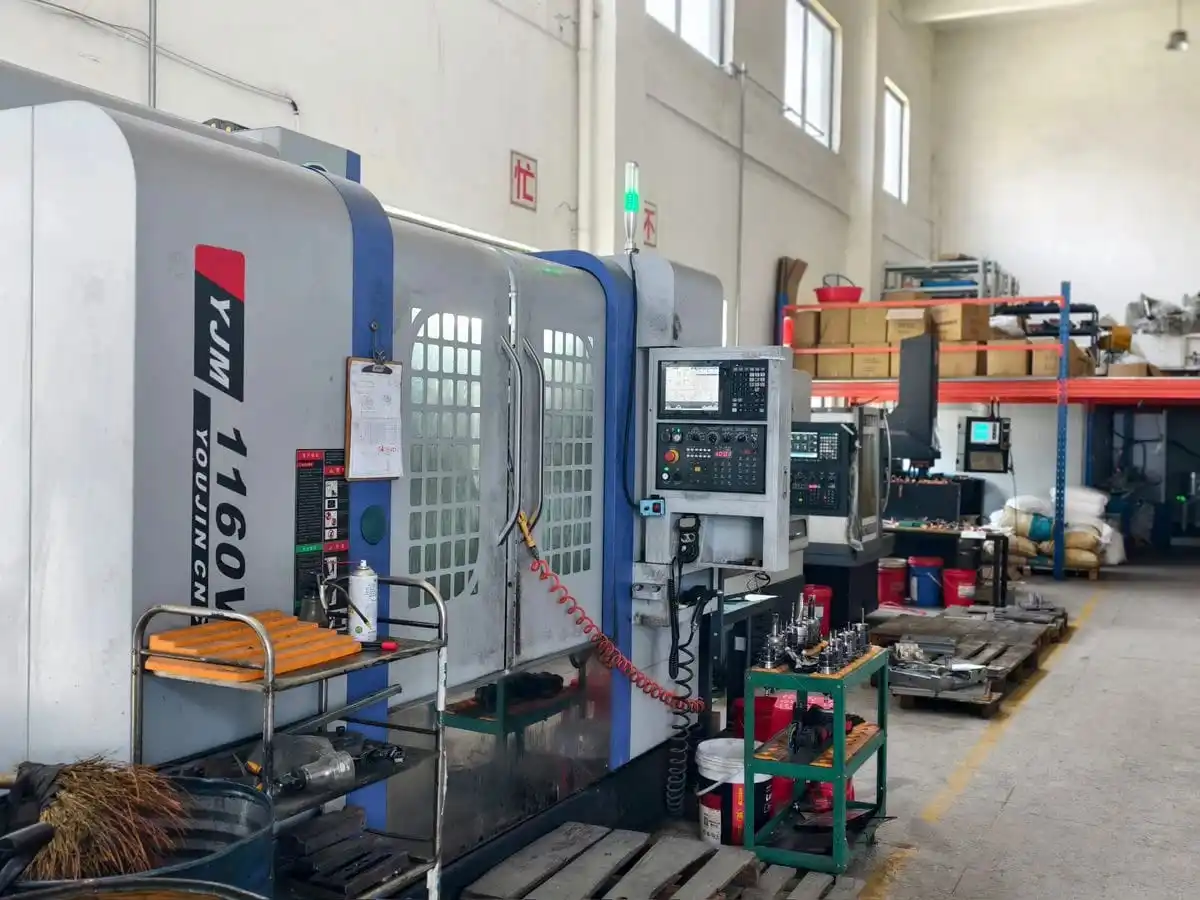
Injection molding machine nameplate close-up: brand, model, tonnage and serial are the details a paper list fabricates last.
Every trading company in plastics can quote your part. Only a fraction of them can show you the room where your mold is being cut. So talk molds, specifically: which CNC and EDM machines built their last three tools, what brand, what size, what they outsourced and to whom. In any factory or trading company decision, this is the sharpest fork: a real molder answers this in one breath, usually too enthusiastically, because the mold shop is where their pride lives. A broker either says tooling is “outsourced to a long-term partner” (true, for them, and fatal for your change orders) or goes quiet. Then ask to see a mold: any mold, mid-assembly, with the runner and cavity steels visible. A working shop can walk to one in thirty seconds. The consequence you are screening for is specific. When your dimension is 0.06 mm off and the fix is a steel transfer, the factory-with-mold-shop turns it in two days. The trader emails the mold shop, waits, relays, marks it up. Five-day fix becomes three weeks, and the project learns that its actual boss is a subcontractor you have never met. In-house steel does not make a supplier perfect. It makes them accountable.
What Do You Ask During a No-Notice Video Tour?
Email schedules are theater; the verification is the call that lands with two hours’ notice. Ask for a live walk, on your camera terms, in this order. Molding floor first: ask the guide to walk machine by machine and read nameplates aloud for three machines you picked off the equipment list they previously emailed you (brand, model, tonnage, serial, year of manufacture). A fabricated machine list falls apart here, because nobody memorizes thirty nameplates on request. Dryers and material room next: ask them to open the hopper dryer log and show bag labels, because material handling is where trading-company handoffs get sloppy, and it is the same drying discipline we walk through in our Guide de séchage de la résine. QC room third: CMM on the granite, calibration stickers with visible next-due dates, and one real inspection happening. Mold shop fourth (see above; it is also where you check whether the tour is the rented showroom trick: no shop means no manufacturer). One working operator conversation fifth: ask whoever is actually running a press what their process sheet says, not what the salesperson believes. Twenty-five minutes, total. A real factory does this without rehearsing; the fake’s calendar suddenly has no open slots for three weeks.
What Do Inspection Records Look Like When They Are Real?
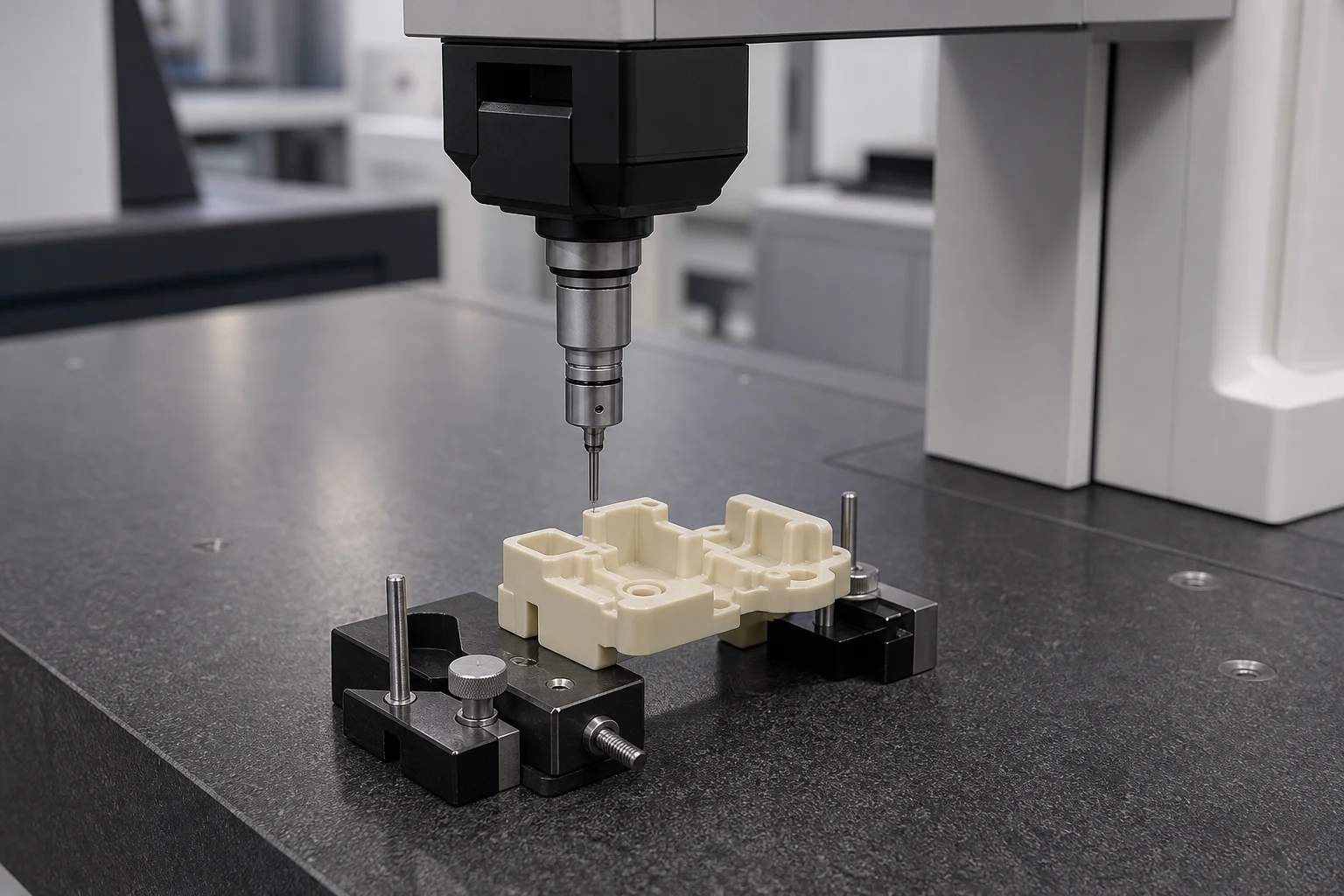
Real FAI evidence starts here: cavity-level measurement on a calibrated CMM, not an averaged summary PDF.
Request two or three pages of live records and check them against each other, not against your hope. A credible set has internal consistency: the FAI report for a part references the same cavity numbers as the Cpk study for that part; the Cpk study cites a CMM whose calibration certificate covers the date the data was collected; the IQC record for the resin lot matches the mill certificate’s lot number; and the dates form a believable chain (a 2020 calibration certificate under a 2025 report is either a typo or a confession). Ask for cavity-separated dimensional reports on a running part, not a one-page averaged summary, because statistical averaging across cavities is exactly how shops with a bad cavity hide it, and a supplier who has never produced per-cavity reports probably does not run them at all. Now the trap question, which costs you nothing: ask who signs off the PPAP-equivalent documentation package for your program, and whether you get the raw data file, not just the report PDF. Real shops hand over CSV or CMM native exports routinely because the auditors already ask. Fabricated evidence trails stop at the PDF, because the PDF is the whole inventory.
How Do Freight and Payment Paper Trails Help You Decide?
You cannot see the factory’s soul, but you can watch what moves under its name. Ask (politely, in the contract-diligence framing) for two or three bill-of-lading copies from recent export shipments to your region, with the shipper name redacted as needed and the rest visible, or check public ocean-freight manifest data yourself: a real manufacturer appears as shipper under its own legal entity repeatedly, over quarters. A trading outfit appears under names that change, or the same factory you are being quoted appears on manifests as somebody else’s shipper. On the money side, the wire details tell a quieter story: a manufacturer’s account is in the company’s registered name; an agent’s is in a name you have not seen on any document. None of this is a conviction by itself, large legitimate groups do have separate export subsidiaries, and that is precisely the point: a real structure is disclosed and documented, a fake one is discovered mid-call. Every test here is a pattern, and it is patterns, not single flags, that end negotiations.
Why Does Engineering Response Time Expose the Difference Best?
Send a drawing during RFQ and start a clock, because you are not waiting for an answer, you are measuring who answers. A staffed engineering group comes back inside a working day with the first pass: wall-thickness notes, gate proposals, and, crucially, questions, since real engineers always have two questions about shrinkage direction or insert availability. A trading company’s clock is the sum of its relay network, and the symptom shows early: technical questions get acknowledged instantly and answered in days, every response arrives as one polished email instead of a threaded conversation, and the answer to a follow-up question about the answer is another “checking with the factory.” Track it as a number, which is what makes the test fair, and put it next to the quote. The 10-point buyer checklist frames the same measurement from the contracting side: DFM depth is one of the cheapest proxies for whether the supplier’s promises are staffed. Three days of silence on a Monday-morning email is not a communication problem. It is an org chart.
When Is the Trading Company the Right Choice?
The honest half of this article: the trader is not a scam, it is a service, and pretending otherwise is how factories lose legitimate deals. A good plastics trading company consolidates kits your single factory cannot make (the molding shop does not do your plating, your silk screen, your zinc inserts), holds low MOQs that no press wants, speaks your language with a PM who never sleeps in your timezone, and absorbs small-lot chaos that would bankrupt a focused factory’s scheduling. For a seven-part assembly shipping 400 kits a quarter, the trader is plausibly the better operator, and their premium buys you the project management. The failure mode is not “using a trader.” It is buying factory pricing and factory accountability from a trader without knowing it, which is when the Cpk nobody measured becomes your field recall. So the correct decision at RFQ is not factory-good/trader-bad; the factory-or-trading-company question only has to be answered honestly, by you, before signing: know what you are buying, pay for the coordination if you need it, and if you wanted the machine owner, run the tests and buy the machine owner. A trader who answers “we are a trading company” in the first email is telling you exactly who they are, and that honesty is itself the audit pass.
What Did It Cost to Skip These Ninety Minutes?
A buyer we eventually quoted had a two-cavity connector tool with a US startup, mid-2025. Three RFQs came back: \$34,000 from a factory like ours, \$22,000 from a “molds and injection” company with a polished site, \$19,500 from an Alibaba storefront. The \$22k won on story: two-day responsiveness, a shiny PDF capability deck, and a factory album. Ninety minutes of the tests above at that moment would have cost nothing. The tool was paid, and at week six the buyer asked to video-walk “their” mold during T1 debugging, and the call found a showroom, then an outsourced mold shop two provinces away where the actual fitter did not know the buyer’s part number existed. The \$22k tool did eventually ship, eleven weeks late, with a gate vestigiality the real owner had no reason to fight for, and re-qualification and cycle tuning burned another \$19k in engineering time and one missed launch slot. The comparison quote we had sent, for the same steel plan and a full PPAP-equivalent pack, had been \$34,000 with an eight-week promise. The premium they refused to pay was \$12,000. The invoice reality was roughly three times that, before counting the launch. Ninety minutes of tests, from your office, on the vendor who seemed nicest. That is the whole business case for this article.
How Do You Run the Full Check in Under an Hour?
Fold it into one call and one afternoon of document review, and reuse it for every supplier.
| Order | Action | Red flag |
|---|---|---|
| 1 | License, ISO cert, bank name chain | Names disagree, or “our factory’s certificate” |
| 2 | Business scope and address vs reality | Scope says sales, factory is “different district” |
| 3 | No-notice video tour, your route | Showroom, locked doors, three-week calendar |
| 4 | Nameplate readout on 3 listed machines | Brand/model/serial mismatch |
| 5 | Mold shop walk with one live mold | “Outsourced,” no photos, no specifics |
| 6 | Records pack: FAI, per-cavity Cpk, calibration dates | PDF-only, averages-only, date collisions |
| 7 | Shipper name on a real bill of lading | Shipper is a different entity each time |
Keep the spreadsheet, score the same way for every vendor, and say the quiet part out loud in your own team meeting: the cheapest quote is usually the most expensive supplier to onboard. Our own version of this table, from the other side of the desk, is in the supplier audit checklist. If you want to see whether we survive our own checklist, the answer is to book a tour: contact us and the video call happens within 48 hours, unscripted, machines included.
Résumé
The factory-versus-trading-company question resolves in ninety minutes if you test in the right order: license and certificate name chain, manufacturing scope, a mold shop that exists on camera, nameplates that match the equipment list, per-cavity records with consistent dates, freight paper under the same legal entity, and an engineering clock measured in hours instead of days. Any single test can be fooled, but the chain of seven is a pattern nobody fakes convincingly while also quoting you a price. Keep the scores in one sheet and run the same battery on every vendor, because consistency is what turns a checklist into evidence you can defend internally. Then buy with your eyes open: take the trader deliberately when you want their coordination services, and take the machine owner deliberately when your schedule, your tolerances, and your 2 a.m. Sunday depend on who holds the process. We would rather you audit us than audit your losses. Start with the tour and the free DFM.
FAQ
Comment puis-je m'assurer qu'un fournisseur spécialisé dans le moulage par injection est bien une véritable usine sans avoir à me déplacer ?
Réalisez une visite vidéo inopinée en suivant votre itinéraire : les plaques signalétiques de trois machines répertoriées, l'atelier de moulage avec un moule en fonctionnement, le séchoir et les registres des matières premières, ainsi que la salle de contrôle qualité en pleine opération de mesure. Vérifiez que le champ d’application de la licence, le titulaire du certificat, le nom de la banque et l’expéditeur figurant sur le connaissement correspondent bien à une seule et même entité juridique. Une véritable usine passe avec succès le test de vérification (usine ou société commerciale) en un seul appel de 30 minutes ; la fausse usine cherche à gagner du temps.
Quels documents permettent de prouver qu'un fournisseur chinois est un fabricant et non un négociant ?
La licence d'activité mentionnant la fabrication dans son champ d'activité, le certificat ISO dont le nom du titulaire correspond à celui de l'entité contractante (vérifiez le numéro dans le registre public du greffe) et les documents d'expédition à l'exportation où l'expéditeur est cette même entité. Trois noms, une seule chaîne. Si la chaîne se rompt, votre responsabilité s'en trouve également compromise.
Une société de négoce peut-elle réussir le test de la visite guidée vidéo ?
Un professionnel chevronné peut vous faire visiter un showroom loué et un espace d'exposition aménagé avec des machines ; c'est pourquoi la visite seule ne suffit pas. Associez-la à des vérifications de la chaîne documentaire et à une analyse minutieuse des archives : les espaces d'exposition aménagés peuvent produire un fichier PDF, mais ils ne peuvent pas fournir, sur demande, des données Cpk cohérentes par cavité avec des dates d'étalonnage correspondantes.
Est-ce un inconvénient de faire appel à une société de négoce pour vos besoins en moulage par injection ?
Pas nécessairement. Les distributeurs apportent une réelle valeur ajoutée pour les kits multiprocessus, les faibles quantités minimales de commande et les programmes nécessitant une communication intensive, et la majoration de prix permet de couvrir ces coûts. Il n’est pas judicieux de payer les prix du fabricant alors que le propriétaire de la machine est un sous-traitant dont l’identité n’est pas divulguée, situé trois maillons plus loin dans la chaîne. Assurez-vous de savoir quel produit vous achetez avant de signer le bon de commande d’outillage.
Qu'est-ce qu'un rapport Cpk au niveau des cavités et pourquoi l'avez-vous refait trois fois ?
Il présente la capacité du processus par cavité du moule, plutôt qu’une valeur moyenne calculée sur l’ensemble des cavités ; ainsi, une cavité défaillante ne peut pas se cacher derrière des cavités performantes. Toute usine appliquant véritablement le contrôle statistique des processus (SPC) dispose de ces rapports ; une société de négoce, en revanche, dispose généralement de fichiers PDF contenant des moyennes fournies par celui qui a réalisé la production. C’est là la seule différence, et la plus simple à mettre en œuvre, qui distingue les deux.
Dois-je faire appel à un organisme tiers de contrôle, tel que SGS, avant de payer pour un moule ?
Pour les outillages d'une valeur supérieure à environ 20 000 $ ou dans le cadre d'un engagement d'approvisionnement pluriannuel, oui, un audit d'une journée coûte quelques centaines de dollars et bénéficie d'une impartialité indépendante au sein de votre propre entreprise. En dessous de ce seuil, la chaîne documentaire, associée à une visite inopinée sur site, couvre gratuitement la majeure partie du risque. L'audit constitue une mesure d'escalade, et non une première étape.
Pourquoi la rapidité de réponse des services techniques revêt-elle une telle importance lors d'un appel d'offres ?
En effet, le délai de réponse reflète la structure organisationnelle. Une équipe d'ingénieurs bien dotée en effectifs répond aux questions techniques par des contre-questions en l'espace d'une journée ; un service de relais vous répond " nous vérifions auprès de l'usine " et vous renvoie, quelques jours plus tard, la fiche technique que vous avez déjà lue. Ce que vous évaluez, c'est l'effectif, pas les manières.
Ideal Pro réussira-t-il le test de la visite guidée vidéo à l'improviste ?
Yes, and we ask you to run it. Send the drawing and a tour request through the page de contact, and within 48 hours you are on a live call with our mold shop, dryer logs, and per-cavity reports open on camera, plus a written 24-hour DFM on your part.
À propos de l'auteur

Alex Yu
Ideal Pro Manufacturing
Alex est le cofondateur d’Ideal Pro, mais lorsqu’il ne supervise pas des projets clés ou ne dirige pas l’équipe technique, vous le trouverez sans doute en train de faire une longue balade à vélo, à la recherche du meilleur café de la ville, ou en train de planifier sa prochaine aventure de voyage. Fort de plus de 20 ans d’expérience dans le commerce international et la gestion de projets, il a tout vu : délais serrés, problèmes techniques complexes et tout ce qui se trouve entre les deux. Il est convaincu qu’un travail de qualité naît d’un esprit bien reposé et d’une bonne tasse de café, et il apporte cette même curiosité et ce même souci du détail à chaque projet qu’il entreprend. Lorsqu’il n’est pas au bureau, il se trouve généralement en plein air, à explorer de nouveaux endroits et à glaner des anecdotes à partager.
 English
 French
 Dutch
 German
 Japanese
 Korean