

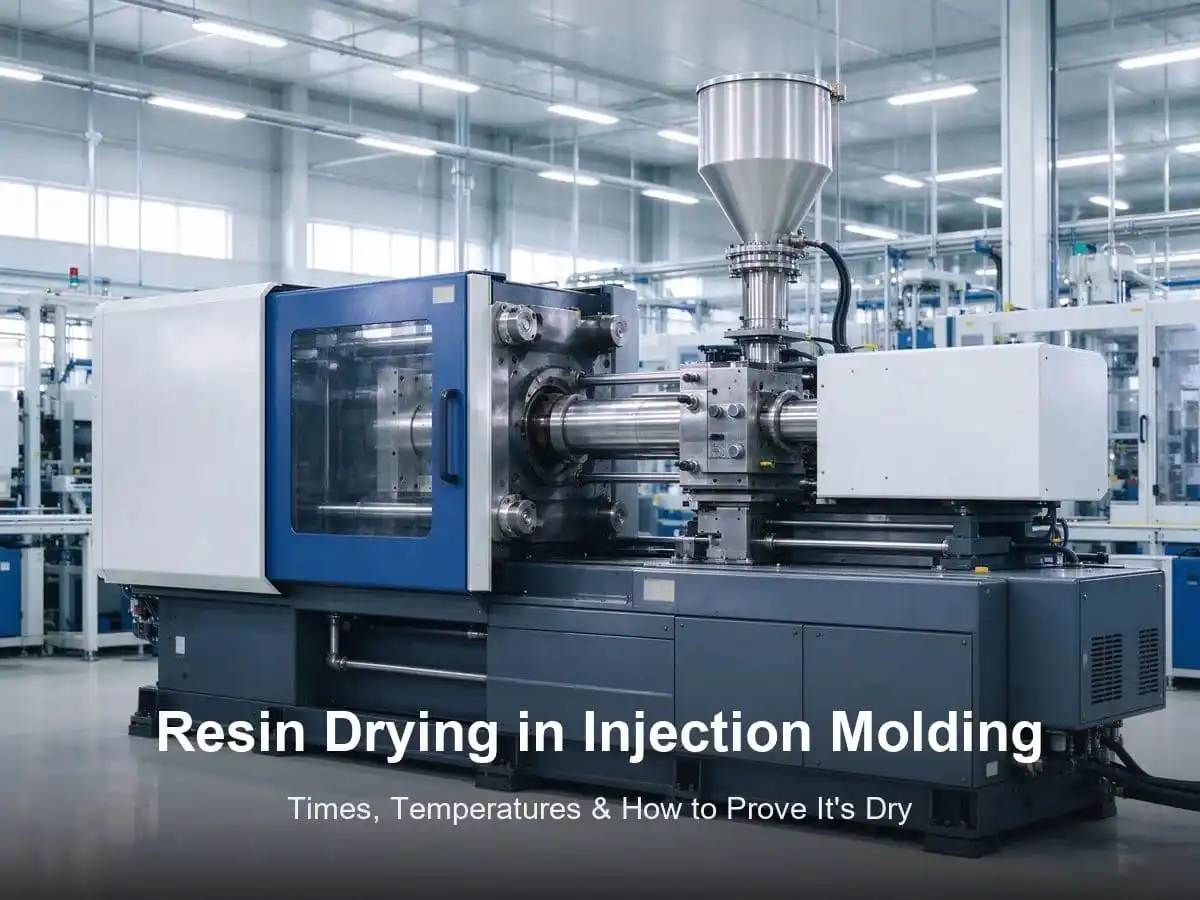
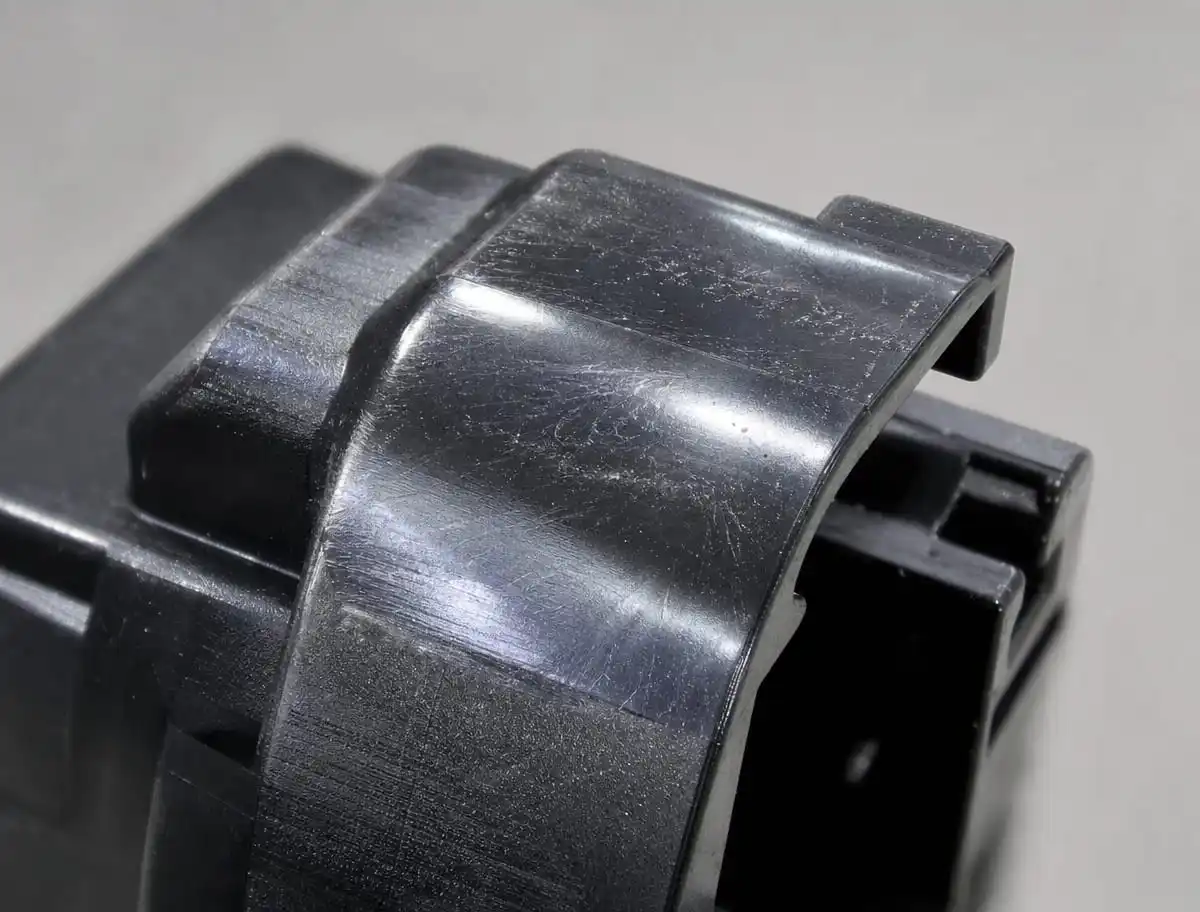
Resin drying in injection molding is the cheapest insurance on the factory floor, and the most commonly skipped. Silver streaks across a black PA66 connector is how bad drying usually announces itself, and it’s also the most misdiagnosed defect on the press. Before anyone touches the mold, we cut the melt from the barrel into a glass of water and watch what it does, then we put a sample in a moisture balance. Drying mistakes are cheap to fix and roughly three times more common than tooling mistakes on moisture-sensitive resins. This guide gives you the family-by-family targets (temperature, time, dew point), how long dried pellets actually survive in your hopper, and the two practical ways to prove the resin was dry instead of assuming it was.
| Quick reference | Typical value |
|---|---|
| Nylon 6/66 target at molding | ≤ 0.2% (many grade sheets say lower) |
| PC target at molding | 0.02–0.04% |
| Standard POM drying need | Usually none (see Section 7) |
| Desiccant dryer dew point, PA/PC/PBT | −30 to -40 °C |
| PA66 re-wetting at 23 °C / 50% RH | First ~0.2% within hours, not days |
How Do You Know the Dryer Lied to You?
A dryer showing a good dew point does not mean your pellets are dry. It means the air leaving the dryer is dry. This is the single most expensive misunderstanding in resin drying in injection molding, and four things have to work together before a pellet enters the barrel, every one of which fails in real shops:
1. Air dryness (dew point). The desiccant wheels get saturated, the filter gets bypassed, or the unit was never serviced. Dew point drifts from −40 to -10 °C and the alarm stays silent.
2. Pellet temperature. Moisture only diffuses out when the bead is hot enough inside. If your throughput doubled but the hopper stayed the same size, material short-circuits through the middle at feed temperature and leaves with its original moisture.
3. Time at condition. The number that matters is the residence time of the last pellet in, not the clock since the dryer was switched on. A hopper sized for a machine running at half rate holds material for half the required time.
4. Airflow through the bed. Channeling blows a dry cone through a wet hopper. We have seen hoppers read 80 °C at the wall and 45 °C in the core.
The symptom pattern tells you which one failed. Streaks and bubbles that are worst at startup and improve mid-shift usually mean the hopper is too small for the required residence time, or the first material in got cold while the dryer warmed up. Streaks that get worse as the shift runs usually mean reabsorption after the dryer: a wet transfer line, an open gravity feed during a door-opening period, or regrind that never saw a dryer at all.
Figure 1: Silver streaks and gas marks on a glass-filled PA connector, the classic appearance signature of unproven drying.
What Counts as “Dry Enough” for Each Material Family?
Here is the reference table we keep taped inside the dryer station. These are typical industry windows for resin drying in injection molding, not gospel: the controlling document is always the current datasheet for the exact grade, color, and filler package on your purchase order. Reinforced and flame-retardant compounds behave nothing like their base resin.
| Family | Target moisture at molding | Dryer temp | Typical time | Dew point | If you skip it |
|---|---|---|---|---|---|
| PP / PE (sealed virgin) | None needed | — | — | ambient | Only dry if surface-condensed: 80 °C, 1–2 h |
| HIPS / GPPS | None needed | — | — | ambient | Splay after cold storage; 70-80 °C, 1–2 h |
| ABS | ≤ 0.2% | 75-85 °C | 2–4 h | −20 to -40 °C | Dull surface, splay, lower impact |
| PC | 0.02–0.04% | 110-120 °C | 3–6 h | ≤ -40 °C | Splay **and** permanent embrittlement |
| PMMA | ≤ 0.1%; optical ≤ 0.03% | 80-90 °C | 3–4 h | -40 °C | Streamers, bubbles in lenses |
| PA6 / PA66 unfilled | ≤ 0.2% (target 0.1–0.15%) | 80-90 °C desiccant, or vacuum at lower temp | 3–6 h | −30 to -40 °C | Splay, silent loss of toughness |
| PA + GF / MF | Grade sheet rules: 0.06–0.3% ranges exist | 80-100 °C | 4–6 h | −30 to -40 °C | Streaks plus fiber-tipped jetting |
| POM copolymer (standard) | Usually none | — | — | — | Toughened grades: separate requirement |
| PBT | 0.02–0.05% | 100-120 °C | 3–4 h | ≤ -40 °C | Hydrolysis: viscosity drop, short shots |
| PET (molding grades) | 0.03–0.05% | 135-150 °C | 4–6 h | ≤ -40 °C | Acetaldehyde smell, molecular loss |
| TPU | ≤ 0.05–0.1% | 80-90 °C | 3–4 h | −20 to -40 °C | Bubbles at gate, poor weld lines |
Two footnotes that save money. First, PA dried with plain hot air oxidizes; if you only have a simple hot-air hopper dryer, keep PA under about 80 °C and accept a longer cycle, or use vacuum. Second, over-drying is a real failure mode: PMMA and PC will discolor and start to crosslink on excessive residence at temperature. Dry to the window, not past it.
How Long Do You Have Before the Hopper Undoes All Your Work?
Dried resin starts reabsorbing the moment it meets humid shop air, and nylon is the fastest thief. Unfilled PA66 at 23 °C / 50% RH takes back roughly the first 0.2% within a few hours and creeps toward its 2.5–3% equilibrium over a day or two. Polycarbonate is slower but less forgiving, because its window (0.02–0.04%) is so tight that even an hour of exposure matters.
Practical rules:
- A drying hopper is sized from throughput × required drying time, with a safety factor. If you consume 30 kg/h and the grade needs 4 h, a 60 kg hopper is undersized no matter what the nameplate says. Sizing at 2–3× hourly consumption covers lunch breaks, mold changes, and the inevitable Tuesday outage.
- Conveying is part of the process. A cold, damp vacuum-convey line will re-wet PC to 0.06% on the way to the press and your dryer will take the blame.
- Once the specified hold time at the press is exceeded, the material is scrap-or-redry territory. Redry on the grade sheet’s re-dry rule if one exists; PC and PBT deserve a viscosity check first (next section) because some of that material has already been hydrolyzed in the barrel.
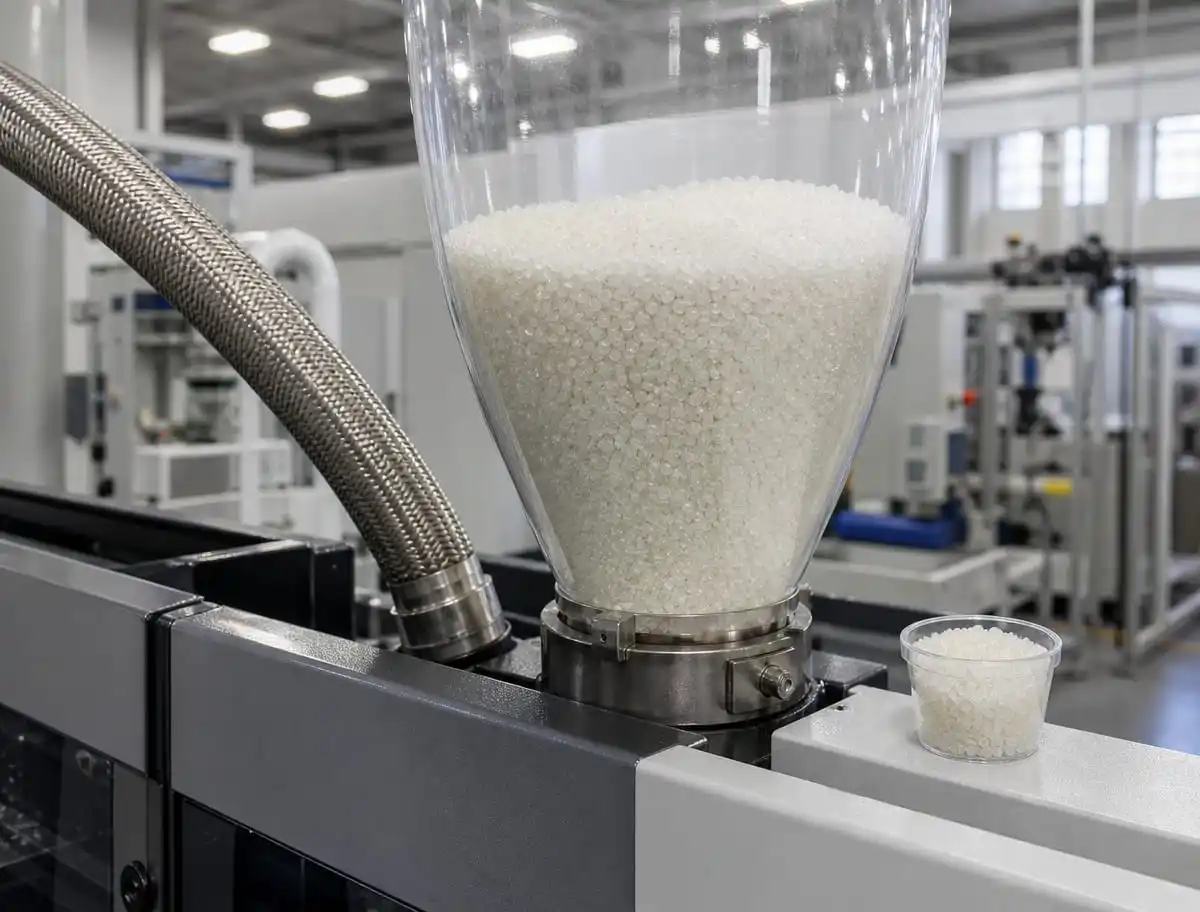
Figure 3: The feed throat is the last controlled point. Sample here, not from the bag.
How Do You Prove the Pellets Are Dry Without a Lab Contract?
There are only three honest answers, and two of them fit on a factory floor.
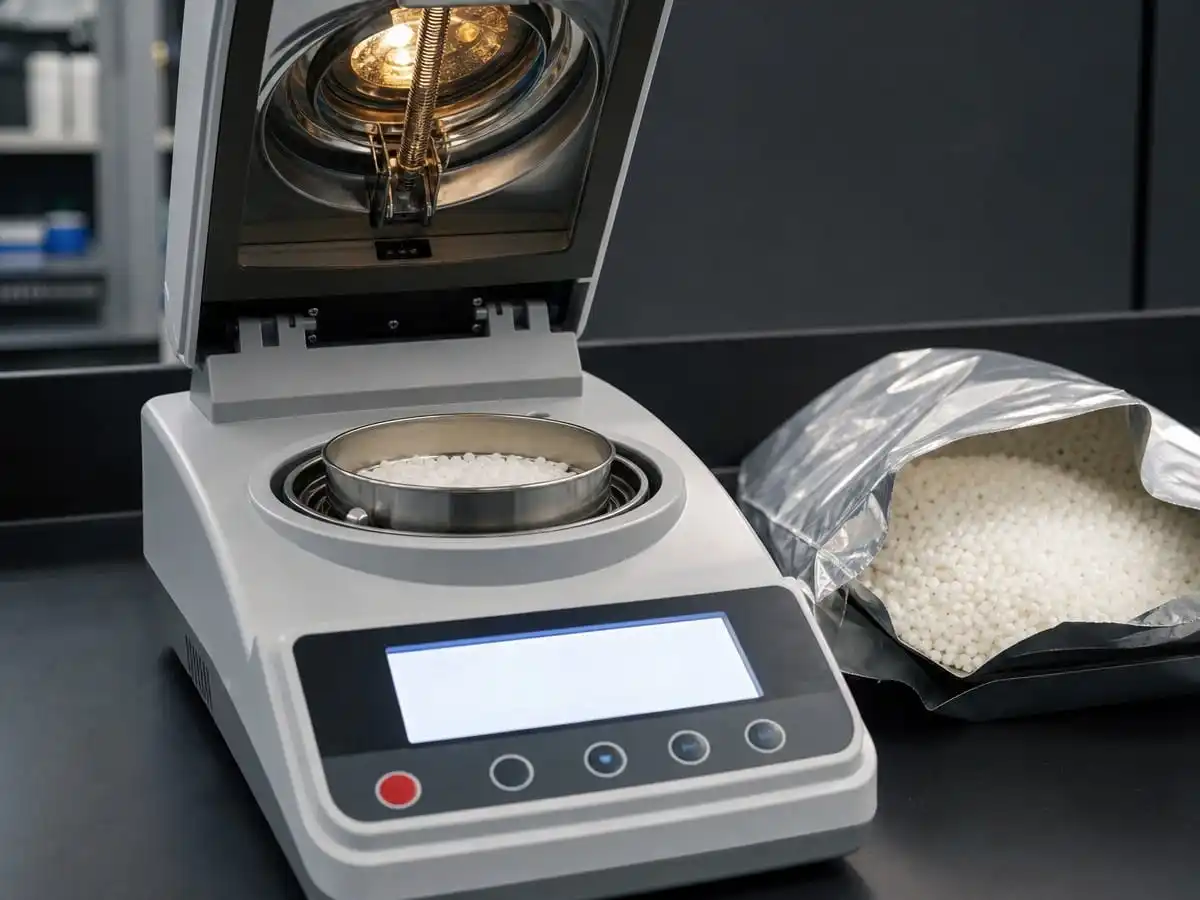
Loss-on-drying (LOD) at the press. A halogen-balance moisture meter costs one or two shots worth of margin and gives a number in five minutes. Weigh a feed-throat sample, dry it per the method, report the mass loss. The trap: LOD measures everything volatile, not just water. Mold release, slip additives, residual monomer, and moisture on fines can all hide inside the number, which is why cheap meters disagree with lab results on filled black compounds more often than on natural unfilled resin. Calibrate the meter against Karl Fischer once per material family you run seriously, and keep that calibration sticker honest.
Figure 2: Feed-throat loss-on-drying check on PA pellets, five minutes per shift replaces a month of guesswork.
Karl Fischer titration. The water-specific reference. Send-out labs run it for tens of dollars per sample; in-line KF cells exist for programs that need per-shot proof. If a customer will argue about moisture at incoming inspection (medical connectors are like this), KF is the language both sides can quote in a SCAR.
The melt-into-water demo. Not quantitative, but it has ended more blame-the-mold arguments in our shop than any instrument: drop purge melt into clear water and watch for a boiling, silvering, micro-bubble halo. If it happens, something is flashing off. Then go find out whether it’s water or something worse.
Whatever method you use, the sample location matters more than the instrument. The specification belongs to the resin entering the screw, so sample at the machine hopper or feed throat after conveying, not from a sealed bag. A bag sample proves the incoming condition; a feed-throat sample proves the process. That difference is where most “we dried for four hours” records quietly die. “Dried for four hours” is a process record, not an acceptance value.
Why Can’t You Just Dry the Part Later?
Because one of the two damages is permanent, and the two look identical on the part.
Surface effects are reversible: vapor streaks, micro-bubbles at the gate, dullness. The water was only a physical intruder; remove it and the resin is the same resin. Structural damage is not. Polyesters (PET, PBT), PC, and to a lesser extent nylons undergo hydrolysis at melt temperature: water molecules cut the polymer chains, and molecular weight drops for good. A PC bracket molded at 0.08% moisture can look flawless and still fail notched impact 40% under spec. Drying the finished bracket changes nothing.
You catch hydrolysis damage with an intrinsic-viscosity or melt-flow comparison against a retained sample of virgin resin, or a simple “snap test” trend on tensile bars from each start-up. Intrinsic viscosity change of more than a few percent is the classic tripwire supplier guides use. If a lot crosses it, the disposition is scrap or regrind-at-a-ratio, not rework. This is also why the wet material you found next to the press is a forensic problem, not a laundry problem: mark it, sample it, decide once you have the viscosity answer.
What About Regrind?
Regrind deserves its own input stream because it earns its own problems: more edge surface per gram (faster re-wetting), more contamination opportunity (floor, robot grippers, purged shots), and at least one prior heat cycle.
Our standing rules:
1. Regrind from a moisture-sensitive grade is collected closed, not in an open bin over the machine.
2. It dries to the same moisture target as virgin, using the same or gentler temperature.
3. Its ratio on the part is documented before T1, not discovered during PPAP. A 20% regrind claim that’s actually 35% will show up as shrink scatter before it shows up as color scatter.
4. Purge and startup shots are segregated from true runner regrind; jetting tails carry charred material.
Supplier guides (Covestro’s Makrolon handling, for instance) are consistent: apply the virgin rules to regrind, then verify properties case by case. Blanket percentage allowances are paperwork, not control. One more habit that costs nothing: keep regrind of the same resin but different colors in separate containers. A natural POM gear batch contaminated with 3% black streaks from a shared bin is a scrap problem no dryer can fix.
Which Dryer Does a Small Shop Actually Need?
Skip the catalog fog. You need to answer three questions: does the family need desiccant air, does the pellet need heat under vacuum or inert gas, and what’s your worst-case throughput?
- Hot-air (no desiccant) hopper dryer — a few hundred to ~$1k. Fine for ABS/PS surface moisture, and the only dryer many job shops with ABS/PP work actually need. Useless for PC, PBT, PET, and honest nylon work.
- Desiccant hopper dryer (single-tower, regen on a timer) — roughly $1.5–5k. The workhorse for PA, PC, TPU at one to four machines. Watch the dew point spec at full flow, not at zero flow; the cheap ones quote −40 at the test bench and −12 in July.
- Two-tower continuous dehumidifying dryer — $6–20k+ (before hopper/silo cost). You need this once more than one machine runs moisture-sensitive grades simultaneously or you run PBT/PET serious. The regen cycle never interrupts drying, so a weekend outage doesn’t strand your Saturday material.
- Vacuum dryer: for PA and heat-sensitive blends where air oxidation during a long dry is the concern. Slower, gentler, and it also degasses the powder film off mineral-filled compounds.
Central vs hopper-by-hopper comes down to material logistics volume. Above roughly 300 kg/day of sensitive resin, central dehumidifying with insulated, dried conveying pays back in rejected lots alone. Below that, one good two-tower unit with correctly sized hoppers is plenty.
When Is Drying a Waste of Money?
Being honest saves credibility. You don’t need a dryer for natural PP and PE molded from sealed, properly stored virgin under a normal roof. You don’t need to dry standard acetal for appearance-grade gears; the Delrin molding guide says outright that standard grades generally don’t need drying before molding, and treating POM like nylon just burns electricity and ages the material. General-purpose PS in bags needs nothing unless it has condensed on it.
But “my material family is usually forgiving” is exactly how shops get bitten, because the forgiving family becomes unforgiving at the first specialty compound: flame-retardant PP with hygroscopic FR salts, black masterbatch carrying wet calcium carbonate, or a toughened POM grade that has a separate moisture limit from the unfilled resin that sits next to it on the rack. The rule that scales: dry from the datasheet of the grade on the ticket, not from the family folklore.
What Does Getting It Wrong Cost?
On a PA66-GF30 automotive connector run for a tier-1, we inherited a troubleshooting loop that had already spent two weeks blaming the gate: silver streaks near the junction, worst on the first shots of each shift. Barrel cut test said moisture. The real answer was two-part: the 45 kg hopper was feeding a machine consuming 22 kg/h, which meant 2 hours of residence against a 4-hour grade requirement, and the Friday regrind bin was being loaded into the top of that hopper without drying at all. Correct dryer sizing (a 140 kg hopper on a desiccant unit), closed regrind handling, and a five-minute LOD check at the feed throat per shift moved the streak defect rate from single-digit percentage on early-shift shots down to effectively zero, and ended a tooling-change request that would have cost five figures. Nothing about the mold changed.
That’s the pattern to remember: drying defects are time-of-day patterns and material-history patterns. Steel defects are position-on-part patterns. Sort them before you spend money on the wrong one.
Why Trust This Drying Guide?
Everything above comes off our own floor: an ISO 9001 custom molder in Shenzhen with eighteen years and a few thousand programs behind it, running 60-ton to 450-ton presses where PA66-GF30 connectors, POM gears, and PC medical housings are weekly work, not brochure material. Our inspectors keep halogen-balance logs at the press side, not just final CMM reports, because that ordering is the whole lesson of this article. The moisture targets follow current supplier processing guides (Delrin, Makrolon, Tritan, BASF UltraMid families) and the measurement methods track ASTM D6869 (Karl Fischer) and D6980 (loss on weight). When a number here and your grade sheet disagree, the grade sheet wins, and we would rather tell you that than defend a pretty table. Every moisture-sensitive lot we ship carries its dry-time record and the feed-throat sample result in the shipment pack, so the number you hold is the number our QC signed, not a template line.
Frequently Asked Questions
What is resin drying in injection molding?
It’s the process of pulling moisture out of plastic pellets below the grade’s limit before they enter the barrel, using heated, dehumidified air with enough residence time. Hygroscopic families (nylon, PC, PET, PBT, TPU) absorb shop-air moisture fast enough that skipping the step directly trades dollars of electricity for dollars of scrap.
Does a -40 °C dew point prove the resin is dry?
No. It describes the air, not the pellet. Proof is a direct moisture result on a sample taken at the last controlled point before the screw, against the grade’s limit.
Can I dry wet parts instead of wet pellets?
You can drive absorbed water out of a finished nylon part, and sometimes you should for dimensional reasons. You cannot re-knit polymer chains that hydrolyzed in the barrel. If a moisture-sensitive grade was melted wet, judge it by viscosity or impact against virgin, not by appearance.
How long can nylon pellets sit in a bag after it’s opened?
Sealed foil with low RH gets you days; an open bag in a summer shop gets you a visible re-wet on a sensitive grade overnight. Reclose with tape and clip, log the open date, and re-dry anything past the sheet’s exposure rule before it feeds a press running tight specs.
What’s the cheapest useful moisture check?
A halogen moisture balance at the feed throat. Budget for one calibration against Karl Fischer per family you run seriously. The instrument alone is not the control; the calibration and the sampling point are.
Does regrind need drying if it came out of a machine that was running dried resin?
Yes, if the grade is sensitive. Regrind has roughly twice the exposed surface of the pellet it came from and spends hours cooling in a bin that is not a dry room.
Should I dry glass-filled grades longer than unfilled?
Not necessarily longer, but always to a lower or tighter spec, and check the sheet: filled grades can be more sensitive to over-drying (additive volatilizing, resin agglomeration) than to the moisture itself. The BASF UltraMid family, for example, warns that over-drying raises melt viscosity on some grades.
How do you verify a dryer after repair?
Run it loaded with water-soaked resin or use a calibrated sample spiked overnight in open air, and confirm the outlet sample meets spec. “The dew point reads fine” is the same trap that got the material processed in the first place.
Who tells me what my material’s limit actually is?
The datasheet that ships with the grade, or your molder if you’ve handed material over. At Ideal Pro we log incoming lot, dry-time, and feed-throat moisture for moisture-sensitive programs and put it in the shipment paperwork. Send the drawing and the grade to our quote page and you’ll get free DFM feedback within 24 hours, including whether your material choice needs conditioning or dryer capacity we should quote for.
Bottom Line
Resin drying in injection molding is an acceptance system, not a setting: control dew point, pellet temperature, true residence time, and airflow together; sample and prove at the feed throat; keep regrind on the same leash; and respect the difference between a reversible streak and a permanent chain cut. The total hardware cost of doing this properly on a two-press shop is under a typical single mold repair, and it turns the most misdiagnosed defect class in molding into a five-minute check at shift start. If you want a second pair of eyes on your material handling plan, our DFM review covers drying and conditioning assumptions for free.
Related reading on our site: why silver streaks appear and how to sort their causes, what wet-run damage does to part toughness, and nylon-specific drying and conditioning practice in our PA processing guide.
 English
 French
 Dutch
 German
 Japanese
 Korean