

If you’re involved in injection molding—whether as a designer, manufacturer, or hobbyist—understanding three critical plastic properties is non-negotiable: shrinkage, flowability, and crystallinity. These properties directly impact part quality, mold design, and production efficiency.
In this guide, we break down each concept in plain language, plus actionable strategies to optimize your molding process. Let’s dive in!
Plastic Shrinkage: What It Is & How to Control It
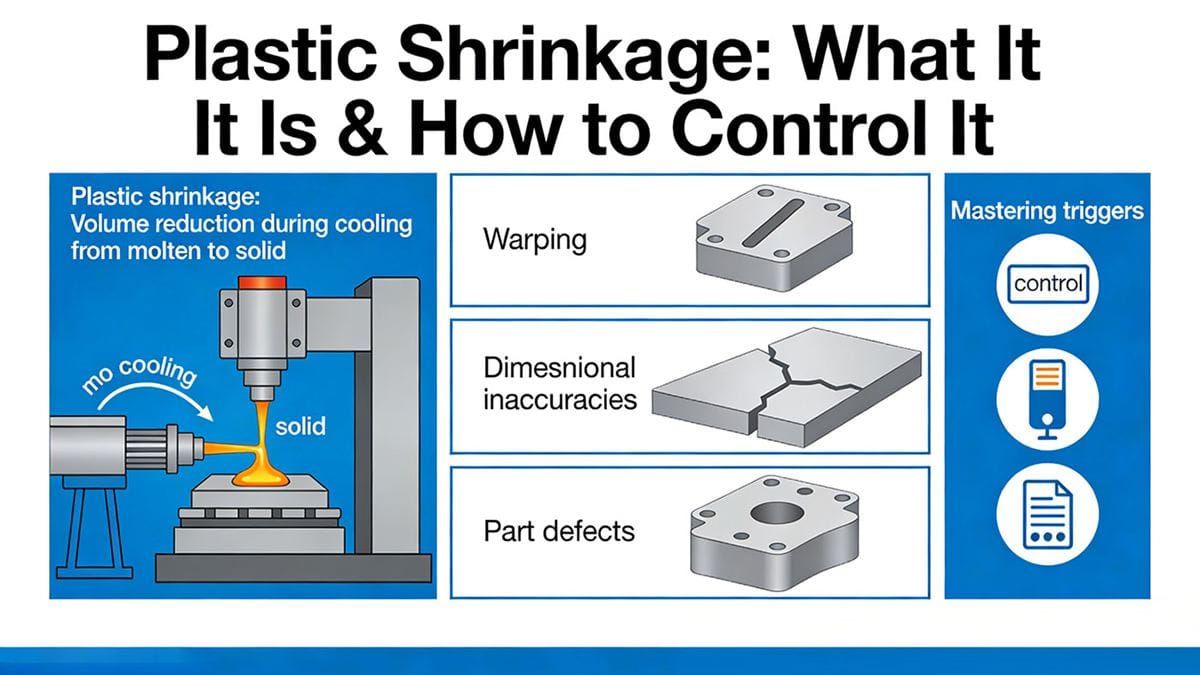
Plastic shrinkage refers to the volume reduction of thermoplastic materials as they cool from molten to solid state during injection molding. Uncontrolled shrinkage causes warping, dimensional inaccuracies, and part defects—so mastering its triggers is key to successful molding.
Key Factors Affecting Plastic Shrinkage in Injection Molding
1.1 Plastic Material Type
Thermoplastics have higher shrinkage rates than thermosets due to crystallization, internal stress, and molecular orientation during cooling. For example:
Crystalline plastics (e.g., PE, PP, PA) shrink more than amorphous plastics (e.g., PMMA, PC)
Post-molding shrinkage (after annealing or moisture conditioning) is also more significant in thermoplastics
1.2 Part Design & Geometry
Wall thickness: Thicker parts cool slower, forming a denser inner layer that shrinks more. Aim for uniform wall thickness to avoid uneven shrinkage.
Inserts: The number, layout, and material of inserts alter flow direction and shrinkage resistance. Metal inserts reduce local shrinkage but may cause stress concentrations.
1.3 Gate Design (Type, Size, Location)
Gates control how molten plastic fills the mold—directly impacting shrinkage:
Large, direct gates minimize shrinkage but increase directional shrinkage (anisotropy)
Wide, short gates reduce directional shrinkage
Areas near gates or parallel to flow paths shrink more than distant or perpendicular sections
1.4 Injection Molding Process Parameters
Adjust these settings to reduce shrinkage:
Mold temperature: Lower mold temperature speeds cooling, reducing shrinkage (critical for crystalline plastics)
Holding pressure & time: Higher pressure + longer holding time = less shrinkage (but more directional shrinkage)
Injection pressure: Increased pressure reduces viscosity and elastic recovery, lowering shrinkage
Melt temperature: Avoid excessive melt temperature—higher temps increase shrinkage
1.5 Mold Design Tips for Shrinkage Control
For high-precision parts, follow this workflow:
Test mold with initial gating and process parameters
Measure part dimensions 24 hours after ejection (allow for post-molding shrinkage)
Adjust cavity dimensions based on actual shrinkage data
Fine-tune process parameters (e.g., mold temperature, holding time) for final optimization
Plastic Flowability: How to Ensure Proper Mold Filling
Flowability (or melt flow) describes how easily molten plastic flows through the mold’s runners, gates, and cavities. Poor flowability leads to incomplete filling, weld lines, and burn marks—while excessive flow can cause flash.
How to Measure Plastic Flowability
Key metrics to evaluate flowability:
Melt Flow Index (MFI/MFR): Higher values = better flow
Archimedean Spiral Flow Length: Longer flow = better flowability
Flow Ratio (Flow Length ÷ Wall Thickness): Ideal ratio = 150–200 for most plastics
Apparent Viscosity: Lower viscosity = better flow
Common Plastics Ranked by Flowability (Injection Molding)
| Flowability Grade | Plastic Materials | Best For |
|---|---|---|
| Good | PA, PE, PS, PP, CA, Poly(4-methyl-1-pentene) | Thin-walled parts, complex geometries |
| Medium | ABS, AS, PMMA, POM, PPO | General-purpose parts with moderate complexity |
| Poor | PC, Rigid PVC, PSU, PAS, Fluoroplastics | Thick-walled parts, simple shapes |
Factors That Improve or Reduce Flowability
2.1 Temperature
Temperature-sensitive plastics (PS, PP, PA, ABS, PC): Increase melt temperature to boost flow
Temperature-insensitive plastics (PE, POM): Temperature changes have minimal effect—focus on pressure instead
2.2 Injection Pressure
Higher pressure increases shear stress, improving flow (critical for low-flow plastics like PE and POM)
Avoid over-pressurization, which causes flash and stress marks
2.3 Mold Design for Optimal Flow
Use a streamlined gating system (short, wide runners)
Ensure smooth cavity surfaces (reduce flow resistance)
Add proper venting (prevents air traps that block flow)
Design uniform cooling systems (avoids cold spots that thicken melt)
Plastic Crystallinity: What It Means for Molding
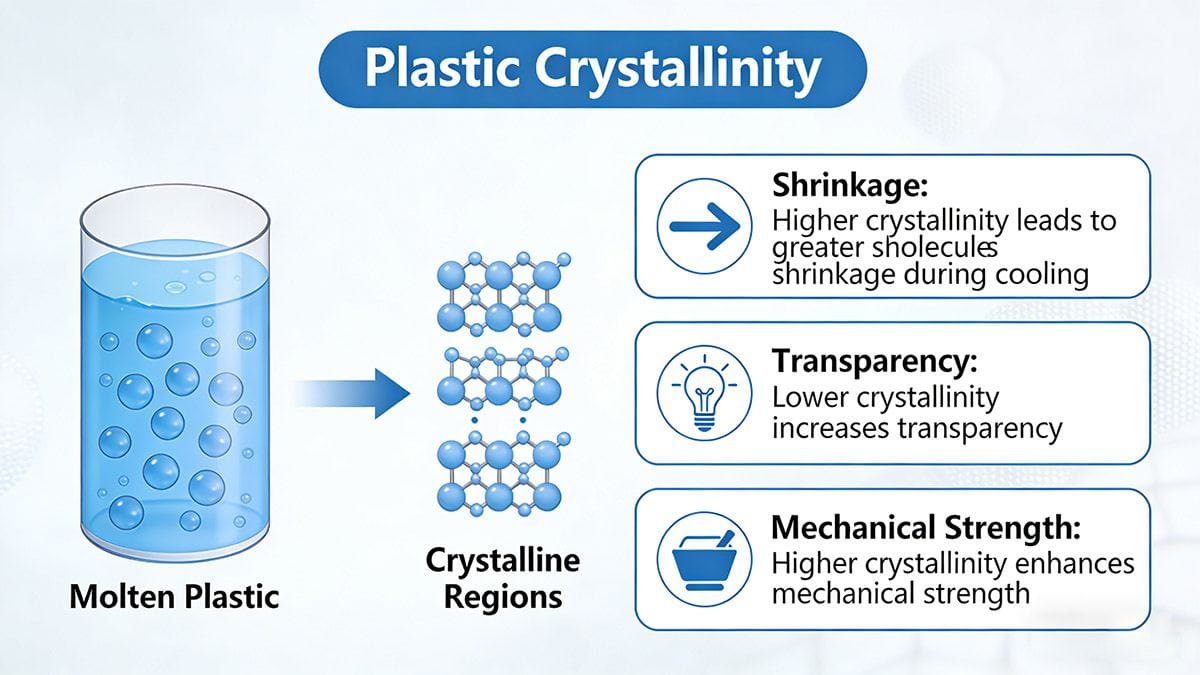
Crystallinity refers to the degree to which polymer molecules arrange into ordered, repeating structures as molten plastic cools. This property impacts shrinkage, transparency, and mechanical strength.
Crystalline vs. Amorphous Plastics: Key Differences
| Property | Crystalline Plastics | Amorphous Plastics |
|---|---|---|
| Structure | Ordered molecular arrangement | Disordered molecular arrangement |
| Transparency | Opaque/translucent (e.g., POM, PE) | Transparent (e.g., PMMA, PC) |
| Shrinkage | Higher (5–15%) | Lower (0.5–3%) |
| Melting Point | Sharp (specific temperature) | Gradual softening range |
| Impact Strength | Better at low temperatures | Less consistent |
| Exceptions | Poly(4-methyl-1-pentene) (crystalline + transparent) | ABS (amorphous + opaque) |
Practical Implications for Injection Molding
Crystalline plastics (PE, PP, PA, POM):
Require more heat to melt (use machines with high plasticizing capacity)
Need controlled cooling (uniform mold temperature prevents uneven crystallization)
Higher shrinkage = adjust mold dimensions and holding pressure accordingly
Amorphous plastics (PMMA, PC, ABS):
Lower shrinkage = easier to achieve dimensional accuracy
Cool faster = shorter cycle times
More prone to stress marks = avoid rapid cooling or over-pressurization
Final Tips for Injection Molding Success
- Always check the material datasheet for shrinkage rates, flowability metrics, and crystallinity data
- Test small batches first to optimize process parameters (mold temp, pressure, cooling time)
- For complex parts, use simulation software to predict shrinkage and flow issues before molding
- Match mold design to plastic properties: e.g., wider gates for low-flow plastics, uniform walls for crystalline plastics
By mastering these three core properties, you’ll reduce defects, improve plastic part quality, and streamline your injection molding process.

 English
 French
 Dutch
Dutch German