

The world of Two-Color Injection Molding1 (often referred to as 2K Molding or Double-Shot Molding) combines complexity with creativity, allowing manufacturers to produce intricate multi-material or multi-colored plastic parts in one cycle.
Two-color injection molding is a highly effective method for producing bi-color parts, but it demands precise control over machinery and processing parameters.
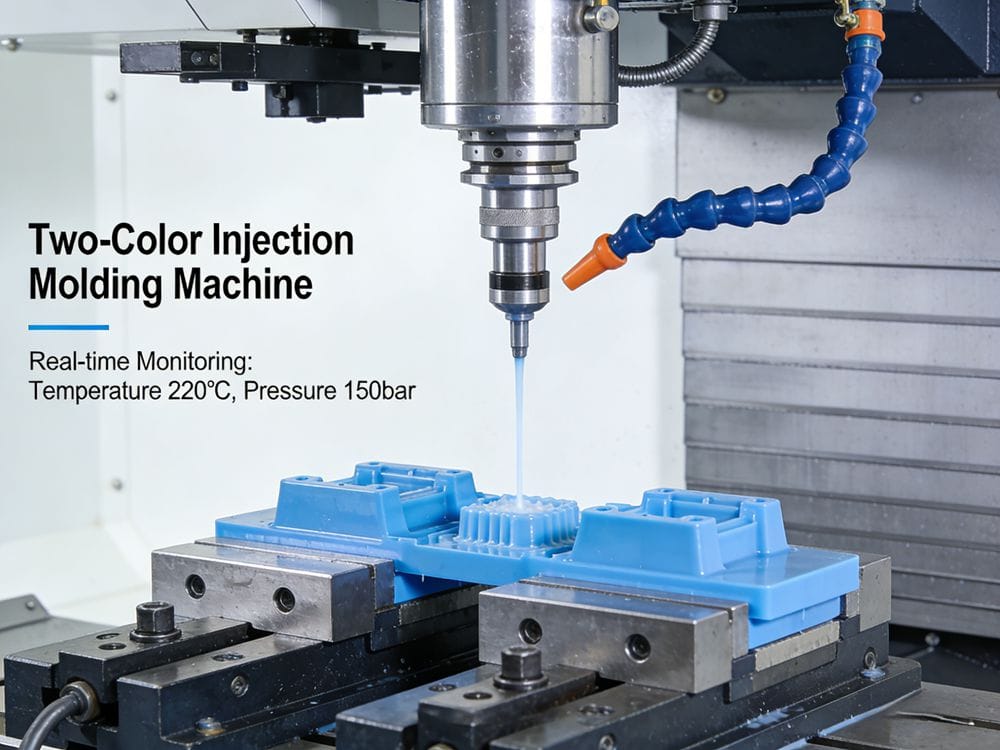
To ensure that your products meet the highest quality standards, it is crucial to understand the nuances of this process. As we explore the production characteristics and mold structures, I will share my insights and experiences.
Production Characteristics of Two-Color Injection Molding?
The journey of two-color injection molding begins with understanding its production characteristics. High-quality bi-color parts hinge on four essential pillars of the process:
Dual Injection Units: A two-color injection molding machine typically consists of two identical plasticizing and injection units.
- Symmetry is Key: The nozzle and mold structures must rotate or shift seamlessly.
- Parameter Consistency: The melt temperature, injection pressure, and shot volume should be consistent to minimize fluctuations.
High-Pressure & High-Temperature Parameters: Unlike standard injection molding, two-color molding requires higher melt temperatures and injection pressures.
- The Reason: Longer and complex mold runners increase flow resistance, necessitating more force to fill the cavity.
Material Selection Criteria2: Choosing the right materials is critical, not just for color but for thermal physics. Good options include:
- High Thermal Stability: To avoid degradation.
- Low Melt Viscosity: For smooth flow.
- Why? High melt temperatures and long residence times require robust materials like Polyolefins, Polystyrene (PS), and ABS.
Ensuring Bonding Quality: To guarantee that the different colored melts bond perfectly, operators should use:
- Higher Melt Temperature
- Higher Mold Temperature
- Higher Injection Pressure & Rate
Pro Tip: The interface between two materials is the most critical bonding point. Optimizing temperature and pressure is essential for a strong bond.
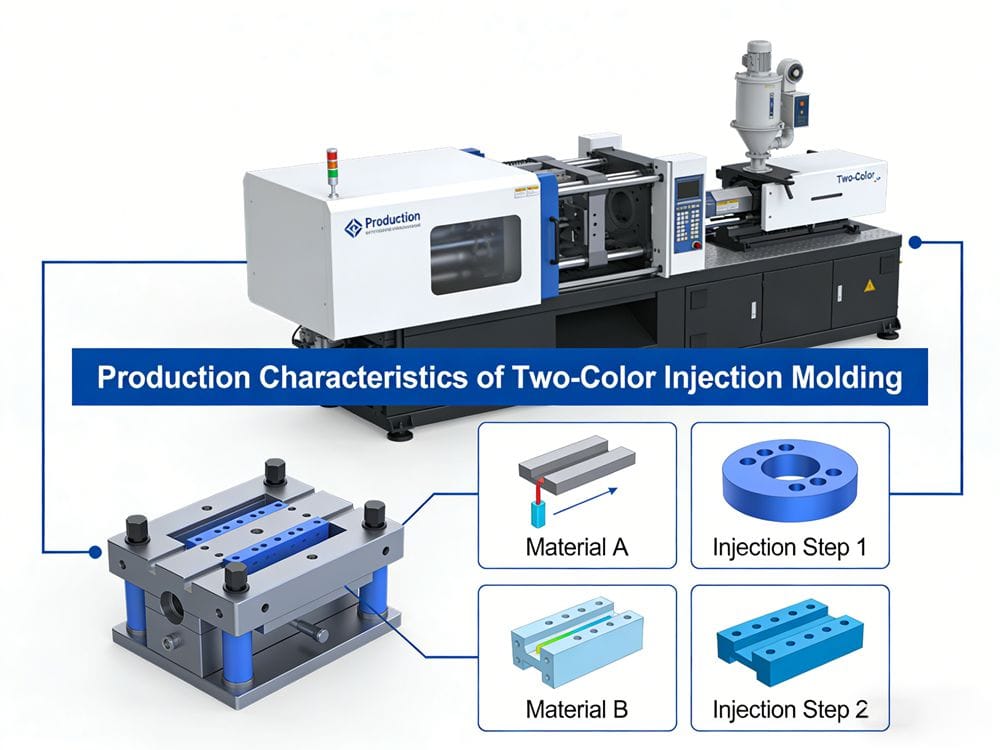
As we explore deeper into the two-color mold structure forms, it's essential to understand the distinctions in methods utilized for efficiency.
Two-Color Mold Structure Forms?
Two-color molds can generally be categorized into two methods: Core Shifting (Translation) and Core Rotation.
Core Shifting (Translation) Method: In this method, the core side of the mold moves linearly.
- Structure: The mold includes two cavity plates and one core plate.
- The Process:
- First Shot: The core closes against the first cavity, and the first material is injected.
- Shift: Once solidified, the mold opens, and the semi-finished part remains on the core plate.
- Translation: The core plate shifts to align with the second cavity.
- Second Shot: The second material is injected.
- Ejection: The mold opens, and the complete part is removed.
Core Rotation Method3: A more modern and efficient approach for high-volume production.
- Structure: This method features two cavities with a rotatable core.
- The Machine: Ideally, it has two barrels with the second positioned vertically.
- The Process:
- Simultaneous Injection: Both barrels inject different plastics at the same time.
- Ejection: Once solidified, the finished part is automatically ejected.
- Rotation: The "rotatable core" turns 180 degrees for the next cycle.
⚡ Efficiency Comparison
The core difference lies in the timing of injections.
- Core Shifting: Sequential injection (Barrel 1, then Barrel 2).
- Core Rotation: Simultaneous injection (Barrel 1 + Barrel 2).
Result: For the same product, production efficiency in the Core Rotation mode is 2 times that of the Core Shifting mode.
📊 Technical Comparison Table
| Feature | Core Shifting (Translation) | Core Rotation |
|---|---|---|
| Mold Complexity | Moderate | High |
| Injection Sequence | Sequential (Alternating) | Simultaneous |
| Cycle Time | Slower | Faster |
| Efficiency | Standard | 2x Higher |
| Best For | Large parts, lower volume | High volume, small/medium parts |

Understanding these methods and their efficiencies will help in making informed decisions for your two-color injection molding projects.
Conclusion
Mastering two-color injection molding requires knowledge of production characteristics and mold structures for optimal results.
Explore this resource to stay updated on cutting-edge techniques and innovations in injection molding, enhancing your production efficiency. ↩
Understand the key factors in selecting materials for two-color injection molding to ensure optimal results. ↩
Discover the efficiency of the Core Rotation Method and its advantages in high-volume production. ↩



 English
 French
 Dutch
Dutch German
 Japanese
 Korean