

In the injection molding process, cooling time accounts for about 80% of the entire production cycle. Inadequate cooling often leads to warping or surface defects, affecting the dimension stability of the parts. Properly scheduling injection, holding, and cooling time can enhance product quality and productivity.
The cooling time refers to the duration from when the plastic melt fills the mold cavity until the part can be taken out. The standard for when the part can be removed is based on it being sufficiently solidified, achieving a certain strength and rigidity, so it does not deform or crack during ejection.
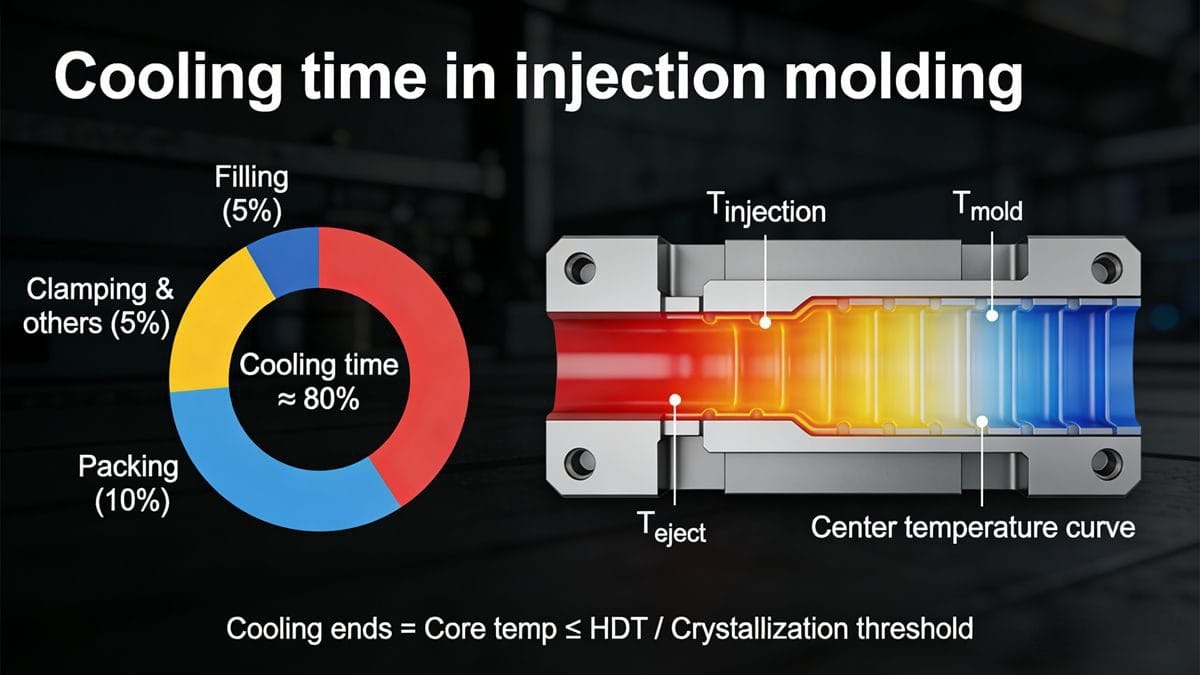
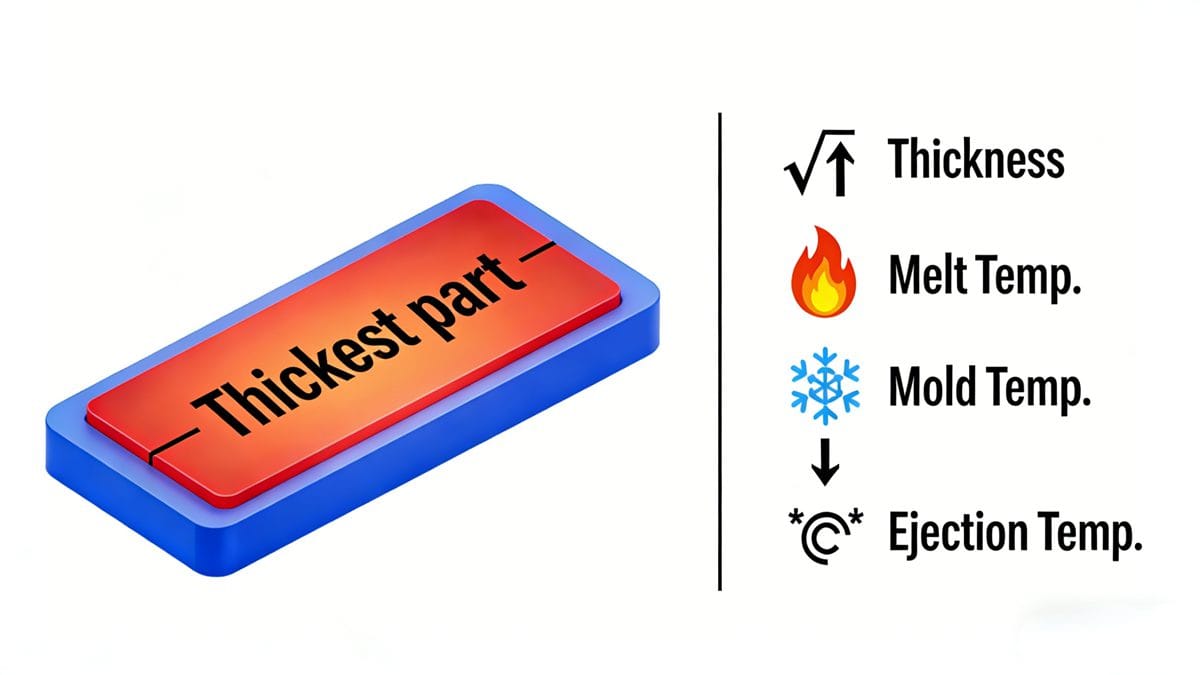
In the world of injection molding, the intricacies of cooling time can be fascinating yet complex. Different factors such as wall thickness, the temperature of molten plastic, ejection temperature, and mold temperature all affect cooling time. Currently, there is no universally applicable formula for calculating cooling time. Instead, formulas are derived based on specific assumptions. Let’s explore the primary factors that define the cooling time in injection molding.
What are the key parameters influencing cooling time?
When we look into the parameters that influence cooling time, three main standards usually serve as references:
- The time required for the temperature at the center of the thickest wall of the plastic part to cool below its heat distortion temperature.
- The time necessary for the average temperature within the cross-section of the plastic part to reach the specified ejection temperature.
- The time required for the center layer temperature at the thickest part of a crystalline plastic part to cool below its melting point or to reach a specified percentage of crystallization.
Each of these standards provides a way to estimate cooling time, but they involve specific conditions.
To calculate cooling time effectively, certain assumptions must be made:
- The plastic is injected into the mold and transfers heat to the mold for cooling.
- The plastic inside the cavity is in tight contact with the mold walls, without any resistance to heat transfer, ensuring instant temperature equalization upon contact.
- The temperature at the mold cavity surface remains uniform throughout the cooling process.
- The thermal conductivity of the mold surface remains constant, assuming a uniform temperature during the filling process.
- The impact of plastic orientation and thermal stress on part deformation is negligible, and part dimensions do not influence the solidification temperature.
Delving deeper into these parameters helps us understand the nuances of cooling time. It’s evident that a holistic approach, factoring in all elements, can lead to better predictions and optimizations in the cooling phase.
How can cooling time be optimized for better production outcomes?
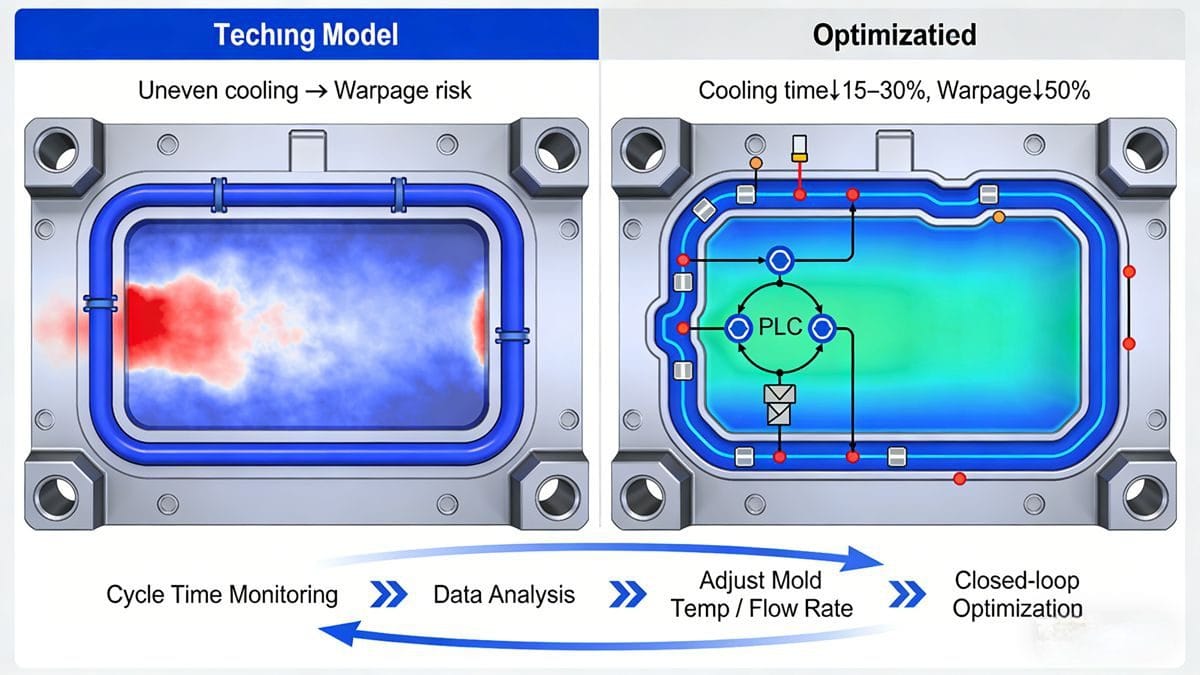
To optimize cooling time, it’s important to focus on several strategies that take into account the unique characteristics of each molding project. Here are a few effective methods:
- Adjusting Mold Temperature: Lowering the temperature of the mold can help reduce the cooling time, but one must be cautious. Too low a temperature may cause defects in the final product.
- Increasing Material Temperature: Higher temperatures for the molten plastic can enhance flow and reduce cooling time, but it must be balanced with the risk of degradation.
- Using Cooling Channels: Incorporating efficient cooling channels within the mold design can significantly improve heat transfer. This is a practical solution for complex shapes requiring precise temperature control.
- Monitoring Cycle Time: Regularly analyzing and adjusting the cycle time in real-time can lead to improvements in cooling time and overall production efficiency.
Each of these strategies requires a careful balance to achieve optimal results.
Here is a structured table summarizing strategies for optimizing cooling time:
| Strategy | Description | Effect on Cooling Time |
|---|---|---|
| Adjusting Mold Temperature | Modify mold temperature to find a balance for optimal cooling | Can reduce cooling time |
| Increasing Material Temperature | Higher temperatures can enhance flow but risk degradation | Can shorten cooling time, if done carefully |
| Using Cooling Channels | Design molds with efficient cooling channels | Improves heat transfer |
| Monitoring Cycle Time | Analyze and adjust cycle times in real-time | Leads to continuous improvements |
Understanding these factors allows for better customization of the injection molding process, ultimately improving product quality and reducing defects. It’s crucial to implement these strategies mindfully, considering both the nature of the material and the design of the product.
Conclusion
In summary, managing cooling time effectively in injection molding is vital for product quality and production efficiency.


 English
 French
 Dutch
Dutch German
 Japanese
 Korean