

The world of manufacturing is ever-evolving, and understanding the role of polyethylene (PE) can significantly impact your production processes and product quality.
Polyethylene (PE) is a versatile thermoplastic used in injection molding, making it suitable for a wide range of applications.

Polyethylene (PE) is one of the most widely used thermoplastic polymers in the world. It is produced from the polymerization of ethylene monomers (with the repeating unit –CH₂–CH₂–, often written as (C₂H₄)ₙ) and belongs to the polyolefin family. PE is known for its versatility, durability, and cost-effectiveness, which have made it indispensable in many industries—from packaging to automotive and medical applications.
Polyethylene’s blend of low cost, chemical resistance, flexibility, and durability has established it as a cornerstone material in modern manufacturing and consumer products. Whether it is used to create flexible packaging films or robust industrial pipes, the ability to tailor its properties through variations in molecular structure and processing methods ensures that PE continues to meet diverse and evolving technological and environmental demands.
What is Polyethylene (PE)?
Polyethylene (PE) is one of the most common thermoplastic polymers produced globally. It serves as the foundation for many products used every day. Understanding its structure and characteristics can help you make informed decisions in your manufacturing processes.
Polyethylene is a polymer made from ethylene and is known for its flexibility and durability.
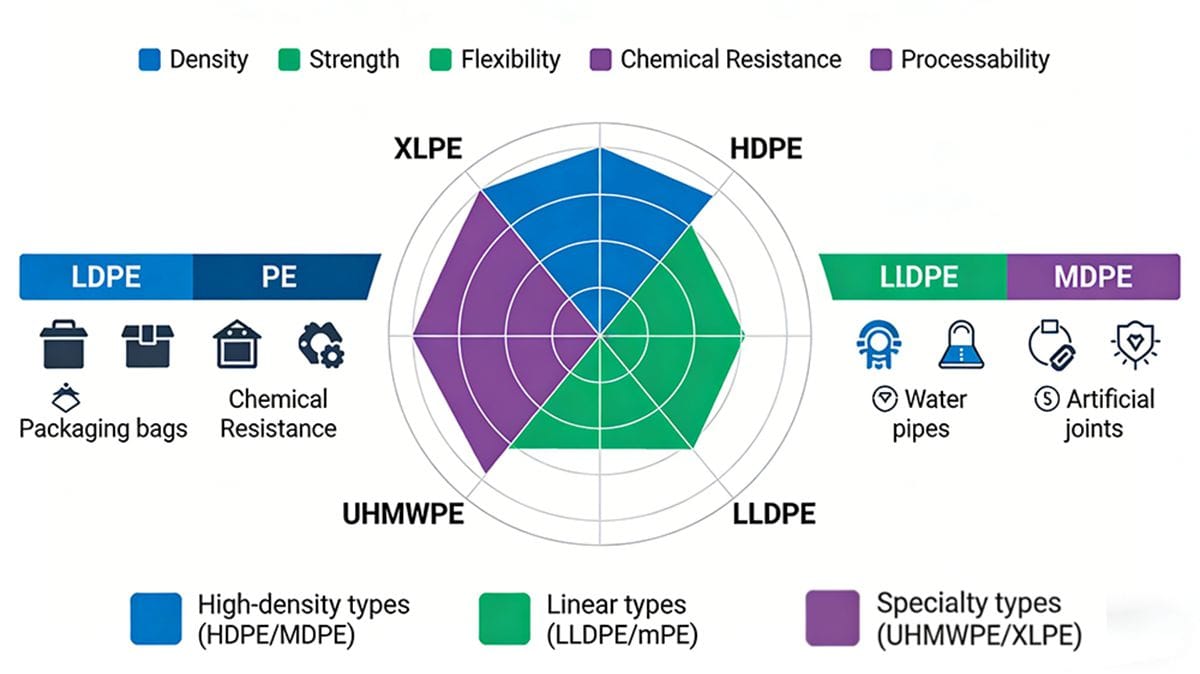
What are the different types of PE materials?
Polyethylene (PE) materials are categorized based on their density, molecular structure, and production methods. Here’s a structured overview of the different types:
| Type | Characteristics | Applications |
|---|---|---|
| LDPE | High branching, flexible, transparent | Plastic bags, packaging films, squeeze bottles |
| LLDPE | Linear structure with short branches, enhanced toughness | Stretch films, agricultural films, industrial liners |
| HDPE | Minimal branching, rigid, chemical-resistant | Bottles, containers, pipes, toys |
| MDPE | Moderate density, balanced strength and flexibility | Gas pipes, shrink films, carrier bags |
| HMWPE | High strength and wear resistance | Industrial equipment, large containers |
| UHMWPE | Long molecular chains, high toughness | Medical implants, conveyor belts |
| XLPE/PEX | Cross-linked chains, heat and chemical resistance | Plumbing systems, radiant heating, insulation |
| VLDPE | Highly flexible with low crystallinity | Food packaging, stretch wrap, soft tubing |
| mPE | Superior clarity and strength | Thin films, food packaging, specialty coatings |
| rPE | Derived from post-consumer/post-industrial waste | Sustainable products, construction materials |
Each type serves distinct industrial and consumer applications based on its structural properties and performance characteristics.
What are the characteristics of PE?
PE (Polyethylene) is a widely used thermoplastic known for its flexibility, low density, and excellent chemical resistance. It is commonly used in packaging, containers, and piping. Key characteristics include good impact resistance, low moisture absorption, and ease of processing.
PE is characterized by its lightweight nature, flexibility, and high chemical resistance.
| Property | Description |
|---|---|
| Physical Properties | Lightweight, flexible (LDPE) vs. rigid (HDPE) |
| Chemical Resistance | Resistant to most acids, bases, and solvents |
| Thermal Properties | Low melting point (~120°C), thermoplastic |
| Electrical Properties | Excellent insulator |
| Mechanical Properties | Varies by type; HDPE is strong, LDPE is ductile |
| Environmental Impact | Non-biodegradable but recyclable |
What are the properties of PE?

PE (Polyethylene) is a versatile thermoplastic with several excellent properties. It has a low density (0.91–0.96 g/cm³), making it lightweight and easy to handle. PE offers excellent impact resistance, especially at low temperatures, making it resistant to cracking and breakage. It also exhibits strong chemical resistance, with the ability to withstand exposure to various acids, bases, and solvents. Its melting point ranges from 120–180°C, making it suitable for different processing methods. PE has very low water absorption, ensuring stable performance even in humid environments.
Properties of PE include lightweight, strong chemical resistance, and low moisture absorption.
PE Material Properties Table:
| Property Parameter | HDPE | LDPE | LLDPE |
|---|---|---|---|
| Density (g/cm³) | 0.94-0.965 | 0.910-0.925 | 0.915-0.940 |
| Melting Point (℃) | 126-136 | 105-115 | 120-125 |
| Molding Shrinkage (%) | 1.5-3.6 | 1.5-5 | 1.5-2.5 |
| Tensile Strength (MPa) | 20-30 | 10-20 | 15-25 |
| Chemical Resistance | Resistant to acids, alkalis, and organic solvents (except oxidizing acids) | Resistant to acids, alkalis, but susceptible to hydrocarbon corrosion | Resistant to acids, alkalis, and organic solvents |
| Electrical Insulation | Excellent, suitable for cable sheathing | Good, suitable for thin film insulation | Good |
Can PE materials be injection molded?
Yes, polyethylene (PE) materials can be successfully injection molded, and they are widely used in this manufacturing process.
PE is thermoplastic and suitable for injection molding processes, making it ideal for various applications.
Key Aspects of PE Injection Molding:
Material Types:
- HDPE: Known for high strength and rigidity.
- LDPE: More flexible and used for various applications.
Processing Parameters:
- Temperature: DE varies; HDPE needs higher temperatures.
- Pressure and Speed: Optimized for mold filling and avoiding defects.
Shrinkage Management:
- PE typically shrinks 1.5–4% during cooling, needing precise mold designs.
Flow Characteristics:
- LDPE flows more easily than HDPE due to lower viscosity.
Applications:
- Common products include buckets, containers, and packaging.
What are the key considerations for PE Injection Molding?
When considering polyethylene (PE) injection molding, several key factors must be addressed to ensure optimal part quality and process efficiency.
Critical factors in PE injection molding include material selection, processing parameters, and mold design.
Key Considerations:
Material Selection:
- Choose HDPE or LDPE based on required properties.
Processing Parameters:
- Adjust temperature and pressure for optimal flow.
Mold Design:
- Proper gate design and shrinkage compensation are vital.
Part Design:
- Maintain wall thickness uniformity to avoid defects.
Post-Processing:
- Careful trimming and potential annealing for stress relief.
Quality Control:
- Implement dimensional checks and mechanical testing.
Cost and Efficiency:
- Optimize cycle time and reduce material waste.
Environmental Considerations:
- Design for recyclability and energy efficiency.
Additional Factors:
- Monitor moisture and flow behavior for quality assurance.

Conclusion
Polyethylene is a flexible and durable material ideal for injection molding, especially when considering the right processing parameters and design factors.



 English
 French
 Dutch
Dutch German
 Japanese
 Korean